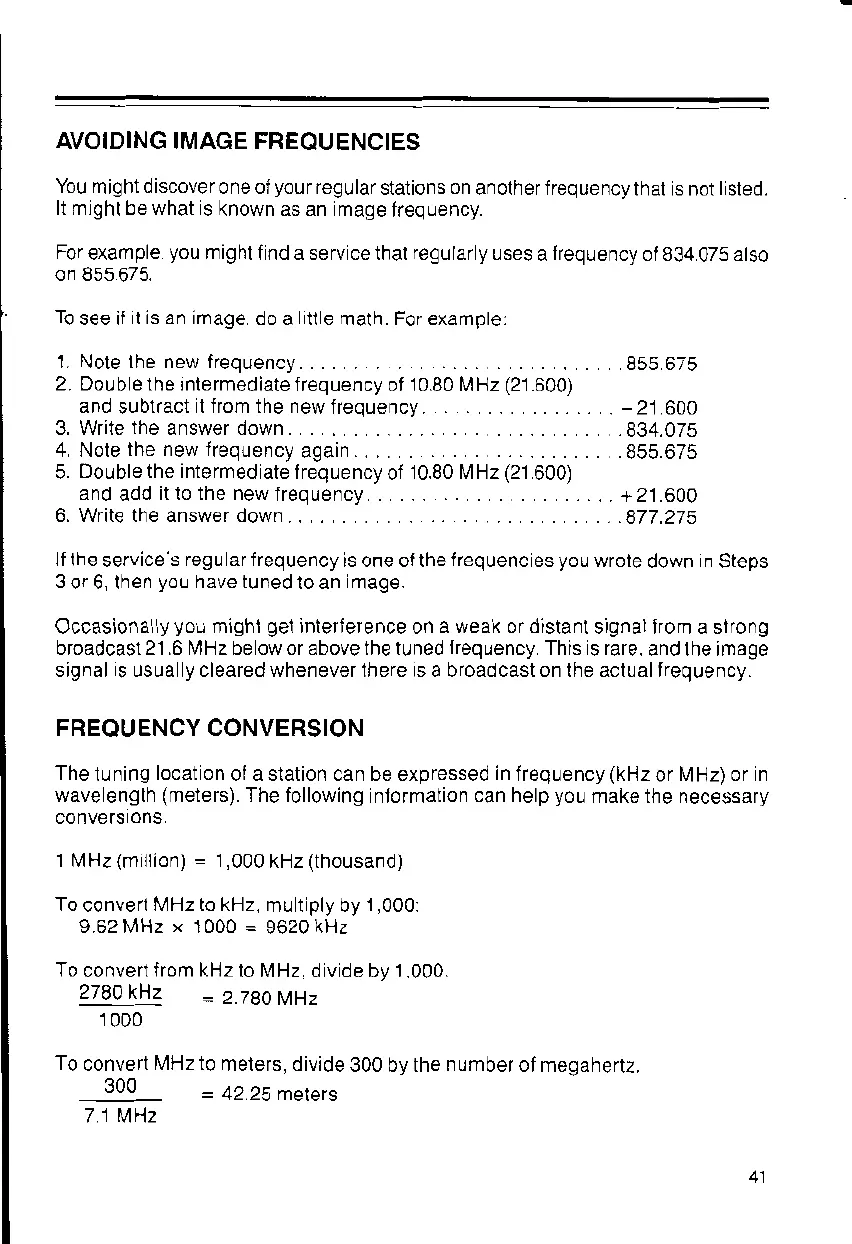
AVOIDING IMAGE FREQU
ENCI ES
You
mightdiscoveroneoiyourreg!larstations on
anotherfrequencythal
s not
tsled.
It mlghl be what
s known as an mage
trequency.
Forexample
you
mighl
f nd a serv cethat
regular
y
uses
a
hequency
o1834075 atso
To
see ii
I is an image
do a tt e math. For example:
1. Note lhe new frequency..
..
855 675
2. Do!b e the Inlermediate
frequency of 10.80 flHz
(21.600)
and
sublract
I from the newfrequency.
.. . .. .. ..
.
-21
600
3. Write
the
answer down.
. . .834.075
4 Note
the new liequency
again. .
........
.855.675
5.
Double the intermed
ate lrequency
ol
10.80 MHz
(21
600)
and
add
it lo the new
lrequency .. .....+21.600
6. Write the answer down
. . . . .A77.275
lfthe
service's
regu ar freq
uency is one of the
ireq
uenc esyou wrote
down
n
Steps
3
or 6, lhen
yo!
have tuned
10 an mage.
Occasionally
yon
mighi
get
interJerence
on
a weak or distanl
signal tfom a slrong
broadcasl21.6 MHz be owor abovethe t!ned
kequency
This
s
rarg.
and lhe image
signal
s
usua
y
cleared whenever there rs a broadcast on lhe aclual frequency.
FREOUENCY CONVERSION
The
luning
locat on
ol a slation can be expressed
in
lrequency
(kHz
or MHz)
or in
wave
englh
(meters).
The following
nJormation
can help
you
make the necessary
convers
ons
1 wHz
(m
llion)
=
1,000
kHz
(thousard)
To
conve
l\,lHz to kHz,
mu t
ply
by
1,000:
9.62MHzx1000=9620kHZ
To
convert
irom kHz
lo MHz d v de by 1.000.
Zr9OJU
=
2.780
MHz
1000
To
convert
MHz to
melers, divide
300 by the
number
of megahertz.
300
=
42 25 melerc
7.1 MHz



 To Next Page