
 Need help?
Do you have a question about the Realistic PRO-2036 and is the answer not in the manual?
Details key features like Hyperscan, Weather Alert, Auto Store, CTCSS, and Rotary Tuner.
Covers features like 2-second scan delay, memory backup, lock-out, priority channels, and display adjustments.
Explains the delay feature and how to lock/unlock channels and remove lockouts from banks.
Introduces frequency guides, ham radio bands, and birdie frequencies for monitoring.
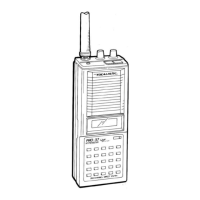
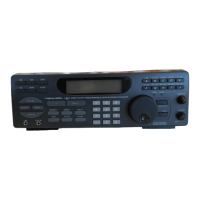
Visual guide to the scanner's front panel controls and back panel connections.
Instructions for installing the supplied antenna and connecting an optional one.
Details AC adapter connection, safety precautions, and memory backup function.
Step-by-step guide to reset the scanner if it becomes unresponsive.
Connect speakers/headphones and follow safety guidelines for listening.
Guides for connecting a tape recorder for continuous or automatic recording.
Detailed explanation of symbols, modes, and indicators shown on the scanner's display.
Explains the function of each key on the scanner's keypad for operation.
How to manage channel banks for organized scanning and group selection.
Initial steps to power on the scanner and adjust audio settings for clear reception.
Procedures for initiating channel scanning and adjusting scan/search speeds.
How to manually change the frequency step for scanning and searching.
Guide to changing the display's backlight intensity for optimal visibility.
How to lock the rotary tuner and FREQ/CHAN buttons, and set ENTER LOCK to prevent accidental changes.
Steps to change the rotary tuner's display mode between frequency and channel.
How to use the rotary tuner to select frequencies or channels.
Procedure to manually select and monitor a specific channel without scanning.
Step-by-step guide to manually store frequencies into scanner channels.
How to automatically store active frequencies into specified channel banks.
Guide to searching for transmissions within a user-defined frequency range.
Procedure to move a stored frequency to an empty channel within the same or different bank.
How to move a frequency to a channel that already contains data, replacing it.
Steps to delete a specific frequency from a channel or reset the entire scanner.
How to enable or disable channel storage banks for scanning.
Steps to designate a channel as a priority channel for important monitoring.
How to scan preprogrammed weather channels and manually tune through them.
How to turn on the weather alert feature to receive severe weather warnings.
Procedure to test the audible alarm for severe weather alerts.
How to view the number of times a transmission was detected on a channel.
How to use the auto recording feature with a tape recorder for priority channels.
Explanation of the Continuous Tone Coded Squelch System for identifying specific transmissions.
How to assign a specific CTCSS tone frequency to a channel for selective scanning.
Procedure to modify or remove CTCSS tone frequencies from channels.
A table listing available CTCSS tone frequencies and their associated letter codes.
Information on frequency reception, line-of-sight, and atmospheric conditions affecting reception.
Details on ham radio frequencies for emergency info and birdie frequencies causing noise.
Lists typical band usage for Canada, including HF, VHF, and UHF bands with their uses.
Outlines common frequencies for VHF and UHF band activities like public safety and mobile units.
Explains the specific frequency steps (e.g., 5.0 kHz, 12.5 MHz) used in different bands.
Lists typical services and their frequency ranges received by the scanner.
Provides a list of abbreviations used in the band allocation section and their meanings.
Explains what image frequencies are and how to identify and avoid them through calculation.
Provides formulas for converting between MHz, kHz, and meters for frequency measurements.
Lists common scanner problems like not scanning or locking up, with suggested solutions.
Detailed frequency ranges and step sizes for different models and bands.
Information on channels of operation, banks, and overall channel capacity.
Technical specifications for sensitivity, scanning rates, delay time, and squelch.
Details on audio power, speaker, power requirements, dimensions, and weight.


 To Next Page
 General