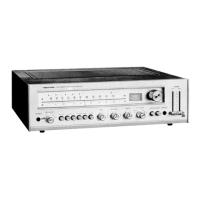
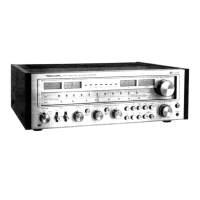
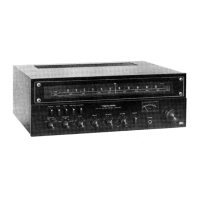
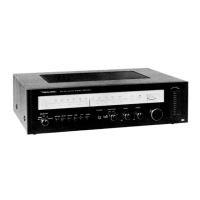
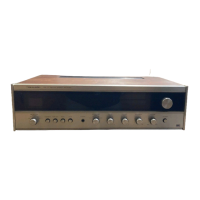
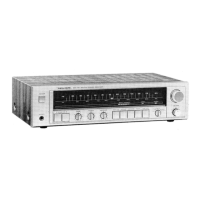
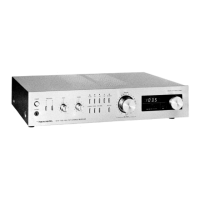
This document is a service manual for the Realistic STA-21 AM/FM Stereo Receiver, Catalog Number 31-2071, custom manufactured for Radio Shack, a division of Tandy Corporation. It provides comprehensive information for the maintenance, repair, and alignment of the receiver.
The Realistic STA-21 is an AM/FM stereo receiver designed to provide audio amplification and radio reception. It features a range of inputs for various audio sources and outputs for speakers and recording devices.
AM Band:
- Range: 510 – 1650 kHz (nominal), 520 – 1620 kHz (limit)
- IF: 455 kHz
- Antenna Sensitivity (S/N 20 dB):
- At 600 kHz: 200 µV/m (nominal), 500 µV/m (limit)
- At 1000 kHz: 200 µV/m (nominal), 500 µV/m (limit)
- At 1400 kHz: 200 µV/m (nominal), 500 µV/m (limit)
- Terminal Sensitivity (20 dB S/N): 10 µV (nominal)
- ACA at S/N 6 dB sensitivity at 1000 kHz: 28 dB (nominal), 20 dB (limit)
- AGC Distortion at 1000 kHz, 100 mV/m, 80% Mod.: 4% (nominal), 10% (limit)
- AGC Figure of Merit: 45 dB (nominal), 38 dB (limit)
- IF Rejection at 600 kHz: 32 dB (nominal), 27 dB (limit)
- Image Rejection at 1400 kHz: 45 dB (nominal), 35 dB (limit)
- Distortion at 5 mV/m 30% Mod.: 1.5% (nominal), 3.5% (limit)
- Tapeout Level at 5 mV/m 30% Mod. 400 Hz: 250 mV (nominal), 200 mV (limit)
- Fidelity 5 mV/m Input, -6 dB Down (1 kHz = 0 dB): 50 – 2500 Hz (nominal)
- Whistle Modulation of 2nd and 3rd Harmonic (at 1 and 5 mV/m): 5% (nominal), 10% (limit)
- Calibration Accuracy:
- At 600 kHz: ±25 kHz (limit)
- At 1400 kHz: ±50 kHz (limit)
FM Band:
- Range (UL and C.S.A. Models): 86.5 – 108.5 MHz (nominal), 88 – 108 MHz (limit)
- Range (European and Australian Models): 87.5 – 108.5 MHz (nominal), 87.5 – 108 MHz (limit)
- IF: 10.7 MHz
- IHF Sensitivity at 90, 98 and 106 MHz: 2.8 µV (nominal), 5.0 µV (limit)
- FM S/N Ratio at 98 MHz, 1 mV Input: 60 dB (nominal), 55 dB (limit)
- FM Limiting -3 dB: 3.2 µV (nominal), 7.1 µV (limit)
- IF Rejection at 90 MHz: 80 dB (nominal), 70 dB (limit)
- Image Rejection at 106 MHz: 50 dB (nominal), 45 dB (limit)
- Capture Ratio: 3 dB (nominal), 6 dB (limit)
- ACA + 400 kHz at 100 µV: 45 dB (nominal), 30 dB (limit)
- Audio THD 400 Hz, 75 kHz Dev.: 0.5% (nominal), 1.0% (limit)
- Audio THD 400 Hz, 22.5 kHz Dev.: 0.3% (nominal), 0.8% (limit)
- Calibration Accuracy:
- At 90 MHz: ±500 kHz (limit)
- At 106 MHz: ±500 kHz (limit)
- AFC Holding Range with 1 mV Signal: ±200 kHz (nominal), 300 – 800 kHz (limit)
- AM Suppression: 38 dB (nominal), 30 dB (limit)
- Maximum Signal Handling Capacity: 0.2 V (nominal), 0.1 V (limit)
- Tapeout Level 1 mV 75 kHz Dev. 400 Hz Mod.: 750 mV (nominal), 750 ± 2.5 dB (limit)
- Frequency Response: Must meet 75 µsec. De-emphasis for UL and C.S.A. Approved Models (50 µsec. De-emphasis for European and Australian Models).
FM MPX:
- Stereo Indicator "ON" Point: 10 µV (nominal), 20 µV (limit)
- Separation at 1 mV:
- 100 Hz: 29 dB (nominal), 22 dB (limit)
- 1 kHz: 34 dB (nominal), 27 dB (limit)
- 10 kHz: 26 dB (nominal), 20 dB (limit)
- Stereo Distortion 1 mV 1 kHz: 0.6% (nominal), 2.0% (limit)
- 38 kHz Rejection: 42 dB (nominal), 35 dB (limit)
- SCA Rejection: 42 dB (nominal), 35 dB (limit)
Audio Section:
- Input Impedance:
- PHONO MAG.: 50 K ohm
- AUX: 100 K ohm
- Output Power at THD 1% 8 ohms (Both Channels Driven at 1 kHz): 11 W (nominal), 8.5 W (limit)
- Power Bandwidth 8 ohms Both Channels Driven THD 1%, 20 Hz – 20 kHz: 8.5 W (nominal), 7 W (limit)
- Sensitivity for Rated Power:
- PHONO MAG.: 2.5 mV (nominal), 3.5 mV (limit)
- AUX: 150 mV (nominal), 200 mV (limit)
- Tape In: 150 mV (nominal), 200 mV (limit)
- Frequency Response at AUX (1 W ± 2 dB): 15 – 30 K Hz (nominal), 20 – 20 K Hz (limit)
- Bass Action at 100 Hz: ±10 dB (nominal), ±10 ± 2.5 dB (limit)
- Treble Action at 10 kHz: ±10 dB (nominal), ±10 ± 2.5 dB (limit)
- Min. Volume Hum and Noise: 1 mV (nominal), 3 mV (limit)
- Max. Volume Hum and Noise Tone Max. at AUX: 15 mV (nominal), 70 mV (limit)
- Signal to Noise Ratio:
- PHONO MAG. 5 mV Input (Input Short): 60 dB (nominal), 55 dB (limit)
- AUX 200 mV Input: 65 dB (nominal), 55 dB (limit)
- Cross Talk at 1 kHz AUX: 46 dB (nominal), 40 dB (limit)
- Bass Compensation at 100 Hz - 30 dB Volume: +9 dB (nominal), +9 ± 2 dB (limit)
- Treble Compensation at 10 kHz - 30 dB Volume: +4 dB (nominal), +4 ± 2 dB (limit)
- Tapeout Level:
- PHONO MAG. at 3 mV 1 kHz: 200 mV (nominal), 200 ± 2 dB (limit)
- AUX at 200 mV 1 kHz: 200 mV (nominal), 200 ± 2 dB (limit)
- PHONO MAG. Eq. Response:
- At 100 Hz: +13 dB (nominal), +13 ± 2 dB (limit)
- At 10 kHz: -13 dB (nominal), -13 ± 2 dB (limit)
- Tapeout Level (DIN Connector):
- AM 5 mV/m Input 30% Mod.: 25 mV (nominal), 25 ± 3 dB (limit)
- FM 1 mV Input 22.5 kHz Dev.: 25 mV (nominal), 25 ± 3 dB (limit)
- AUX 200 mV Input: 25 mV (nominal), 25 ± 3 dB (limit)
- PHONO MAG. Overload: 80 mV (nominal), 60 mV (limit)
Usage Features:
The receiver includes standard controls for AM/FM tuning, volume, balance, bass, and treble. Input selection is managed via a selector switch for Phono, Aux, and Tape inputs. Speaker selection allows for main and remote speaker systems. A tape monitor switch is also present for monitoring recordings. The front panel features a headphone jack for private listening.
Maintenance Features:
The service manual provides detailed instructions for disassembly, alignment, and troubleshooting.
- Disassembly: Step-by-step instructions are provided for removing the chassis from the wooden cabinet, detaching the front panel, and removing the rear panel.
- Alignment: Comprehensive alignment procedures are outlined for the main amplifier, reset circuit, AM IF & RF, FM RF & IF, and FM MPX sections. These procedures specify the required equipment (e.g., signal generator, AC voltmeter, oscilloscope, distortion meter, frequency counter), connection points, audio frequencies, and target levels for adjustment. Specific trimmer and coil locations are identified for precise tuning.
- Troubleshooting: A detailed troubleshooting guide lists common symptoms (e.g., no output, pilot lamp issues, no speaker output, blown fuse, no output on one channel, no AM/FM, no MPX separation, no stereo light, inoperative "TAPE OUT" or "PHONO" input) and their corresponding causes and remedies. This section helps technicians diagnose and fix problems efficiently.
- Parts List: Electrical parts lists (capacitors, coils, transformers, diodes, fuses, integrated circuits, meters, pilot lamps, resistors, SCRs, switches, transistors, variable capacitors, variable resistors) and exploded view parts lists (cabinet components, chassis, brackets, knobs, cords, heat sinks) are included with reference numbers, descriptions, and part numbers for easy identification and ordering of replacement components.
- Diagrams: The manual includes a block diagram illustrating the signal flow, a dial stringing diagram for proper assembly of the tuning mechanism, IC and transistor lead identification, assembled board views (top and bottom) for AM/FM Tuner, IF & MPX, Pre & Tone Amp, Main Amp & Power Supply, and Jack boards, an IC internal diagram, and a schematic diagram for detailed circuit analysis. An exploded view diagram aids in understanding the physical assembly of the receiver.
- Protective Circuit: A brief description of the protective circuit is provided, explaining how it safeguards the main amplifier from shorted speaker terminals or low impedance loads by shutting down the output. Instructions for resetting the circuit are also included.
The manual emphasizes maintaining a stable line voltage (120V AC for UL/CSA models, 220/240V AC for European/Australian models) and a room temperature of 25°C during alignment procedures to ensure accurate results. It also notes that nominal specifications represent design targets, while limit specifications define the absolute worst acceptable conditions.

 Need help?
 General

 To Next Page