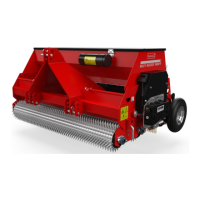
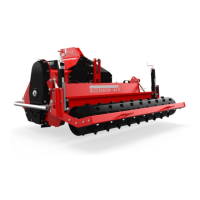
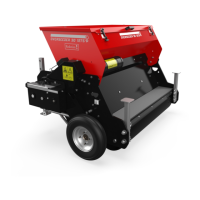
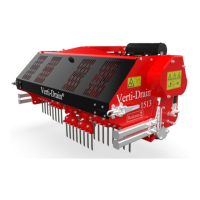
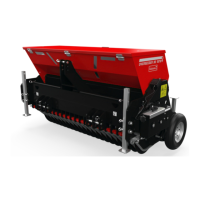
The Redexim Speedseed is a specialized machine designed for tilling lawns and other grassed areas, primarily for seeding purposes. It is not an independently operating machine and requires an appropriate tractor for operation. The Speedseed is available in four models: 1200, 1600, 2100, and 2400, each with varying working widths and capacities.
Function Description:
The Speedseed's primary function is to create precise seeding slits in the ground and accurately dispense seeds. It utilizes a spiked roller to create holes in a square pattern, ensuring even seed distribution. The machine is designed for efficient and safe operation, provided the user adheres to all safety instructions outlined in the manual. Its design allows for adjustment of working depth and seed quantity to suit different seed types and ground conditions. The Speedseed is intended for forward motion only during operation; driving backward with the running wheel on the ground is strictly prohibited.
Important Technical Specifications:
| Model |
1200 |
1600 |
2100 |
2400 |
| Working width |
1.2 m (82.7") |
1.58 m (94.4") |
2.1 m (47.2") |
2.4 m (62.2") |
| Working depth |
5 mm - 20 mm (0.19" - 0.78") |
5 mm - 20 mm (0.19" - 0.78") |
5 mm - 20 mm (0.19" - 0.78") |
5 mm - 20 mm (0.19" - 0.78") |
| Seeding speed |
Up to 12 km/h (7.5 mph) |
Up to 12 km/h (7.5 mph) |
Up to 12 km/h (7.5 mph) |
Up to 12 km/h (7.5 mph) |
| Weight |
350 kg (772 lbs) |
450 kg (992 lbs) |
550 kg (772 lbs) |
700 kg (992 lbs) |
| Seeding hole spacing |
Square 30 mm (1.18") |
Square 30 mm (1.18") |
Square 30 mm (1.18") |
Square 30 mm (1.18") |
| Holes/sq meter (single spiked roller) |
990 |
990 |
990 |
990 |
| Recommended tractor |
20 HP (min. 450 kg lift) |
30 HP (min. 550 kg lift) |
40 HP (min. 1000 kg lift) |
40 HP (min. 1000 kg lift) |
| Seed-tray capacity |
168 litres (5.9 cu. ft.) |
225 litres (7.9 cu. ft.) |
300 litres (7.9 cu. ft.) |
336 litres (11.8 cu. ft.) |
| Max. capacity (theoretical) |
14175 m² (152523 ft²) |
18900 m² (203438 ft²) |
24900 m² (268021 ft²) |
28350 m² (305046 ft²) |
| Seeding density (per 100 m²) |
Fine: 0.2-2.8 kg (0.44-6.17 lbs); Coarse: 0.2-4 kg (0.44-8.82 lbs) (adjustable in 10 steps) |
Fine: 0.2-2.8 kg (0.44-6.17 lbs); Coarse: 0.2-4 kg (0.44-8.82 lbs) (adjustable in 10 steps) |
Fine: 0.2-2.8 kg (0.44-6.17 lbs); Coarse: 0.2-4 kg (0.44-8.82 lbs) (adjustable in 10 steps) |
Fine: 0.2-2.8 kg (0.44-6.17 lbs); Coarse: 0.2-4 kg (0.44-8.82 lbs) (adjustable in 10 steps) |
| Shipping dimensions (LxWxH) |
1500x870x1070 mm (75x34x42") |
1900x870x1070 mm (75x34x42") |
2415x870x1070 mm (134x34x42") |
2700x870x1070 mm (150x34x42") |
| Three-point connection |
CAT 1-2 |
CAT 1-2 |
CAT 1-2 |
CAT 1-2 |
| Lubricant |
EP 2 |
EP 2 |
EP 2 |
EP 2 |
| Tyre pressure |
1-2 bar (14.5-29 psi) |
1-2 bar (14.5-29 psi) |
1-2 bar (14.5-29 psi) |
- |
Standard parts include 5 gear sets for adjusting seeding density, a manual container, a seed tray with a sight-glass, and a seeding wheel adjustable to the area. An optional set of spikes for the back roller is available for all models. For the Speedseed 1600, an optional wheel kit (article number 224.160.000) is available, which can reduce the minimum required horsepower by 10 HP and can be quickly attached or removed.
Usage Features:
- Safety First: Users must read and understand the manual before operation. Safety stickers (Fig. 3, 4, 5) on the machine must always be visible and legible.
- Area Preparation: Before use, the area to be treated must be inspected, and loose obstacles removed. Irregularities should be avoided.
- Tractor Compatibility: The Speedseed must be used with an appropriate tractor that meets the minimum lifting capacity requirements. The tractor/Speedseed combination should be tested for noise, safety, and ease-of-use.
- Working Depth Adjustment: The working depth (5-20 mm) is adjusted by turning the top rod. Shortening the rod inclines the machine forward, lowering the seeding depth. For hard ground, irrigation or verti-drain® may be necessary to soften the soil.
- Seed Quantity Setting: Seed quantity is set using various change gears located in the seed tray. The manual provides a table (Tab. 1) with gear combinations for different seed types (Bentgrass, Kentucky Bluegrass, Ryegrass) and corresponding seeding densities. A spreading test (section 15.2) is recommended to determine the exact seeding quantity for specific seeds.
- Operating Speed: The maximum driving speed is 12 km/h (7.5 mph). Higher speeds are not recommended to prevent excessive wear and damage.
- Operational Tips: A field can be tilled 2 or 3 times in different directions for higher seeding density. Sharp turns should be avoided. If spike elements hit hard objects, they may be damaged and should be filed or replaced.
- Slope Operation: The machine can operate on slopes up to 20 degrees, but work should always be done downhill.
- Environmental Conditions: Do not use the Speedseed in the dark, during heavy rain/storms, or when the soil is frozen or very wet.
- Starting/Stopping Procedure: The starting procedure involves putting seed in the tray, setting the quantity, driving to the area, starting at 3 km/h, and carefully lowering the machine until the spike elements cut the ground. The working depth can be adjusted while the machine is stopped and locked. To stop, decrease speed, raise the machine, and move to the next area.
- Disconnection: When disconnecting, slowly lower the machine to the ground, lock the roller, loosen and remove the top rod, and remove the lower arms from the tractor. Ensure the machine is stored on a stable, level surface, and the spikes are protected from damage.
Maintenance Features:
- Pre-Use Check: Before each use, check for loose bolts/nuts and tighten them to the correct torque. Verify the presence and legibility of safety stickers and replace them if damaged.
- Initial Maintenance (After first 20 operating hours): Grease the roller bearings using EP 2 lubricating grease. Check for loose bolts/nuts and tighten as needed. Grease the drive chains with a chain spray.
- Regular Maintenance (Every 100 operating hours): Grease the roller bearings and drive chains. Check for loose bolts/nuts and tighten. Check the tension of the drive chains and adjust the tensioners. Inspect the seeding roller for dirt/damage and clean or replace if necessary. Check and adjust the seeding slit opening if needed. Perform a spreading test to verify seed quantity. Inspect spike elements for damage and repair or replace as necessary.
- Hydraulic System: If present, regularly inspect hydraulic hoses and replace them if damaged or worn, ensuring replacements meet manufacturer specifications. Always relieve pressure from the hydraulic installation before any work.
- Repairs: Only authorized technical personnel should carry out adjustments and repairs. Use original Speedseed parts only. Keep a record of all repairs.
- Troubleshooting: The manual includes a troubleshooting guide for common issues such as seed spoilage, incorrect working depth, and drive wheel slipping, providing possible causes and solutions.


 To Next Page
 General