Regency
®
CLASSIC C34-3 Direct Vent Freestanding Gas Stove
25
INSTALLATION
CATHEDRAL CEILINGS
Round Support (RDS) & Square
Support (SQS)
If your home has a cathedral ceiling (no attic
space between the ceiling and the roof), install
the chimney and support as follows.
1) Situate the chimney in a convenient loca-
tion as near as possible to the appliance
outlet. Cut and frame a hole in the roof for
the support. The sides of this hole must be
vertical with 1-1/4" clearance.
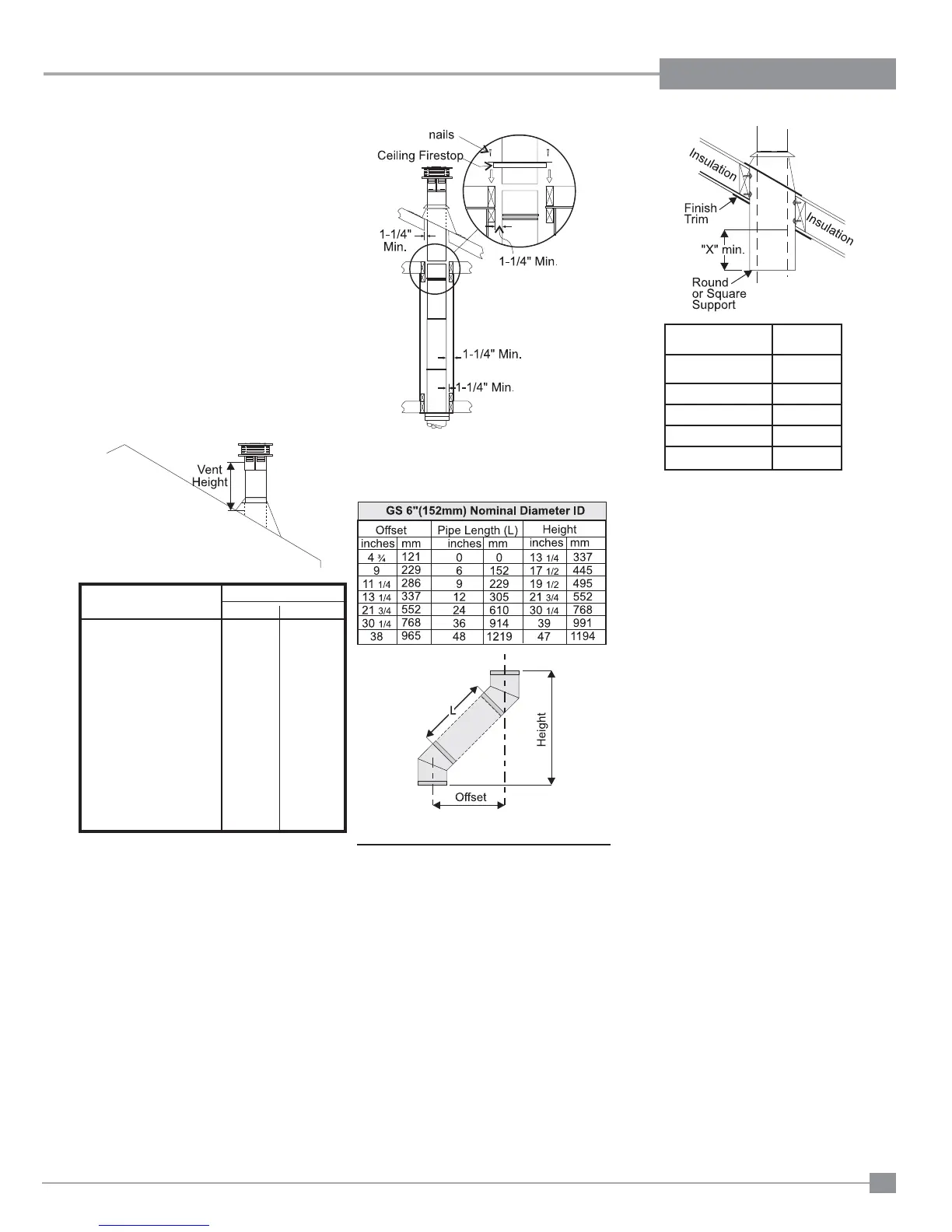
2) Place the support in the opening. Lower it
to the correct height as determined by the
table and diagram below.
Using a level, make sure the support is
vertical. If the support extends above the
roof, cut it fl ush with the top of the roof. Nail
the support to the frame opening using (8)
3" spiral nails or #8 x 1-1/2" screws.
Note: If you are using a 6" square support
you may fi nd it diffi cult to screw it
in place because it is fairly small
inside.
Simpson Dura-Vent has provided angle
brackets with this support which can be
screwed to the outside of the support
box and nailed to surrounding framing as
required. Use a minimum of four #8 x 1/2"
screws per bracket. In some cases these
brackets may need to be trimmed (e.g.:
to fi t under a fl ashing). Place the Finish
Collar around the support and fasten it to
the ceiling using the screws provided.
3) Use appropriate roof fl ashing. Place the
fl ashing under the upper shingles and on top
of the lower shingles approximately half of
the fl ashing should be under the shingles.
4) Assemble the desired lengths of Black Pipe
and Elbows necessary to reach from the
appliance adaptor up through the support
box and fl ashing to proper height as per
Diagram 12, local codes or "Exterior Vent
Terminal Locations" section. Ensure that
all pipe and elbow connections are in their
fully twist lock position.
5) Ensure vent is vertical and secure fl ashing to
the roof with roofi ng nails. Slide the storm
collar over the pipe section and seal with a
mastic.
6) Twist lock the vent cap on to the last sec-
tion.
Offset Chart
Diagram 12
Diagram 13
Roof Pitch Minimum Vent Height
Feet Meters
fl at to 7/12 2 0.61
over 7/12 to 8/12 2 0.61
over 8/12 to 9/12 2 0.61
over 9/12 to 10/12 2.5 0.76
over 10/12 to 11/12 3.25 0.99
over 11/12 to 12/12 4 1.22
over 12/12 to 14/12 5 1.52
over 14/12 to 16/12 6 1.83
over 16/12 to 18/12 7 2.13
over 18/12 to 20/12 7.5 2.29
over 20/12 to 21/12 8 2.44
support the vent pipe every 3 feet, to
avoid excessive stress on the elbows,
and possible separation. Wall straps
are available for this purpose. See
diagram 9.
Galvanized pipe and elbows may be utilized
in the attic as well as above the roofl ine.
The galvanized fi nish is desirable above the
roofl ine due to its higher corrosion resist-
ance.
Continue to add pipe sections through the
fl ashing until the height of the vent cap meets
the minimum height requirements specifi ed
in diagram 12 or local codes. Note that for
steep roof pitches, the vertical height must
be increased. A poor draft, or down drafting
can result from high wind conditions near
big trees or adjoining roof lines, in these
cases, increasing the vent height may solve
the problem.
7) Ensure vent is vertical and secure the base
of the fl ashing to the roof with roofi ng rails,
slide storm collar over the pipe section and
seal with a mastic.
8) Install the vertical termination cap by twist
locking it.
Notes:
a) For multistorey vertical installations, a
Ceiling Fire stop (Part# 963) is required
at the second fl oor, and any subsequent
fl oor. See diagram 13. The opening
should be framed to 10 " x 10" inside
dimensions, in the same manner as
shown in diagram 10.
b) Any occupied areas above the fi rst fl oor,
including closets and storage spaces,
through which the vertical vent passes,
must be enclosed.
Slope "X"
0/12 - 2/12 4"
2/12 - 7/12 5-1/2"
7/12 - 12/12 6-3/4"
12/12 - 24/12 7-1/2"
24/12+ 12-1/2"



 To Next Page