Page 31
4. Start the engine and run up to normal operating
temperature with the radiator cap removed to clear any air-locks in
the system. Stop engine and check coolant level, topping up if
required.
5. Replace radiator filler cap.
Checking for leaks
After refilling the system, ensure that the hose connections are
securely tightened. Run the engine and check for water leaks.
In the event of the cooling system having been disturbed, i.e. cylinder
head removal or water pump change, it is recommended that a
"Barseal" pellet ("R" part No. 9947) is introduced through the radiator
filler neck. New gaskets should always be fitted and fixing nuts
tightened to the correct torque to prevent possible ingress of coolant
in to the oil system.
Operation 2 Radiator removal and replacement
The radiator, comprising an upper and lower tank connected by a
matrix, is mounted to the body by two support brackets. An overflow
pipe drains surplus coolant to the ground should the system be over
filled.
To remove (Figure 3)
1. Drain the cooling system as described in operation 1
2. Slacken hose clips and disconnect radiator hoses from
water pump and thermostat housing
3. Remove the four set screws and washers securing the
radiator to the support brackets located on each side of the radiator,
attached to the body.
4. Remove the radiator.
5. Slacken the hose clips and remove the hoses. Check the
condition and renew if necessary.
Refit in the reverse order, refill the cooling system as described earlier
in this section and check the cooling system for leaks.
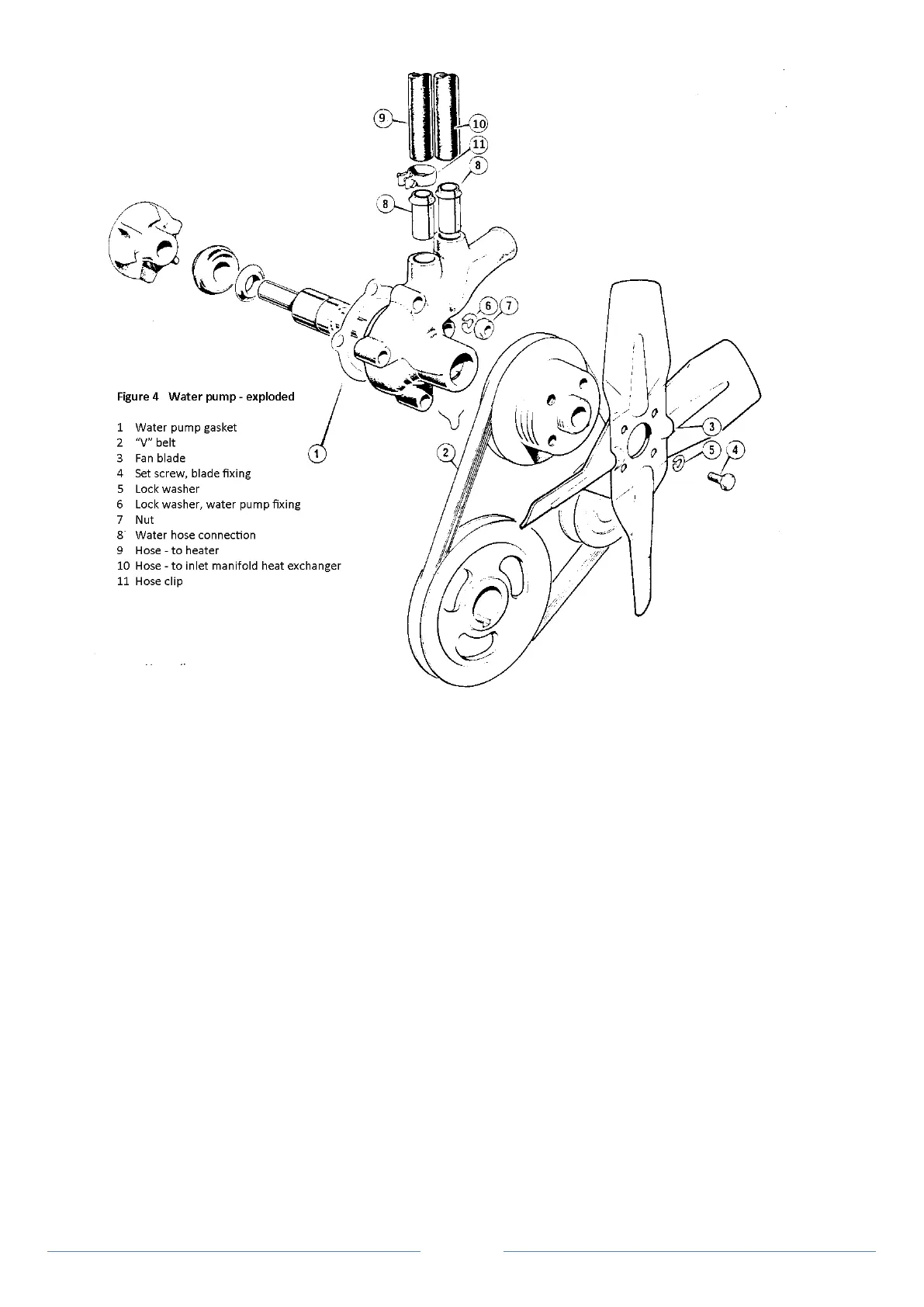
Operation 3 Water pump removal and replacement
The water pump is mounted on the face of the cylinder block and
comprises a cast iron impeller mounted on a spindle with a seal and a
thrower. The seal, bearing against the impeller, prevents leaks around
the spindle. The coolant inlet is on the right of the pump body. A
fabricated pulley, fitted to the front of the spindle, seats the four
bladed fan, see Figure 4.
Leaking coolant from the seating face of the impeller could indicate a
worn gasket or impeller seal. If the latter is the case then a new pump,
available only as an assembly, will have to be fitted.
To remove
1. Drain the cooling system and remove the radiator as
described in operations 1 and 2.
2. Slacken the alternator adjusting screw and mounting bolts.
Pivot the alternator towards the engine and remove the fan belt.
3. Slacken the hose clips and disconnect the hoses from the
pump.



 To Next Page