11
Residual head UPR 15-60
0
100
200
300
400
500
600
0 200 400 600 800 1000 1200
CH-flow [l/h]
Residual head [mbar]
dT 20°C 18kW
Pump 'high'
Pump 'low'
Residual head UPR 15-70
0
100
200
300
400
500
600
700
0 200 400 600 800 1000 1200 1400 1600
CH- flow [l/h]
Residual head [mbar]
Pump 'high'
Pump 'low'
dT 20°C 28kW
fi g. 08 Graph residual head UPR 15-60 for the CH installation with
Avanta Plus 18s, 24s, 30s, 24c and 28c
LT.AL.W7H.000.013
fi g. 09 Graph residual head UPR 15-70 for the CH installation with
Avanta Plus 35c and 39c
LT.AL.W7H.000.014
2.3.2 Circulation pumps
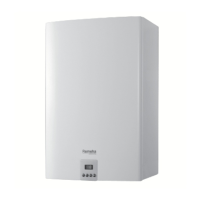
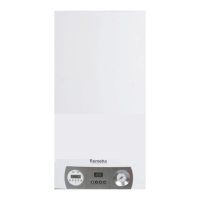
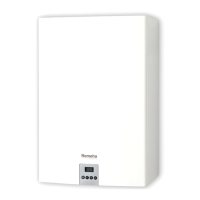
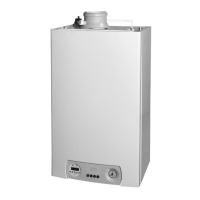
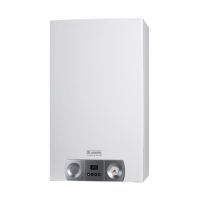
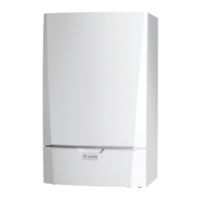
The Remeha Avanta Plus 18s, 24s, 30s, 24c and 28c are fitted
with the Grundfos UPR 15-60 and the Avanta Plus 35c and
39c with the UPR 15-70, two-speed circulation pumps. The
control unit ensures that when the hot-water function is active,
the pump runs at ‘high’. The factory setting of the pump for CH
function is ‘low.’ If necessary, the service installer can adjust
this to ‘high’ by switching parameter 21 (from 0 to 1) see
par. 2.9.8.
2.3.3 Additional guidelines for the domestic and CH
water
• The system should be filled with mains cold water (for the
UK this will usually have a pH of between 7 and 8).
• Flush the pipes and radiators thoroughly to remove all fluxes
and debris before connecting the boiler to the central heat-
ing system.
• The temperature of the central heating pipes and the
radiators can rise to 95°C.
• Use untreated tap water only to fill the CH system.
• The pH value of the system water must be between 6 and 9
• In case inhibitors are being used, please follow the
instructions given in par. 2.3.4.
2.3.4 Water treatment
If used correctly water treatment can improve the boilers
efficiency and increase the anticipated life expectancy of the
boiler. For further information a special document “Quality
requirements CH water” is available from Broag.
As most systems contain a variety of metals, it is considered
good practice to provide some form of water treatment in order
to prevent or reduce the following:
• Metallic corrosion
• Formation of scale and sludge
• Microbiological contamination
• Chemical changes in the untreated system water
All scale deposits however small will reduce the efficiency of
the boiler and should be prevented.
Suitable chemicals and their use should be discussed with a
specialist water treatment company prior to carrying out any
work (environmental aspects, health aspects). The specifica-
tion of the system and manufacturers recommendations must
be taken into account, along with the age and condition of
the system. New systems should be flushed thoroughly to
BS 7593(1992) to remove all traces of flux, debris, grease
and metal swarf generated during installation. Care to be
taken with old systems to ensure any black metallic iron oxide
sludge and other corrosive residues are removed, again by
power flushing, ensuring that the system is drained completely
from all low points.
120577.indd 11120577.indd 11 6-3-2009 14:48:456-3-2009 14:48:45



 To Next Page
 Loading...