1.34
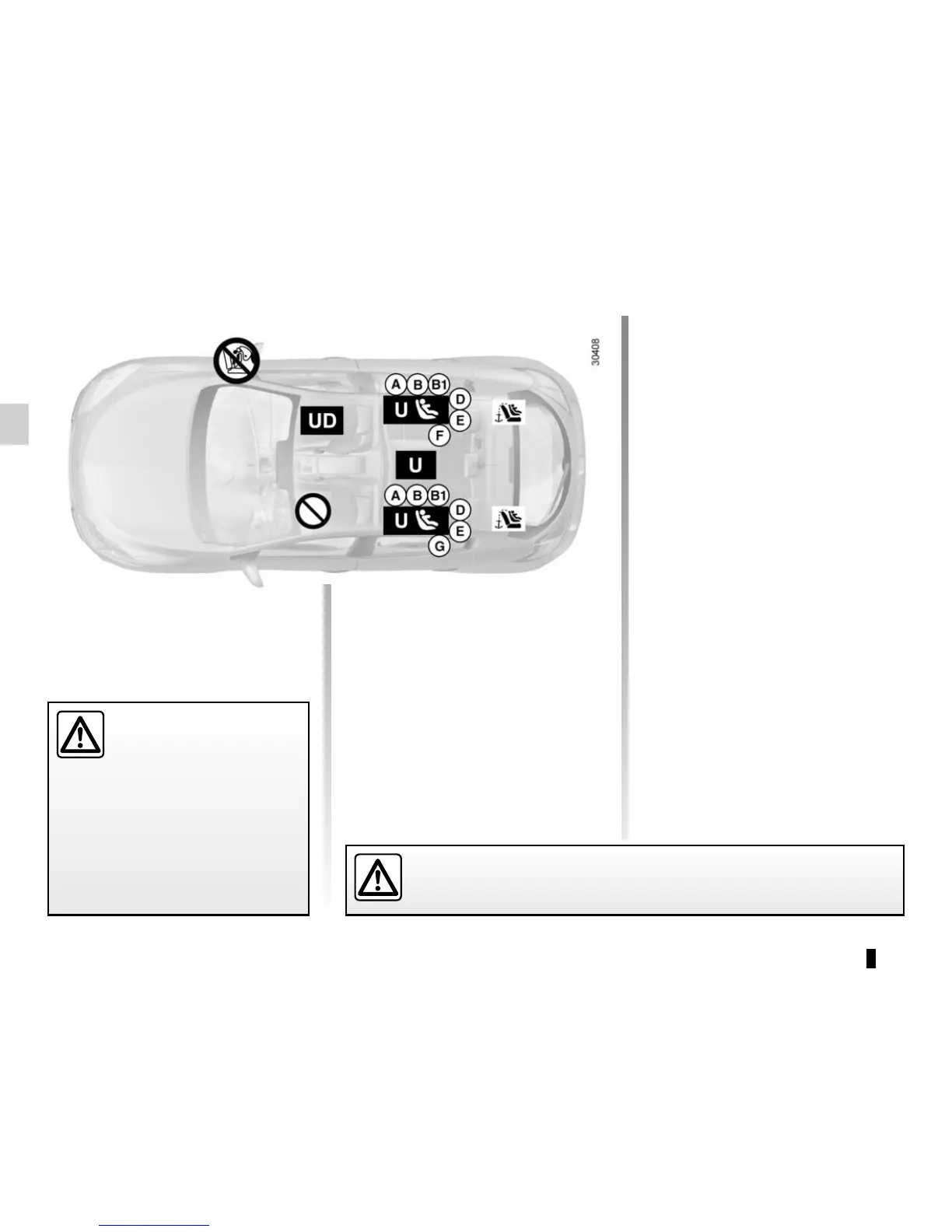
² Seat not suitable for fitting child
seats.
Child seat attached using the belt
¬ Seat which allows a child seat
with “Universal” approval to be attached
by a seat belt.
− Seat which only allows a rear-
facing seat with “Universal” approval
to be attached with a seat belt.
³ Check the status of the air bag
before fitting a child seat or allowing a
passenger to use the seat.
RISK OF DEATH OR
SERIOUS INJURY: before
fitting a rear-facing child
seat in the front passenger
seat, check that the air bag has been
deactivated (refer to the information
on “Child safety: deactivating/acti-
vating the front passenger air bag”
at the end of the paragraph).
Child seat attached using the ISOFIX
mounting
ü Seat which allows an ISOFIX
child seat to be fitted.
± The rear seats are fitted with
an anchorage point which allows a
forward-facing ISOFIX child seat with
universal approval to be fitted. The an-
chorage points are located under the
luggage compartment carpet and are
indicated by a marking.
The size of the ISOFIX child seat is in-
dicated by a letter:
– A, B and B1: for forward-facing seats
in group 1 (9 to 18 kg);
– C: rear-facing seats in group 1 (9 to
18 kg);
– D and E: shell seat or rear-facing
seats in group 0 or 0+ (less than
13 kg);
– F and G: cots in group 0 (less than
10 kg).
Using a child safety system which is not approved for this vehicle will not
correctly protect the baby or child. They risk serious or even fatal injury.
CHILD SAFETY: Fitting a child seat (2/13)
Five-door versions (five seats) WITH front passenger air bag



 To Next Page