7
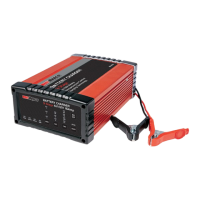
RBC25SS3
RBC5SS3
CHARGE CYCLES
Stage Function Description
1
Diagnosis
The charger will check the connection and evaluate the battery. If the
connection is wrong or the battery is bad, Er1 or Er2 will be shown
and the charge will not proceed. If connections are correct, and a
chargeable voltage identified, the battery charger will proceed to the
next charging stage.
2
Desulphation
This feature provides a stepped or pulsed voltage to help remove the
sulphation of plates, which can occur when batteries are left discharged
for prolonged periods. The sulphation of battery plates prohibits the ability
of the battery to accept charge and reduces service life. To minimise
sulphation, recharge the battery promptly after use or charge regularly
(monthly).
3
Pre-Charge
A low voltage and current is used to slowly increase battery condition
and further improve electrolytic consistency which can become uneven
due to day to day use.
4
Soft Start
At an increased voltage, the current is slowly increased over time to
control heat, reduce gassing, and minimise battery stress.
5
Bulk Charge
(Constant Current)
The Bulk Charge settings will reduce the time to charge and ensure
better battery health.
CC1 CC1 - Charging at maximum current.
CC2
CC2 - To control the battery temperature and reduce electrolyte loss, the
Amps are held at a reduced constant current.
CC3
CC3 - The Amps are further reduced and held constant to get close to
maximum charge whilst further minimising electrolyte loss.
6
Absorption
(Constant Voltage)
Applying an even higher voltage whilst reducing current over time
ensures the battery is topped up but not over-charged.
7
Analysis
The charger conducts an analysis of the battery over a period of
time to determine the battery discharge rate. Based on the battery
performance, the battery charger will recommence charging, or move
to the next stage.
8
Recondition
(High Voltage Repair)
The recondition phase applies maximum voltage to maximise battery
condition and further repair and clean battery plates. This may be
required following significant discharge, for batteries with uneven cell
capacity or, to alleviate acid stratification when Calcium batteries are
left discharged for more than a couple of days.
Note - The battery charger will assess the condition of the battery and
may not perform this function.
9
Maintain
The charger monitors the battery voltage and recommences the charge
sequence once the voltage drops to 12.8V (or 6.4V).



 To Next Page