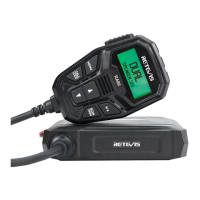
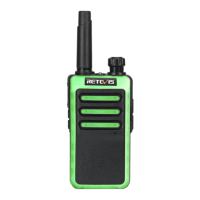
10
CAUTION
User’ instructions should accompany the device when transferred to other users.
Unauthorized modication and adjustment
Changes or modications not expressly approved by the pay responsible for compliance may void the user’s authority granted by the
local government radio management depaments to operate this radio and should not be made. To comply with the corresponding
requirements, transmitter adjustments should be made only by or under the supeision of a person ceied as technically qualied to
peorm transmitter maintenance and repairs in the private land mobile and xed seices as ceied by an organization representative
of the user of those seices. Replacement of any transmitter component (cstal, semiconductor, etc.) not authorized by the local
government radio management depaments equipment authorization for this radio could violate the rules.
Radio License
Governments keep the radios in classication. Two-way radios are only operated on authorized radio frequencies that are regulated by
the local radio regulato authorities (such as FCC, ISED, OFCOM, ANFR, BFTK, ComReg, Bundesnetzagentur, and so on.). For detailed
classication and the use of your two-way radios, please contact the local government radio management depaments. Use of this
radio outside the count where it was intended to be distributed is subject to government regulations and may be prohibited.
This radio equipment contains frequency bands that are subject to licensing procedures before this radio system is allowed to be
operated. Please make sure you have a valid radio license or radio operator permit before use.
FCC
This device complies with pa 15 of the FCC Rules. Operation is subject to the condition that this device does not cause harmful
inteerence. (Licensed radios are applicable)
Note: This equipment has been tested and found to comply with the limits for a Class B digital device. These limits are designed to
provide reasonable protection against harmful inteerence in a residential installation. This equipment generates, uses and can radiate
radio frequency energy and, if not installed and used in accordance with the instructions, may cause harmful inteerence to radio
communications. However, there is no guarantee that inteerence will not occur in a paicular installation. If this equipment does cause
harmful inteerence to radio or television reception, which can be determined by turning the equipment o and on, the user is
encouraged to t to correct the inteerence by one or more of the following measures:
—Reorient or relocate the receiving antenna.
—Increase the separation between the equipment and receiver.
—Connect the equipment into an outlet on a circuit dierent from that to which the receiver is connected.
—Consult the dealer or an experienced radio/TV technician for help.
Disposal
The crossed-out wheeled-bin symbol on your product, literature, or packaging reminds you that all electrical
and electronic products, batteries, or accumulators must be taken to designated collection locations at the
end of their working life. Do not dispose of these products as unsoed municipal waste. Dispose of them according to
the laws and rules in your area.
RF Safety
This two-way radio uses electromagnetic energy in the radio frequency (RF) spectrum to provide communications between two or more
users over a distance. RF energy, which when used improperly, can cause biological damage. Please refer to the following websites for
more information on what RF energy exposure is and how to control your exposure to assure compliance with established RF exposure
limits: http://www.who.int/en/
Transmit no more than the rated duty factor 50% of the time. Transmitting necessa information or less, is impoant because the radio
generates measurable RF energy exposure only when transmitting in terms of measuring for standards compliance. For users who wish
to fuher reduce their exposure, some eective measures to reduce RF exposure include:
•Reduce the amount of time spent using your wireless device.
•Use a speakerphone, earpiece, headset, or other hands-free accesso to reduce proximity to the head (and thus head exposure).
While wired earpieces may conduct some energy to the head and wireless earpieces also emit a small amount of RF energy, both wired
and wireless earpieces remove the greatest source of RF energy (handheld device) from proximity to the head and thus can greatly
reduce total exposure to the head.
•Increase the distance between wireless devices and your body.
•This radio is designed for and classied as “Occupational/Controlled Use Only”. Occupational/Controlled environments are dened as
locations where there is exposure that may be incurred by people who are aware of the potential of exposure, for example, as a result of
employment or occupation. It means a radio must be used only by individuals aware of the hazards, and the ways to minimize such
hazards; Not intended for use in a General population/uncontrolled environment.
Electromagnetic Inteerence/Compatibility
Nearly eve electronic device is susceptible to electromagnetic inteerence (EMI) if inadequately shielded, designed, or otherwise
congured for electromagnetic compatibility.
During transmissions, your radio generates RF energy that can possibly cause inteerence with other devices or systems. To avoid such
inteerence, turn o the radio in areas where signs are posted to do so, such as hospitals or healthcare facilities.
• Persons with pacemakers, implantable cardioveer debrillators (ICDs) or other active implantable medical devices should
• Consult with their physicians regarding the potential risk of inteerence from radio frequency transmitters, such as poable radios
(poorly shielded medical devices may be more susceptible to inteerence).
• Turn the radio OFF immediately if there is any reason to suspect that inteerence is taking place.
• Do not car the radio in a chest pocket or near the implantation site, and car or use the radio on the opposite side of the body
from the implantable device to minimize the potential for inteerence. Hearing Aids: Some digital wireless radios may inteere with
some hearing aids. In the event of such inteerence, you may want to consult your hearing aid manufacturer to discuss alternatives.
• Other Medical Devices: If you use any other personal medical device, consult the manufacturer of your device to determine if it is
adequately shielded from RF energy. Your physician may be able to assist you in obtaining this information.
WARNING: MODIFICATION OF THIS DEVICE TO RECEIVE CELLULAR RADIOTELEPHONE SERVICE SIGNALS IS PROHIBITED UNDER FCC
RULES AND FEDERAL LAW.
Turn o your radio in the following conditions
•Turn o your radio prior to entering any area with a potentially hazardous or explosive atmosphere. Only radio types that are
especially qualied should be used in such areas as “Intrinsically Safe”. Note: the areas with potentially explosive atmosphere referred
to above include blasting caps, blasting areas, inammable gas, dust paicles, metallic powders, grain powders, fueling areas such as
below decks on boats, fuel or chemical transfer or storage facilities, areas where the air contains chemicals or paicles (such as grain,
dust or metal powders) and any other area where you would normally be advised to turn o your vehicle engine. Areas with potentially
explosive atmospheres are often – but not always posted.
Use of Communication Devices While Driving
•Always check the laws and regulations on the use of radios in the areas where you drive. Use of Communication Devices, for example,
mobile radio, may not be allowed.
• Give full attention to driving and to the road.
• Use hands-free operation, if available.
• Pull o the road and park before making or answering a call, if driving conditions or regulations so require.
• Do not place a poable radio in the area over an air bag or in the airbag deployment area. The radio may be propelled with great
force and cause serious inju to occupants of the vehicle when the airbag inates.
Protect your hearing
• Use the lowest volume necessa to do your job. Turn up the volume only if you are in noisy surroundings.
• Limit the amount of time you use headsets or earpieces at high volume.
• When using the radio without a headset or earpiece, do not place the radio's speaker directly against your ear.
• Use carefully with the earphone maybe possible excessive sound pressure from earphones and headphones can cause hearing loss.
CAUTION: Exposure to loud noises from any source for extended periods of time may temporarily or permanently aect your hearing.
The louder the radio's volume, the less time is required before your hearing could be aected.
Hearing damage from loud noise is sometimes undetectable at rst and can have a cumulative eect.


 To Next Page
 Loading...