Need help?
Do you have a question about the Ride1up Roadster V2 and is the answer not in the manual?
Owner's responsibility for proper assembly, inspection, and safe riding practices.
Guidelines for safe operation including age, weight limits, and water submersion.
Safe usage of the charger, battery, and avoiding electrical hazards.
Regular checks, proper usage, and performance considerations for brakes.
Ensuring security of components, professional checks, and tire care.
Covers routine checks, riding at night, age restrictions, and riding under influence.
Steps for correctly installing the front wheel, emphasizing quick release security.
Procedure for attaching the handlebars and stem, including headset adjustment.
Instructions for inserting and adjusting the seat post and saddle.
Proper torque and adjustment for the seat post clamp to secure the saddle.
Guidance on correctly installing pedals, noting left/right orientation and torque.
Specific torque values for critical assembly components like seat clamp and handlebars.
Table detailing spoke lengths and tension for different wheel configurations.
Explanation of charging LED lights and essential battery maintenance guidelines.
How to turn the system on/off, best practices for riding, and using PAS/walk assist.
Guide to changing display units from kilometers per hour to miles per hour.
Procedure for reporting shipping damage, making claims, and warranty part replacement.
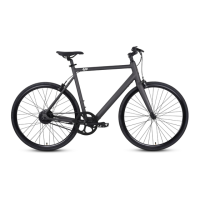
The Ride1UP Roadster V2 is an e-bike designed for use on paved roads and paths, offering an assisted cycling experience. It combines traditional bicycle mechanics with electrical components to provide pedal assistance and, in some models, a throttle for added power. The e-bike is intended for riders aged 18 and over, with a maximum permitted overall weight (rider + cargo) of 275 lbs.
The primary function of the Ride1UP Roadster V2 is to provide electric pedal assistance, making cycling easier and more accessible, especially for longer distances or uphill climbs. The e-bike features a motor that engages when the rider pedals, offering varying levels of assistance controlled via an LCD display. Some models may also include a throttle for on-demand power without pedaling. The electrical system is powered by a rechargeable lithium-ion battery, which is integrated into the bike's frame. The bike is equipped with standard bicycle components such as brakes, gears (if applicable), and a drivetrain, allowing it to function as a regular bicycle even without electrical assistance. Safety features include front and rear lights, as well as reflectors, which are crucial for visibility, especially during night riding.
Operating the Ride1UP Roadster V2 involves several key steps and considerations. Before riding, it is essential to ensure the bike is properly assembled and all nuts and bolts are securely tightened. The e-bike system is switched on and off by holding an orange button on the LCD display for 2 seconds. For safety, it is recommended to turn on the e-bike only after straddling the frame and to turn it off before dismounting. This minimizes the risk of unintentional acceleration if the pedals are bumped while the bike is powered on and in an assistance level of 1 or higher.
The pedal assist system (PAS) allows riders to choose from multiple levels (typically 1 to 5) to adjust the amount of motor assistance received while pedaling. Increasing the PAS level provides more power from the motor. The e-bike also features a walk assist function, activated by pressing and holding the down button, which is useful for maneuvering the bike up hills or through grass when walking alongside it. If the e-bike is parked for more than 10 minutes, the system automatically switches off to conserve battery.
The LCD display provides important information such as speed, battery level, and PAS level. It also allows for customization, such as switching between kilometers per hour (KM/H) and miles per hour (MPH). This setting can be accessed by turning on the display and, within 10 seconds, pressing and holding the 'M' button to enter the settings menu.
Regular maintenance is crucial for the safety, performance, and longevity of the Ride1UP Roadster V2. Owners are responsible for ensuring proper assembly and inspection of all components, especially the tightening of nuts and bolts. It is highly recommended to have the bike inspected or assembled by an experienced bike mechanic prior to first use.
Brake safety is paramount, requiring regular checks for wear and tear and functionality. Before each ride, a quick visual check and test of the brakes should be performed, and any worn parts must be repaired or replaced immediately. Riders should practice emergency stops in a safe area to become comfortable with the e-bike's braking characteristics, noting that wet weather reduces braking power and increases stopping distances.
Tire pressures should be checked regularly, adhering to the correct psi range indicated on the tire sidewalls, and tire tread depth should also be monitored. After any accident or crash, the e-bike must be taken to a bike repair specialist for a thorough inspection, as damage may not always be visible. Any signs of cracks, scratches, or changes in coloring in highly stressed areas indicate that the part has reached its life expectancy and should be replaced immediately.
Battery care is a critical aspect of maintenance. The battery should always be charged in an ambient temperature, on a non-flammable and dry surface, away from heat, humidity, or flammable materials, and never covered. It is important not to leave the battery unattended while charging or store it connected to the charger. If a spark is observed during charging, the charging port and charger tip should be inspected, and support contacted. When charging, the bike should be turned off, and the charger plugged into a wall socket before connecting it to the bike's charging port. The charger's LED indicators will show red when charging and turn green when fully charged. It typically takes 2-4 hours for a full charge with the standard charger. For extended battery life, it is recommended to charge the battery to 80% and use it until it reaches 20%. For long-term storage, the battery should be kept with a 40-80% charge and checked monthly, recharging to 40-80% if it drops below 25%. Recommended storage temperatures are 50°-77°F in a dry area. The charger port cover should always be closed when not charging to prevent moisture ingress, which can damage the battery.
In case of electrical component issues, the LCD display will show an error code. Owners should refer to the provided error code troubleshooting table to identify the fault description and suggested checking method. For any warranty claims, it is essential to contact Ride1UP support with appropriate photos and/or videos of the issue. Professional assembly is required to uphold the limited warranty, and proof of professional assembly or a post-assembly sign-off by a bike professional may be required.
 General
| Battery Capacity | 252Wh |
|---|---|
| Range | 20-35 miles |
| Top Speed | 24 mph |
| Weight | 33 lbs |
| Frame | 6061 Aluminum Alloy |
| Gears | Single Speed |
| Max Load | 275 lbs |
| Wheel Size | 700c |
| Battery | 36V Lithium-ion |
| Brakes | Tektro Dual Pivot Brakes |
| Tires | 700x28c |
| Pedal Assist Levels | 5 |
| Display | LED Display |

 To Next Page