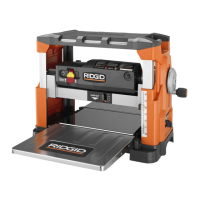
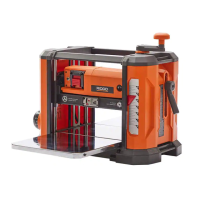
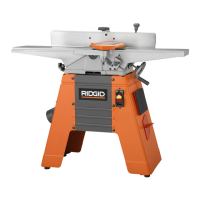
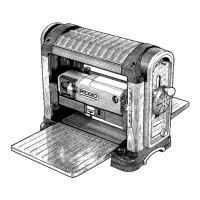
This document is an operator's manual for a 13-inch thickness planer, model R4331, manufactured by RIDGID. It provides comprehensive instructions for the safe operation, assembly, adjustment, and maintenance of the tool.
The primary function of this thickness planer is to size workpieces to a desired thickness while creating a smooth, level surface. It achieves this by removing material from lumber through a rotating cutter head equipped with adjustable blades or knives. The planer is designed for planing the surface of a piece of lumber.
Usage Features:
The planer is equipped with several features to enhance its usability and performance. It has a powerful 15 amp motor designed to handle tough cutting jobs. The automatic feed system, consisting of infeed and outfeed rollers, moves the wood through the planer, ensuring consistent material removal.
The depth adjustment crank handle is used to raise and lower the cutter head assembly, allowing the user to set the desired planing depth. A key feature is the IND-I-CUT™ depth gauge, located on the front of the planer, which indicates the amount of wood to be removed in a planing pass, up to 1/8 inch. This helps users make precise adjustments. For repetitive planing tasks, the REPEAT-A-CUT™ feature, located on the right side of the planer, offers preset measurements, allowing for consistent thickness across multiple workpieces.
To minimize snipe (depressions at the ends of a workpiece), the planer includes a SURE-CUT™ Carriage Lock. This lock helps stabilize the cutter head, reducing imperfections. The thickness scale on the planer accurately displays the height of the cutter blades, up to a maximum of 6 inches, providing a quick visual reference for workpiece thickness.
For dust management, the planer has a dust guide to which a 2-1/2 inch shop vac hose can be attached. This helps minimize sawdust accumulation on the workpiece and in the work area.
The planer's power switch assembly includes a switch key, which serves as a safety feature. When the key is removed, the planer cannot be accidentally started, preventing unauthorized or hazardous use. Infeed and outfeed table extensions are provided to support longer workpieces. These extensions can be folded upright for easy storage and must be leveled with the planer table for accurate planing.
The manual emphasizes several planing tips for optimal results. It recommends planing both sides of a workpiece to achieve uniform moisture content and prevent warping. For rough workpieces, it suggests using a surface planer or jointer first to create an initial flat surface before using the thickness planer. Users are advised to make several light cuts for workpieces with significant thickness variations to achieve a finer finish.
The planer is designed to handle sound lumber, free from loose knots, nails, screws, stones, or other foreign objects that could damage the blades. It is crucial to feed the workpiece in the direction of the grain to prevent tearing of wood fibers and blade chipping.
Maintenance Features:
The manual outlines several maintenance procedures to ensure the longevity and optimal performance of the planer. Regular cleaning is essential; sawdust buildup can interfere with normal motor ventilation and lead to inaccurate planing. The motor should be blown out or vacuumed frequently. The dust hood should be cleaned after each use, and the planing table surface should be waxed to ease workpiece movement.
The cutter blades are double-edged and can be turned to use the opposite, unused edge before requiring replacement. The manual provides detailed instructions for blade adjustment and replacement, emphasizing the use of heavy leather gloves and caution due to the sharpness of the blades. It also advises checking the feed rollers for resin buildup and cleaning them with a mild, nonflammable tar and pitch remover to prolong their wear.
The thickness scale alignment should be routinely checked and adjusted if necessary to ensure accurate cuts. The brush assemblies, located at the right front and left rear of the planer, are externally accessible and should be inspected every 10 to 15 operating hours for wear. Replacement is recommended when either brush has less than 1/4 inch of carbon remaining.
The planer's bearings are permanently lubricated and do not require further attention. The universal motor is designed for easy maintenance, provided it is kept clean and free from water, oil, or sawdust.
For safety, the manual stresses the importance of periodically inspecting tool cords and extension cords for damage and replacing them immediately if any is found. It also advises against modifying the tool or using non-recommended accessories. In the event of a motor overload, the planer is equipped with an overload protector device that automatically shuts down the motor. The user must allow the motor to cool for 15-30 minutes before manually resetting the protector.
The manual also includes a troubleshooting section to help users diagnose and resolve common issues such as snipe, torn grain, uneven depth of cut, and motor problems. It recommends seeking service from an authorized service center for complex repairs to ensure safety and reliability. For convenience, a magnetic blade wrench is provided and can be stored on the left side panel of the planer. The power cord can be wrapped around the planer for storage when not in use.



 To Next Page
 General