This document serves as the user manual for the MIG 135E welding machine, an inverter welder designed for various welding applications. It emphasizes safety, proper operation, and maintenance to ensure user safety and optimal performance.
The MIG 135E welding machine utilizes advanced inversion technology, which transforms the standard power frequency (50Hz/60Hz) into direct current and then inverts it into high frequency using high-power devices. This process involves voltage-drop and commutation with an output high-power D.C. power supply via Pulse Width Modulation (PWM). This inversion technology significantly reduces the machine's weight and volume while increasing conversion efficiency by over 30%.
The machine is specifically designed for self-shielded flux-cored welding. It incorporates a unique electronic reactor circuit that precisely controls short-circuiting and mixed transfer, leading to superior performance compared to traditional silicon-controlled or tapped welding machines. Key advantages of the MIG 135E include a stable wire feed rate, portability, energy efficiency, and electromagnetic noise-free operation. Users can expect less spatter, easier arc starting, a deep welding pool, and a high duty cycle. The synergic design of this equipment makes it highly efficient and power-saving, suitable for both family use and diverse metal or technique demands.
For safe operation, the manual outlines critical personal protection precautions. Installation, operation, maintenance, and repair must be performed by qualified professionals or individuals with relevant knowledge and skills. Personal protective equipment (PPE) such as protective masks, overalls, insulating gloves, and shoes are mandatory. Fire extinguishing equipment should be readily accessible. Defective cables must be repaired or replaced immediately. Users should never view the arc without appropriate shaded lenses. Supervisors are required for work in high-altitude or confined spaces like boxes, boilers, or cabins, where adequate ventilation and constant observation are essential. Individuals with cardiac pacemakers should consult a physician before approaching the power source or welding areas. The power source must not be used for pipeline thawing, battery loading, or motor start-up.
Operational safety guidelines further detail precautions against electrical shock, fumes and gases, welding sparks, arc rays, and electric and magnetic fields. To prevent electrical shock, all working materials must be grounded, and "live" electrical parts should never be touched. Worn or damaged parts must be repaired or replaced. Users should wear dry insulated boots and dry leather gloves. The power source must be disconnected before any maintenance or service. Electrodes should never be changed with bare hands or wet gloves, nor should electrode holders be cooled in water. Holding the electrode and holder under the arm is prohibited. Working in moist or damp areas should be avoided; if unavoidable, the floor near the operating table must be covered with a rubber insulation pad.
Regarding fumes and gases, sufficient ventilation is always required in confined spaces. Fumes from welding certain metals can be harmful, so users should avoid breathing them in. Additional precautions are necessary when welding materials like stainless steel, nickel, nickel alloys, or galvanized steel. Keeping one's head out of the fumes rising from the arc is crucial. If natural or forced ventilation is insufficient, a respirator should be worn.
Welding sparks pose a risk of fire or explosion. Welding operations should not be carried out in degreasing, cleaning, or spraying areas. Welding or cutting gas-filled pipes, sealing grooves (boxes), or other devices is prohibited due to explosion risks. Welding or cutting near flammable gases or substances is also forbidden. When not welding, ensure no component in the wire circuit contacts the workpiece or earth to prevent overheating and fire. When stopping welding, remove the electrode from the pliers or cut the welding wire from the torch nozzle.
Arc rays can burn eyes and injure skin. Users must wear a hat, safety glasses, ear protection, and button their shirt collar. A welding helmet with the correct filter shade is essential. Protective barriers should be set around the welding site to prevent arc or welding spatter from injuring others.
Electric and magnetic fields also require attention. Individuals with cardiac pacemakers should not approach the power source or welding workplaces without a physician's permission. Welding cables must never be placed or wrapped around the body. The body should not be positioned between the welding wire and the workpiece cable; if the welding wire cable is on the right side, the workpiece cable should also be on the right side.
Noise produced during welding can cause hearing loss, so prescribed protective equipment should be worn. Hoisting the power source requires specific attention: it should not be lifted by a strap or hand if equipped with one. When using a forklift, the power source must be fork-fitted and fixed from the side to prevent dumping. When using a crane, the cable should be tied to the suspension ring, with the angle between the cable and the vertical direction not exceeding 15 degrees. If the power source includes a cylinder and wire feeder, these must be unloaded first. When moving the power source on the ground, the cylinder must be fixed with a strap or chain to prevent injury. If the wire feeder is hoisted by lifting lugs, it must be firm and insulated.
The manual explicitly states that no equipment or parts should be altered or changed from the standard specification without written permission from the company, as doing so will void the equipment warranty.
Installation of the MIG 135E involves connecting the output cable and, optionally, installing braces. The machine is designed for flux-cored welding, with the torch and earth clamp pre-fixed. It features a power voltage compensation device, allowing it to operate normally even with power voltage fluctuations of ±15% of the rated voltage. For long cables, a larger section cable is recommended to reduce voltage drop, as excessively long cables can affect arcing performance and other system functions.
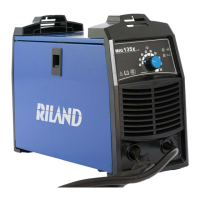
Operating functions are detailed, including the control panel and its components. The adjusting knob is used to set the welding current. The power source is synergic, meaning it automatically matches the feeding speed once the current is configured. When the knob points to "stand-by," the machine is in standby mode. An "O.C." (Abnormal Indicator) lights up during an anomaly and turns off once the issue is resolved. The Power Indicator illuminates when input power is connected and the adjusting knob is set to "1" or above. Some machines feature a "Fan as needed" function, where the fan only operates when the internal temperature exceeds a limit and stops when it drops below it.
The operation steps include connecting the power supply, performing wire inching, setting the welding value, and starting welding. For wire inching, the side panel is opened, the wire spool is fixed to the roller (rotating anticlockwise), and the driving roller is matched to the wire type and size. The wire is then inserted through the plastic tube into the driving rollers and pushed to the machine output connector. The driving rolls are then locked. Pressing the torch switch initiates slow wire feeding (8 m/min); releasing it stops the feeding. Users are warned that welding wire exiting the contact tube can injure hands, eyes, or face. The adjusting knob sets the current, and the synergic design automatically adjusts feeding speed. The abnormal indicator flashes for overcurrent and lights up for overheating. For self-shielded flux-cored welding, the earth clamp is connected to the workpiece, and pressing the torch switch starts welding.
The manual also addresses environmental considerations and common problems. The power source should not be used in rain or snow. It should be placed horizontally, with an inclination not exceeding 10°. The storage environment must be clean, protected from sand and dust, and dry, with relative humidity not exceeding 50% at 40°C or 90% at 20°C. The equipment should not be surrounded by heat, fire, or welding spatter. Ambient temperature requirements are -10℃ to +40℃ during welding and -20°C to +55°C during transportation and storage.
Troubleshooting covers common issues like difficult arc starting, output current not matching the rated value, and unstable current. Solutions include checking grounding wire clamp contact, ensuring proper joint contact, verifying power voltage, and addressing potential electrical network interference.
Daily maintenance and checking are crucial for prolonging the unit's lifespan and ensuring smooth operation. Maintenance frequency depends on usage rate and environment. Electrical connections should be checked at least twice a year, and damaged cables repaired or replaced. Oxidized connections should be cleaned and tightened. Inner parts of the machine should be cleaned with a vacuum cleaner and soft brush. Water or moisture must be avoided; if present, the machine should be dried, and insulation condition measured with a megohm meter before use. If stored for a long time, the machine should be returned to its original packing box and placed in a dry environment away from direct sunlight.
Daily checking specifically for the welding torch includes inspecting the loophole for proper installation and distortion, checking for splash, and ensuring the electric hole is fixed and not damaged or blocked. For the wire sending tube, checks include the extended size of the pipe, matching wire diameter to tube inner diameter, and inspecting for partial winding or extension. Cable checks involve the torch cable (for over-bending or loose metal connecting points), output cable (for insulation wear, naked connecting heads, or loose connections), input cable (for fixed power supply input, protective equipment input, and output end, reliable security equipment cable connection, fixed power input end cable, and worn/bare conductor), and earth cable (for breakage or loose connections to the power supply and main part).
The troubleshooting section emphasizes that only authorized repair agents with valid certifications should perform repairs and internal servicing. It provides remedies for fault symptoms such as the power indicator not lighting up with no welding output, the power indicator lighting up with no welding output, and the power indicator lighting up with an abnormal indicator. These remedies range from checking power cord connections and electric wire nets to inspecting heat-variable resistors, power panels, silicon bridges, and control circuits. For an illuminated abnormal indicator, solutions include waiting for overheating protection to reset, or checking for inverter circuit faults and damaged IGBT board fieldistors or transformer components.


 To Next Page
 General