Need help?
Do you have a question about the RM Italy KL506 and is the answer not in the manual?
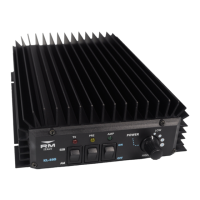
The KL506 is a high-frequency (HF) 10-meter linear amplifier designed for amateur radio use, capable of operating across the 1.8-30MHz range with a low-pass filter. Its primary function is to amplify RF signals, boosting output power for various narrowband modulation types including SSB, CW, AM, and FM.
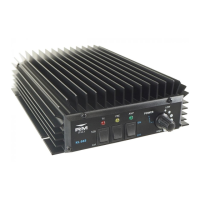
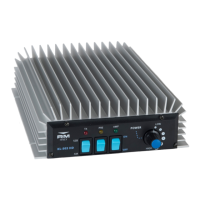
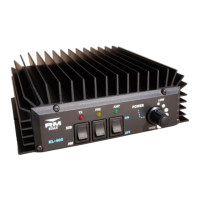
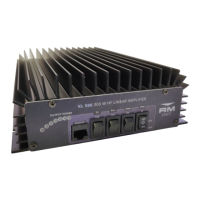
The KL506 features a front panel with controls for output power level display, remote control port, SSB delay switch, amplifier ON/OFF switch, and input power attenuator. LED indicators show the selected output power level (Green for Low, Orange for Medium, Red for High) and preamplifier status.
A remote head, not supplied, can be connected via an RJ45 port (cable length max 3m) to replicate front panel functionality. Remote control pin functions include:
The amplifier should be installed in a well-ventilated area to prevent overheating. A short 50 Ohm patch cable connects the RTX input (SO239) to the transceiver's output. The ANT output connects to an SWR Bridge/Wattmeter (if used), then to the antenna. The antenna must be rated for at least 500W power handling and tuned before connecting the amplifier. The amplifier requires a suitable 13.8VDC (±1V) 50A power supply or auto battery, with correct polarity. Cables connecting the amplifier to the PSU should be at least 10mm² (7 AWG) and kept as short as possible to minimize voltage drop. For mobile installations, leads should not exceed 3m and connect directly to the auto battery, with an additional inline fuse for protection.
Before use, ensure the amplifier is switched off. Adjust the transceiver's RF output power to 7W (10W max). The amplifier does not have protection against excessive input power, so avoid overdriving it beyond 10W. Optimal performance is achieved with about 7W input on the 10m band. The input attenuator can be used to reduce the amplifier's output if needed, offering three levels (Low, Medium, High power).
The amplifier is designed for a 50-ohm resistive load. If using an antenna outside this requirement, an antenna tuning unit (ATU) is necessary. VSWR should be less than 1.5:1 for optimal performance; values up to 2.0:1 are acceptable but may reduce power and increase heat. The amplifier has no protection against excessive VSWR. Use good quality, short 50 Ohm feeder cables to minimize losses.
The KL506 supports SSB, CW, AM, FM, SSTV, and data modes. In SSB mode, if an external PTT input is not connected, the front panel switch should be set to SSB to add a delay to the RTX relays, preventing dropout during speech pauses. For AM or FM, the SSB delay switch should be set to AM.
The built-in RX preamplifier can be activated to boost received signal levels, improving intelligibility. It operates independently of the amplifier but is automatically switched out of line during transmission. An LED indicates when the preamp is active.
The KL506 features an active-low PTT input on the rear panel (RCA/Phono socket). Shorting the center pin to ground triggers the RTX relay. If left unconnected, the amplifier uses an RF sense circuit (similar to VOX) to automatically switch to TX when RF is applied to the input connector. Connecting the PTT input to the transceiver's PTT output is recommended, especially for SSB operation.
While designed for the 10m amateur band (28.000-29.700MHz), the amplifier offers useful gain across 160m to 10m. However, it lacks low-pass filtering. When operating on other HF bands, a suitable external low-pass filter is essential to suppress harmonic output, prevent interference, and comply with regulations. Gain increases on lower bands, requiring less input power for the same output level. Adjust drive accordingly to avoid overdriving, ensuring input to the amplifier does not exceed 10W.
The KL506 comes with a 24-month warranty against manufacturing defects from the date of purchase. This warranty does not cover RF transistors, external damage, or aesthetic damage.
A suitable ground system for both RF and AC power supply is crucial for safety and to prevent returned RF from causing equipment problems. Poor grounding can lead to erratic operation during transmission. Mobile installations require good bonding to the vehicle chassis ground.
For high duty cycle modes like FM and Data, continuous operation should be avoided to prevent excessive transistor junction temperature. Transmission times should be limited to a few minutes, and sufficient cooling time should be allowed if the heatsink becomes too hot.

 To Next Page
 General