
 Need help?
Do you have a question about the Roberts duologic and is the answer not in the manual?
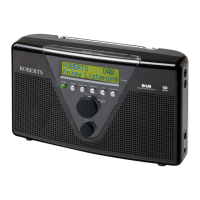
Identifies all controls on the front panel of the radio, including buttons, display, and indicators.
Details the headphone socket, auxiliary input, USB, and DC power input sockets located on the radio.
Instructions for inserting four LR20 (D size) alkaline batteries and setting the battery switch.
Importance of setting the battery switch correctly and understanding the charge indicator light.
Recommendations for removing batteries for extended periods and optimal power source usage.
Guide to inserting NiMH/NiCad batteries and connecting the mains adaptor for charging.
Explanation of the charge indicator light flashing green and steady green for charging status.
Important warnings about heat exposure and proper disposal of rechargeable batteries.
Steps to connect the mains adaptor plug to the radio and mains socket for power.
How batteries are disconnected when the AC adaptor is in use.
Important notes on keeping the mains socket accessible and disconnecting the adaptor.
How to extend the aerial, switch on, and perform an initial scan for DAB stations.
Understanding the scanning progress, station selection, and 'No stations available' message.
Advice on relocating the radio for better signal reception if stations are not found.
Using the Tuning control to scroll through available DAB stations and select one.
How to adjust volume and what to do if a station is 'Not Available'.
Note directing users to page 17 for information on using radio station presets.
How to use the Info button to cycle through various display options for DAB.
Details of display modes: scrolling text, program type, multiplex name, time/date, frequency, bit rate, and signal strength.
Instructions for using the Auto Tune button to find new DAB stations, including quick and full scans.
How station counts increase and stations are added to the list during a scan.
How to identify, select, and return from secondary DAB radio services.
How to manually tune to specific DAB channels using the Info and Tuning controls.
How signal strength is displayed and how multiplex names are shown during manual tuning.
How to display signal strength and use it to position the radio for optimal reception.
Steps to adjust DRC settings (0, 1/2, 1) to manage audio loudness differences.
Information on how DRC affects sound and its dependence on broadcast support.
How to select the FM band and use the Auto Tune button to scan for stations.
Understanding upward/downward scanning, displaying station frequency, and RDS data.
Setting the required volume and a reference to preset station selection on page 17.
Instructions for tuning to FM stations using the Tuning control, changing frequency by 50 kHz.
How to adjust the volume and switch off the radio after manual tuning.
How to use the Info button to cycle through display options in FM mode.
Details of display modes: scrolling text, program type, time/date, frequency, and audio mode (stereo/mono).
Instructions to store one favourite DAB or FM station by pressing and holding the Favourite button.
How the display confirms that 'My Fav. saved' successfully.
How to automatically tune to the stored favourite DAB or FM station by pressing the Favourite button.
How to store preferred DAB or FM stations as presets by using the Preset button.
How to view only preset stations and select one using the Tuning control.
How to exit the preset view to access the full station list again.
How to switch to Mono mode to reduce hiss on weak FM stations.
How to return the radio to Auto (Stereo) mode for FM reception.
How to select 'Local' or 'Distant' scan zones to find stronger or weaker FM signals.
Explanation of how Local and Distant settings affect signal reception during auto-scan.
How to view the radio's current software version using the Info and Tuning controls.
How the software version is displayed after navigating the menu.
Steps to perform a factory reset, which restores settings and erases presets.
Advice on resetting the product for malfunctions due to electrostatic discharge.
Information that a DAB scan is performed automatically after a system reset.
Details on the 3.5mm headphone socket for private listening and automatic mute of the loudspeaker.
How to connect external audio sources (CD, MP3) via the Auxiliary input socket.
Steps to select and cancel the Auxiliary Input mode using the DAB/FM button.
Importance of setting the battery switch correctly for Alkaline or NiMH/NiCad batteries.
Warnings against mixing old/new or different types of batteries to prevent damage and ensure performance.
Information on safe charging, battery protection, and optimal performance recommendations.
Understanding the flashing and steady green charge lights and typical charging duration.
How the charge indicator behaves when using batteries or when charging rechargeable batteries.
Recommendations for storing batteries and handling rechargeable batteries for longevity.
Crucial safety guidelines to prevent battery leakage, overheating, explosion, and injury.
How the display backlight behaves when powered by batteries versus AC mains.
Information on future software updates, registration, and where to find upgrade information.
Important advice on environmental conditions, ventilation, and placement to protect the radio.
Technical details including power requirements, battery life, frequency coverage, and speaker output.
Details on loudspeaker size, output power, socket types, and aerial system.
Details of the 12-month guarantee, exclusions, and the procedure for making a claim.
Contact information for technical support and service department for guarantee claims.
 General
| Brand | Roberts |
|---|---|
| Model | duologic |
| Category | Portable Radio |
| Language | English |



 To Next Page