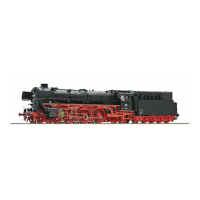
Voreingestellte Adresse: DCC/NMRA / Motorola
®
: 03
Die CV-Werte (DCC) bzw. Register-Werte (Motorola
®
) der Tabelle gelten nur
für den Sound-Decoder der „BR 012, DB“.
Der Sounddecoder wurde optimal auf diese Lok eingestellt. Dennoch können
Sie viele Decoder-Eigenschaften Ihren Wünschen anpassen. Dazu lassen sich
bestimmte Parameter (die so genannten CVs – Conguration Variable – oder
Register) verändern.
Beachten Sie dazu die Kapitel „Einstellmöglichkeiten im DCC-Digitalbetrieb“
und „Einstellmöglichkeiten im Motorola
®
-Digitalbetrieb“ in der Soundde-
coder- Betriebsanleitung. Prüfen Sie aber vor jeder Programmierung, ob diese
tatsächlich notwendig ist. Falsche Einstellungen können dazu führen, dass der
Decoder nicht richtig reagiert.
Für einen hohen Fahrkomfort ist der Decoder werkseitig auf 28 Fahr-
stufen vorprogrammiert. Damit ist er mit allen modernen DCC- (wie
Z21
®
, MULTIMAUS
®
und
Lokmaus 2) und Motorola
®
-Steuergeräten einsetzbar.
Hinweis: Setzen Sie den Decoder auf Lokmaus 1-Anlagen ein, können Sie
das Fahrgeräusch über die Horntaste abrufen. Für eine korrekte Lichtfunktion
muss der Decoder jedoch auf 14 Fahrstufen umprogrammiert werden.
Beachten Sie dazu die Lokmaus-Handbücher oder fragen Sie Ihren
Fachhändler.
Bei diesem Decoder der neuesten Generation ist eine stärkere Verknüpfung
von Fahr- und Sound-Abläufen vorhanden: So setzt sich die Lok bei einge-
schaltetem Sound (Funktionstaste «F1» aktiviert) vorbildentsprechend erst
dann in Bewegung, wenn die Sound-Sequenz «Dampf kochen» vollständig
abgeschlossen und der Zustand «Dampfdruck betriebsbereit» erreicht ist.
Umgekehrt wird die Sound-Sequenz «Dampfdruck absenken» nur dann nach
erneuter Betätigung der Funktionstaste «F1» (jetzt «Sound aus») ablaufen
und anschließend in den Zustand «Ruhefeuer» übergehen, wenn die Lok
beim Betätigen der Taste «F1» bereits zum Stehen gekommen ist. Ein schnel-
les Ein- oder Ausschalten des Sounds über die Taste «F1» ist somit nur dann
möglich, wenn die Lok schon bzw. noch in Bewegung ist. Das momentane
oder dauerhafte (= „Durchläuten“) Aktivieren des Signales der Lok erfolgt
ausschließlich nur durch Einschalten der Funktion, da die Programmierung der
Funktionstaste als Schalter («ein»/«aus») und nicht als Taster (Taste gedrückt
= Funktion ausgelöst, Taste losgelassen = Funktion aus) ausgelegt ist (dies ist
bei bestimmten Sounds als „Durchläutesignal“ nötig).
Das bedeutet: Ein zweiter Signalton kann erst nach einer 2. Betätigung der
Funktion («Signalton aus») ausgelöst werden.
Gesamtablauf der Funktion :
1. Tastendruck = «Signalton ein», 2. Tastendruck = «Signalton aus»,
3. Tastendruck = «Signalton ein», 4. Tastendruck = «Signalton aus», etc.!
Default address: DCC/NMRA / Motorola
®
: 03
The values for CV (DCC) or Register (Motorola
®
) showing in the table are only
obtained for the Sounddecoder of the “BR 012, DB“.
The Sounddecoder was optimized for this locomotive. However, many of
the decoder properties can be adjusted to meet your specic needs. Certa-
in parameters (the so-called conguration variables [CVs] or registers) are
used for this purpose. Please consult the chapter “Adjustment Options with
DCC Digital Mode“ and „Adjustment Options with Motorola
®
Digital Mode“
of the included Sounddecoder operating manual for further details. Before
starting any type of programming, please make sure that this action is really
necessary. Wrong settings may cause the decoder to respond incorrectly.
The decoder is factory-set to 28 running steps for optimal traveling com-
fort. This means the decoder can be used with all modern DCC (e.g. Z21
®
,
MULTIMAUS
®
and Lokmaus 2) as well as Motorola
®
control units.
Note: The running sound can be triggered with the horn button when using
the decoder with Lokmaus 1 systems. However, the decoder must be reset to
14 running steps in order for the light function to work properly. Please con-
sult the Lokmaus manuals for further details or contact your retailer.
A stronger link between driving and sound sequences is available in the case
of this newest generation sound decoder: therefore the engine will not start
to move correspondingly when the sound model is switched on (‘F1’ func-
tion key activated) until the ‘placing in service’ sound sequence is completely
closed and ‘Steam Pressure Ready for Operation’ status has been reached.
Conversely, the ‘Lower Steam Pressure’ sound sequence will then only run and
subsequently convert to the ‘Self Fuel’ status, following the operation of the
‘F1’ function key (now: ‘Sound Off’) again, if the engine had already stopped
when the ‘F1’ key was operated. Therefore, switching the sound on or off
quickly by means of the ‘F1’ key will only be possible if the engine is already
or still in movement. The momentary or longterm (= ‘Sounding Through’) ac-
tivation of the signal of the engine will take place exclusively by switching on
the function, because the programming of the function has been designed as
a switch (‘on/off’), not as a key (key pressed = function triggered: key released
= function off); this is necessary as a ‘sounding through signal’ in the case of
certain engine sounds.
This means that a second signal sound can only be triggered after the second
operation of the function.
The whole sequence of the function is:
1
st
switch pressure = signal tone one, 2
nd
switch pressure = signal tone off,
3
rd
switch pressure = signal tone on, 4
th
switch pressure = signal tone off, etc.
Adresse programmée en usine: format «DCC» du NMRA / Motorola
®
: 03
Les coëfcients suivants des variables «CV» au format «DCC» respectivement
des «régistres» au format «Motorola
®
» furent programmés en usine et ne
sont valables que pour le décodeur spécial «BR 012, DB».
Les différentes variables du décodeur ont été optimalisées en usine pour cette
machine. Vous avez néanmoins la possibilité de modier un grand nombre
des caractéristiques techniques selon votre gré. Pour cela, vous pouvez mo-
dier certains paramètres (variables de conguration CV ou registres). Des
8070341940 I_2022.indd 18070341940 I_2022.indd 1 25.01.2022 11:44:0925.01.2022 11:44:09


 To Next Page
 Loading...