
 Need help?
Do you have a question about the RODE Microphones NT1A-MP and is the answer not in the manual?
Graph detailing the microphone's frequency response from 20Hz to 20,000Hz.
Diagram illustrating the microphone's directional pickup patterns at various frequencies.
Instructions on connecting and providing phantom power (P48/P24) to the NT1-A.
Guidance on using the popshield and positioning for optimal vocal recordings.
Techniques for miking guitar/bass amplifiers, including off-axis placement.
Methods for capturing piano sound with single or stereo microphone setups.
Recommended positions for single microphone placement and multi-mic techniques.
Approaches for miking drum kits using single or stereo overhead techniques.
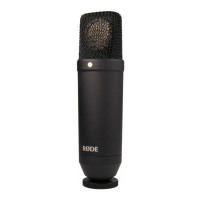
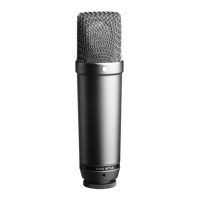
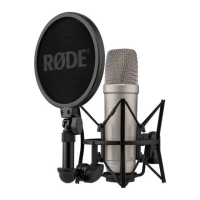
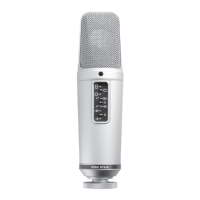
The RØDE NT1-A is a studio condenser microphone designed for professional vocal recordings and a wide range of other instruments. It is marketed as the 'Complete Vocal Recording Solution' due to its comprehensive package and high-quality performance.
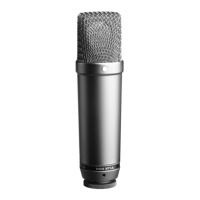
The NT1-A functions as a high-quality studio condenser microphone, capturing sound with exceptional clarity, warmth, and an extended dynamic range. Its core design incorporates an externally polarized 25mm (1") condenser capsule and JFET impedance converter with a bipolar output buffer, contributing to its ultra-low noise transformerless circuitry. This advanced electronic design, coupled with state-of-the-art surface mount electronics, allows the microphone to deliver a clean and transparent sound, making it suitable for demanding recording environments. The microphone's cardioid polar pattern is indicated by a gold dot on its face, which signifies the front of the microphone and its primary pick-up area. This directional characteristic ensures that the microphone primarily captures sound from the source it is pointed at, while rejecting off-axis noise, which is crucial for focused recordings.
The NT1-A is versatile enough for various recording applications beyond vocals, including acoustic and electric instruments, as well as percussion. Its ability to handle high Sound Pressure Levels (SPL) makes it robust for capturing loud sources without distortion, a feature often found in more expensive microphones. The microphone requires phantom power, specifically P48 or P24 volts, to operate. It is essential to connect all cables before applying power and to never remove the microphone cable while power is connected to prevent damage. The use of a reputable, high-quality power supply is strongly recommended to ensure optimal performance and prevent potential damage not covered by the warranty.
The NT1-A is designed for ease of use while offering professional-grade results. For vocal recordings, the supplied popshield attachment is strongly recommended. This accessory is crucial for minimizing plosive sounds (such as hard 'P', 'B', 'T', and 'K' sounds) that can create sudden jets of air, potentially overloading the microphone capsule and producing undesirable 'popping' sounds. The pop shield also helps to reduce the risk of moisture reaching the microphone capsule, which can cause problems for condenser microphones.
Microphone placement is key to achieving desired sound quality. The gold dot on the microphone indicates the front, and it should always face the sound source. Experimentation with microphone technique is encouraged. A good starting point for recording is to set the channel EQ to 'OFF' or 'FLAT' and adjust the sound by manipulating the acoustic environment, such as placing reflective or absorbent panels around the source. Changing the room's acoustic properties is often more effective than relying solely on EQ. Once the desired sound is achieved acoustically, EQ and effects like reverb can be used sparingly for enhancement. It's also noted that 'cutting' a particular frequency can sometimes be more effective than 'boosting' another, as boosting can increase noise levels.
For vocalists, the placement of the microphone and pop shield relative to the performer can vary based on factors like room acoustics, vocal performance, and voice type. A recommended starting point is to position the pop shield directly in front of the vocalist, approximately 15cm (6") away from the microphone. This helps maintain a consistent distance and reasonable recording levels. Experimenting with 'off-axis' angles (where the vocalist is not directly facing the gold dot) can also yield different sonic results.
When recording electric guitar or bass amplifiers, the microphone can be placed close to the loudspeaker, directed slightly off-axis. If a PAD (attenuator) is not available, moving the microphone further from the speaker may be necessary to avoid distortion at loud volumes. For piano recording, a single microphone can be placed approximately 60cm (2') above the center of the soundboard, aimed slightly towards the front. For stereo piano recording using a matched pair of NT1-As in an X/Y configuration, the microphones should be angled 90-110 degrees to each other over the hammers, with one mic aimed at the lower strings and the other at the higher strings, both facing the piano. This setup creates an effective stereo image with lower frequencies on the left and higher frequencies on the right.
For acoustic guitar, a common single microphone position is 20-30 centimeters from where the neck and body meet. Adjusting this distance and position allows for fine-tuning the response based on the instrument, playing style, and desired sound. An alternative technique involves combining a small capsule microphone (like the NT5 or NT55) close to the guitar with an NT1-A placed about a meter away. The individually captured sounds can then be mixed.
Drum recording offers several techniques. For a single overhead microphone, it's suggested to place the mic above the direct center of the kit at a height equal to the kit's width, with the gold dot facing down. For two overhead microphones, they should be placed at a similar height, approximately 1-2m (3-6') apart, and generally equidistant from the snare drum. For an X/Y stereo technique with a matched pair, the microphones are placed in the single mic position, with their gold dots pointing down and angled 90-110 degrees to each other.
Proper storage and care are essential for maintaining the NT1-A's performance and longevity. After each use, the microphone should be removed from its shock mount, wiped with a dry, soft cloth, and placed in the supplied protective sleeve/dust cover. If the microphone is used regularly, it is still strongly recommended to cover it with the protective sleeve/dust cover, even while it remains in the shock mount.
A critical maintenance feature involves the moisture-absorbent crystals supplied with the microphone. These crystals should be placed at the head of the microphone(s) to absorb any present moisture, which can be detrimental to condenser microphones. Over time, these crystals will absorb moisture and change color from blue to pink, indicating they need to be dried. They can be easily re-used by placing them in an oven at 100-150 degrees Celsius for approximately ten minutes. Once they turn blue again, they will be effective once more.
The NT1-A also comes with a full 10-year guarantee upon online product registration, demonstrating RØDE's confidence in its durability and quality. This warranty covers parts and labor for repairs due to manufacturing defects but excludes damage from normal wear and tear, modification, shipping damage, or misuse contrary to the instruction guide. In case of issues, users are advised to contact their dealer or RØDE directly for support and service.
 General
| Acoustic Principle | Pressure Gradient |
|---|---|
| Type | Condenser |
| Polar Pattern | Cardioid |
| Frequency Response | 20 Hz - 20 kHz |
| Output Impedance | 100Ω |
| Equivalent Noise Level | 5 dBA |
| Weight | 326 g |
| Output Connection | XLR |
| Dynamic Range | 132 dB |
| Power Requirements | 48V Phantom Power |
| Max SPL | 137 dB SPL (@ 1kHz, 1% THD into 1kΩ load) |
| Signal to Noise Ratio | 89 dB |



 To Next Page