17
COMMISSIONING
Before commissioning:
> Make sure that the data plate and the customer specications match.
> Ensure that:
• the electrical connections are correct.
• the Drum Motor turns freely.
• belt tension is suitable to prevent belt slippage.
• the belt is not over-tensioned.
Operation
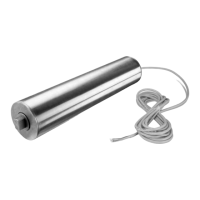
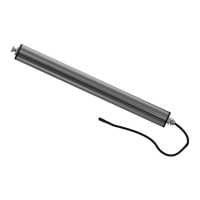
Do not put the Drum Motor into operation unless the machine in which it is to be installed
complies with the Machinery Directive 2006/42/EC.
General Information
Attention!
> Operate the Drum Motor only if:
• it has been correctly installed.
• it has been correctly connected to the power
supply.
• its rotating parts are secured from accidental
contact.
Rotating parts! Moving parts can
crush and cut. Do not reach between the Pulley
and the belt. Operate the Pulley only with a
suitable guard.
> Always operate the Drum Motor with a
conveyor belt.
The conveyor belt must cover at least
2/3 of the shell.
Test run:
1. Attach the shaft of the Drum Motor to a test
frame or conveyer frame.
2. Secure the shell against accidental contact.
3. Start the Pulley.
Ambient Temperature – Heat Dissipation
• Drum Motors are normally cooled by dissipating
heat through contact between the surface of the
Pulley and the conveyor belt.
• The Pulleys are lled with oil to improve heat
dissipation.
> Make sure that there is always a sufcient
temperature difference between the Pulley’s
motor stator and the ambient temperature.
• Drum Motors are designed and tested under
full load without rubber lagging for use in an
ambient temperature of maximum +40 °C.
• In the presence of rubber lagging, transportation
of hot materials, operation with sprockets and/or
ambient temperatures higher than +40 °C, heat
dissipation will be less effective.
• This may result in:
> Motor winding protection being switched off.
> Motor winding burning out due to constant
overtemperature.
> In case of ambient temperatures of lower than
-5 °C and higher than +40 °C, please contact
RULMECA.
Reversing Conveyors
• All Drum Motors are reversible.
> Design the conveyer drive control system so
that the Pulley comes to a standstill before it
starts in the reverse direction.


 To Next Page
 Loading...