Need help?
Do you have a question about the rulmeca RDR BL3 and is the answer not in the manual?
Instructions on choosing and installing RDR BL3 Drive Rollers and how to use the manual.
Alerts to hazards during RDR BL3 use, categorized by severity (Hazard, Warning, Caution).
Essential safety guidelines for installation and use, emphasizing qualified personnel and compliance.
Details risks of personal injury from electrical work, maintenance, and moving parts.
Checks for visible damage, response to faults, and forbidden actions like tampering or dismantling.
Considerations for integrating the RDR BL3 into complex logistic systems and documentation.
Information on how Drive Rollers are packed, tested, and identified with quality control labels.
Factors determining roller pitch and ensuring correct package movement on the conveyor.
Ensuring linear transfer via horizontal alignment and even load distribution on rollers.
Guidance on selecting the Drive Roller and determining the correct gear reduction ratio.
Practical example for Drive Roller selection and formulas for speed unit conversions.
Details on strap transmission and Poly-V belt systems for motion transfer.
Table of Poly-V belts and fitting guidelines for optimal Drive Roller performance.
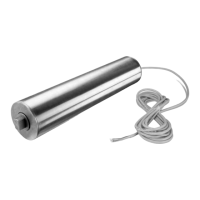
Details various configurations: tube types, lagging, pinion options, and connector types.
Dimensional, environmental, electrical data, and performance specifications for the Drive Roller.
Explains the adhesive label on the Drive Roller and its role in tracing manufacturing data.
Conditions before wiring, safety, and guidelines for selecting a suitable 24VDC power supply.
Techniques to minimize EMI, including filtering, shielding, and proper grounding.
Measures to protect against voltage spikes and surges on the DC supply line.
Recommendations for short circuit protection, including fitting a 5A instantaneous fuse.
Overview of the RDR BL3 Drive Roller's cable, connector, pinout, and wire specifications.
Procedure for operating the Drive Roller using external connections for start/stop functions.
Methods for adjusting speed using voltage signals and potentiometers, with speed tables.
How to change the Drive Roller's rotation direction using a signal input and default behavior.
Explains fault signal output logic and how to connect it to a PLC input via an additional relay.
Details on motor overheating, power limitation, automatic restart, and causes.
Explanation of overload protection due to jams, motor stop, and restart procedure.
Current absorption tables for Drive Rollers with 12:1 and 16:1 reduction ratios.
Current absorption tables for Drive Rollers with 24:1, 36:1, 49:1, 64:1, and 96:1 reduction ratios.
Steps for handling accidents or faults, including emergency stops, first aid, and fault resolution.

 To Next Page
 General