4
2.0 GENERAL INFORMATION
WARNING:
Improper installation, or installation not made in
accordance with these instructions, can result
in unsatisfactory operation and/or dangerous
conditions and can cause the related warranty
not to apply.
2.1 Introduction
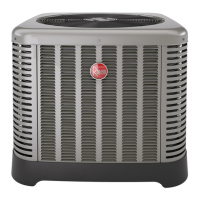
The RD17AZ series heat pumps are specifically
designed to operate with existing indoor air
handlers and furnace coils combinations that use
thermal expansion valves, as well as matching
communicating EcoNet™ enabled air-handlers,
gas furnaces, and Control Center. A conventional
24VAC 2-stage thermostat is used with existing
indoor equipment or matching Rheem air handlers
or furnace and coil combinations. For peak
perfomance, a matching Econet enabled air handler
or gas furnace and Econet Control Center is
recommended.
This installation instruction manual contains
complete instructions for installation and setup
using the EcoNet™ or conventional 24VAC 2-stage
controls. Please refer to the manufacturer's
specification sheets for complete performance
data, thermostat, and accessory listings.
The information contained in this manual has
been prepared to assist in the proper installation,
operation, and maintenance of the air conditioning
system.
Read this manual and any instructions packaged
with separate equipment required to make up the
system prior to installation. Homeowner should
retain this manual for future reference.
2.2 Agency Performance Audit
Testing Notice
For purposes of verifying or testing efficiency
ratings, the test procedure in Title 10 APPENDIX M
to Subpart B of Part 430 (Uniform Test Method for
Measuring the Energy Consumption of Central Air
Conditioners and Heat Pumps) and the clarifying
provisions provided in the AHRI Operations
Manual 210/240 that were applicable at the date
of manufacture should be used for test set up and
performance.
Should this unit be selected for performance audit
testing, follow the instructions included in the
Appendix (Section 12.1) of this manual.
2.3 Importance of Quality
Installation
A quality installation is critical to assure safety,
reliability, comfort, and customer satisfaction. Strict
adherence to applicable codes, the information in
this installation manual, the outdoor unit installation
manual, and the thermostat installation manual
are key to a quality installation. Read the entire
instruction manuals before starting the installation.
IMPORTANT: This product has been designed and
manufactured to meet certified AHRI capacity and
efficiency ratings with the appropriate outdoor
units. However, proper refrigerant charge, proper
airflow, and refrigerant line sizing are critical to
achieve optimum capacity and efficiency and to
assure reliable operation. Installation of this
product should follow the manufacturer’s refrigerant
charging and airflow instructions located in this
installation manual and the charging chart label
affixed to the outdoor unit. Failure to confirm
proper charge and airflow may reduce energy
efficiency and shorten equipment life.
The equipment has been evaluated in accordance
with the Code of Federal Regulations, Chapter XX,
Part 3280.
Install the unit in accordance with applicable
national, state, and local codes. Latest editions are
available from: “National Fire Protection Association,
Inc., Batterymarch Park, Quincy, MA 02269.” These
publications are:
• ANSI/NFPA No. 70-(Latest Edition) National
Electrical Code.
• NFPA90A Installation of Air Conditioning and
Ventilating Systems.
• NFPA90B Installation of warm air heating and air
conditioning systems.
Install the unit in such a way as to allow necessary
access to the coil/filter rack and blower/control
compartment.
2.4 System Sizing and
Selection
Before specifying any heat pump equipment, a
survey of the structure and heat loss and heat
gain calculations must be made. A heat loss
calculation involves identifying all surfaces and
openings that lose heat to the surrounding air in
the heating mode and quantifying that heat loss. A
heat gain calculation makes similar measurements
and determines the amount of heat required to
be removed in the cooling mode. A heat gain
calculation also calculates the extra heat load
caused by sunlight and by humidity removal. These
factors must be considered before selecting a
heat pump system to provide year-round comfort.
General Information


 To Next Page
 Loading...