•
Loosen the bevel lock lever and move the saw arm to the left
to the desired bevel angle.
•
Bevel angles can be set from 0
0
to 45
0
.
•
Align the indicator point with the desired angle.
•
Once the saw arm has been set at the desired angle, se-
curely tighten the bevel lock lever.
•
Place the workpiece flat on the mitre table with one edge
securely against the fence. If the board is warped, place the
convex side against the fence. If the concave edge of the
board is placed against the fence, the board could collapse
on the blade at the end of the cut, jamming the blade.
•
When cutting long pieces of timber or molding, support the
opposite end of the stock with a roller stand or with work
surface level with the saw tabel.
•
Align the cutting line on the workpiece with the edge of saw
blade.
•
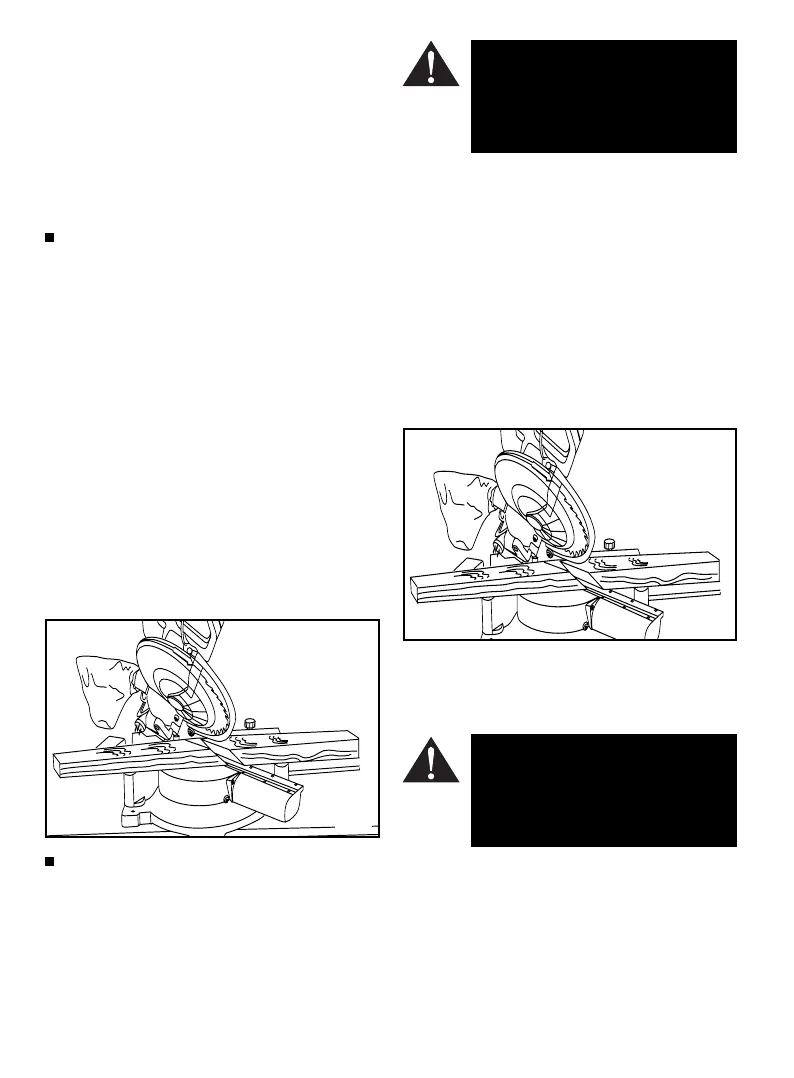
Grasp the stock firmly with one hand and secure it against
the fence. Tighten the vice to secure the workpiece. (Fig .23)
•
Before turning on the saw, perform a dry run of the cutting
operation just to make sure that no problems will occur
when the cut is made.
•
Grasp the saw handle firmly, press the lock-off switch, then
squeeze the trigger switch. Allow several seconds for the
blade to reach maximum speed.
•
Press the laser on/off switch to turn the laser on.
•
Pull the safety lock and then slowly lower the blade into
and through the workpiece.
•
Release the trigger switch and allow the saw blade to stop
rotating before raising the blade out of workpiece.
•
Before turning on the saw, perform a dry run of the cutting
operation just to make sure that no problems will occur
when the cut is made.
•
Grasp the saw handle firmly, press the lock-off switch, then
squeeze the trigger switch. Allow several seconds for the
blade to reach maximum speed.
•
Press the laser on/off switch to turn the laser on.
•
Pull the safety lock and then slowly lower the blade into
and through the workpiece.
•
Release the trigger switch and allow the saw blade to stop
rotating before raising the blade out of workpiece.
COMPOUND MITRE CUT
A compound mitre cut is a cut made using a mitre angle and
a bevel angle at the same time. This type of cut is used to
make picture frames, cut molding, make boxes with sloping
sides, and for certain roof framing cuts.
To make this type of cut the mitre table must be rotated to
the correct angle and the saw arm must be tilted to the
cottect bevel angle. Care should always be taken when mak-
ing compound mitre setups due to the interaction of the two
angle settings.
Adjustments of mitre and bevel settings are interdependent
with one another. Each time you adjust the mitre setting you
change the effect of the bevel setting. Also, each time you
adjust the bevel setting you change the effect of the mitre
setting.
It may take several settings to obtain the desired cut. The
first angle setting should be checked after setting the second
angle, since adjusting the second angle affects the first.
Once the two correct settings for a particular cut have been
obtained, always made a test cut in scrap wood before mak-
ing a finish cut in good wood. (Fig.24)
TO MAKE A COMPOUND CUT WITH YOUR MITRE SAW
•
Pull out the lock pin and lift the saw arm to its full height.
•
Loosen the mitre table lock knob.
•
Rotate the mitre table until the pointer aligns with zero on the
mitre scale.
•
Tighten the mitre table lock knob.
NOTE: You can quickly locate 0˚, 22.5˚ left or right and 45˚ left
or right on the scale. The mitre table can be seated in
one of the poositive stop notches, located in the mitre
tabel frame.
WARNING: To avoid serious personal injury,
keep your hands outside the no hands zone;
at least 75mm from the blade. Never perform
any cutting operation freehand ( without hold-
ing workpiece against the fence). The blade
could grab the workpiece if it slips or twists.
Fig.24
WARNING: To avoid serious personal injury,
keep your hands outside the no hands zone;
at least 75mm from the blade. Never perform
any cutting operation freehand ( without hold-
ing workpiece against the fence). The blade
could grab the workpiece if it slips or twists.
Fig.25
Page 11


 To Next Page
 Loading...