Need help?
Do you have a question about the Sam4s SPS-520 and is the answer not in the manual?
Steps to open the register by assigning a clerk to it for sales.
Instructions for ringing in items, both preset and open priced.
Process for displaying the total, receiving payment, and calculating change.
Procedure for handling payments split between cash and credit.
How to print a receipt after a sale if it did not print automatically.
How to change the default receipt printing setting.
Procedure to apply a discount to the subtotal of a sale.
Using the CLEAR button to remove errors without affecting the sale.
How to void the entire sale and start over.
Removing a single previously entered item from the sale.
Steps for processing an item return after a sale has been finalized.
Instructions for replacing the receipt paper when it runs out.
Procedures for running X, Daily (Z1), and Event (Z2) reports.
Guide to adding or modifying items, including descriptors and pricing.
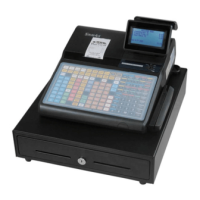
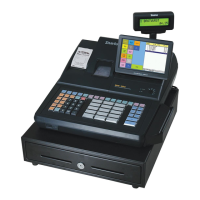
The SAM4S SPS-520 is a point-of-sale (POS) system designed for retail and hospitality environments, offering a comprehensive suite of functions for managing sales, inventory, and reporting. Its user-friendly interface and robust features aim to streamline daily operations, from opening the register to processing complex transactions and generating detailed reports.
The primary function of the SAM4S SPS-520 is to facilitate sales transactions. This includes the ability to ring up items using preset keys on the keyboard or by scanning barcodes, accommodating both fixed-price and open-priced items. The system supports various transaction types, such as single item sales, multiple item sales, and split tender payments, allowing customers to pay using a combination of cash, check, or credit card.
Beyond basic sales, the SPS-520 incorporates features for error correction and transaction management. Users can clear numerical keystrokes made in error, cancel an entire sale if issues arise, or void individual items within a sale before finalization. This flexibility helps maintain accuracy and efficiency during busy periods. The system also supports returns for finalized sales, requiring the original receipt for verification, which helps manage inventory and customer service.
For managerial oversight, the SPS-520 provides robust reporting capabilities. It can generate X-readings for current totals without resetting them, and daily (Z1) or end-of-event (Z2) reports that reset totals for the next operational period. These reports are crucial for tracking sales performance, managing inventory, and preparing for new shifts or events. The system also supports sending reports online, ensuring data is accessible for further analysis.
A key feature of the SPS-520 is its programming functionality, which allows for the addition and modification of items (PLUs). This includes setting item names, assigning them to specific groups (e.g., "Coolers," "Hot Bev"), and defining their pricing structure. The system supports both preset-priced and open-priced items, offering flexibility for businesses with varying product catalogs. This programming capability ensures the POS system can adapt to changes in product offerings and pricing strategies.
Operating the SAM4S SPS-520 begins with opening the register. If the display shows "CLOSED," a clerk must be assigned by turning the key to the
Ringing in sales is straightforward. For preset items, users simply press the corresponding button on the keyboard or scan the item's barcode. To ring multiple quantities of an item, the quantity is entered, followed by the X/TIME button, and then the item key or barcode scan. For open-priced items, the price is entered without a decimal point, followed by the item's button. This intuitive process minimizes training time and speeds up transactions.
Finishing a sale involves pressing the SBTL (subtotal) key to display the total, informing the customer of the amount due, and then entering the amount received. The system supports various payment methods: CASH, CHECK, CHARGE, or ECT. The change due to the customer is then displayed on the screen. Split tender transactions are also supported, allowing a customer to pay a portion with one method (e.g., cash) and the remainder with another (e.g., credit card).
The system includes features for managing receipts. If a receipt doesn't print automatically or an additional copy is needed, the RCPT ISSUE button can be pressed. The default receipt printing setting can be toggled using the RCPT ON/OFF button, but this should only be done after a transaction is finalized to avoid errors.
Discounts can be applied to subtotals. After ringing in items and pressing the SUBTOTAL button, the desired discount button (e.g., 10% DISC) can be pressed.
Error correction is facilitated by the CLEAR button, which removes numerical keystrokes or error messages without affecting items already entered. For more significant errors, the CANCEL key can void an entire sale, allowing the user to start over. To remove a single item within a sale, the VOID button is used after highlighting the item on the screen. This function is available before any tender button is pressed.
Returns for finalized sales are managed by pressing the RETURN button (when not in the middle of a sale), scanning the item to be returned, and then finalizing the return with the CASH button. The system also allows for multiple items to be returned in a single transaction.
Managerial reports, such as X-readings, Daily Reports (Z1), and End of Event Reports (Z2), are accessed by leaving the key in the REG position and pressing the corresponding report button. After entering the Manager Password (9999), reports can be printed or sent online. It's crucial to run both Daily and Event reports before starting a new event to clear any training or test sales data.
Programming items involves turning the key to PRG, pressing the PLU button, then PLU ADD & CHANGE. Users can then select a button or scan an item to modify its details. This includes changing the product name using the Descriptor button, setting its group link (e.g., "COOLERS"), and defining its price. The system allows for items to be set as open-priced (by changing "PRESET" from YES to NO) or preset-priced. Prices are entered via the PRICES tab, ensuring accurate pricing for all products.
The primary maintenance feature highlighted in the manual is related to paper management for the printer. The system provides a clear warning message ("WARNING RECPT PAPER END") when the paper roll is low or empty. To ensure continuous operation, users are instructed to replace the paper roll promptly, making sure the paper feeds from the underside of the roll. The system is designed to resume printing from where it left off, preventing data loss. Users are also advised against pulling paper through the printer without lifting the blue release lever, which could damage the mechanism. This simple, yet critical, maintenance step ensures that receipts and reports can be generated without interruption.
 General
| Type | Electronic Cash Register |
|---|---|
| Printer | Thermal printer |
| Paper Width | 58 mm |
| Clerks | 10 |
| Display | LCD display |
| Connectivity | USB, Serial |

 To Next Page