4.15 Limitation of flow rate or capacity
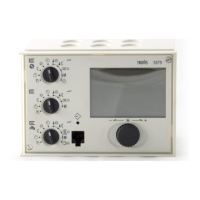
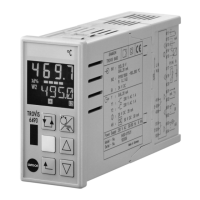
The TROVIS 5475-2 Heating and District Heating Controller can be used in conjunction with
heat meters to limit the flow rate or capacity.
To be able to limit the flow rate based on a 0 or 4-20 mA signal issued by heat meters, the heat
meters must be equipped with high-resolution measuring technology, especially the flow
measuring element, and the signal must reflect the measured value with a delay time of less than
5 seconds, if necessary, caused by signal averaging.
You can activate/deactivate function block FB 22 = ON and FB 23 = ON to determine the signal
range (0 or 4 to 20 mA), the upper measuring range value (the flow rate flowing through the
flow measuring element at 20 mA signal), the required minimum limit value (creep feed rate)
and the maximum limit value.
When the flow rate in control operation reaches the set maximum limit value, the controller swit-
ches to flow rate control with the maximum limit value as the set point; the flow temperature con-
trol then takes over from the flow rate control when the temperature at the flow sensor VF ex-
ceeds the current set point by 5 K. In system code numbers 4 to 6, the heating circuit valve is
preferably controlled via flow rate.
When the flow rate in control operation falls below the set minimum limit value, the control valve
of the heating circuit is temporarily closed. The control operation is first started again when the
temperature at the flow sensor VF falls below the current set point by 5 K.
Alternatively, the flow rate or capacity can also be limited based on a pulse signal 3 to 500
pulse/hour from the heat meter.
The function block settings FB 22 = OFF and FB 23 = ON determine the maximum pulse rate to
be limited for the mere heating operation and for drinking water heating as well as the associ-
ated influencing factors.
Since the readout of the current pulse rate which also includes the flow rate registered in the
controller or the capacity registered in the controller is calculated as a function of the distance
in time between the incoming pulses, it is natural that sudden surges in flow rate or capacity
cannot be directly registered by the controller. This applies particularly to low pulse rates!
If the pulse rate P in control operation reaches the set maximum limit, the set point of the corre-
sponding control loop is reduced. The severity of the intervention can be determined by chang-
ing the associated influencing factor.
In system code numbers 4 to 6, the set point of the control loop with a lower limit value is re-
duced in principle by the pulse rate limitation.
Determining P [pulse/hr]:
For example, if a heat meter issues one pulse per kilowatt hour (resolution = 1 kWh/pulse), the
maximum pulse rate P [pulse/hr] must be set as described below for a desired limitation to
P = 30 kW:
P [pulse/hr] = P [kW] / resolution [kWh/pulse]
P [pulse/hr] = 30 kW / 1 kWh/pulse = 30 pulse/hr
19


 To Next Page
 Loading...