33
ENGLISH
Cookware Microwave-
Safe
Comments
Glassware
• Oven-to-tableware
✓
Can be used, unless decorated
with a metal trim.
• Fineglassware
✓
Can be used to warm foods or
liquids. Delicate glass may break
or crack if heated suddenly.
• Glassjars
✓
Must remove the lid. Suitable for
warming only.
Metal
• Dishes
✗
May cause arcing or fire.
• Freezerbagtwist
ties
✗
Paper
• Plates,cups,
napkins and
Kitchen paper
✓
For short cooking times and
warming. Also to absorb excess
moisture.
• Recycledpaper
✗
May cause arcing.
Plastic
• Containers
✓
Particularly if heat-resistant
thermoplastic. Some other
plastics may warp or discolour at
high temperatures.
Do not use Melamine plastic.
• Clinglm
✓
Can be used to retain moisture.
Should not touch the food. Take
care when removing the film as
hot steam will escape.
• Freezerbags
✓ ✗
Only if boilable or oven-proof.
Should not be airtight. Prick with a
fork, if necessary.
Wax or grease-proof
paper
✓
Can be used to retain moisture
and prevent spattering.
✓
: Recommended
✓✗
: Use Caution
✗
: Unsafe
Cooking guide
MICROWAVES
Microwave energy actually penetrates food, attracted and absorbed by its
water, fat and sugar content.
The microwaves cause the molecules in the food to move rapidly. The rapid
movement of these molecules creates friction and the resulting heat cooks
the food.
COOKING
Cookware for microwave cooking:
Cookware must allow microwave energy to pass through it for maximum
eciency. Microwaves are reflected by metal, such as stainless steel,
aluminium and copper, but they can penetrate through ceramic, glass,
porcelain and plastic as well as paper and wood. So food must never be
cooked in metal containers.
Food suitable for microwave cooking:
Many kinds of food are suitable for microwave cooking, including fresh or
frozen vegetables, fruit, pasta, rice, grains, beans, fish, and meat. Sauces,
custard, soups, steamed puddings, preserves, and chutneys can also be
cooked in a microwave oven. Generally speaking, microwave cooking is
ideal for any food that would normally be prepared on a hob. Melting butter
or chocolate, for example (see the chapter with tips, techniques and hints).
Covering during cooking
To cover the food during cooking is very important, as the evaporated water
rises as steam and contributes to cooking process.
Food can be covered in dierent ways: e.g. with a ceramic plate, plastic
cover or microwave suitable cling film.
Standing times
After cooking is over food the standing time is important to allow the
temperature to even out within the food.
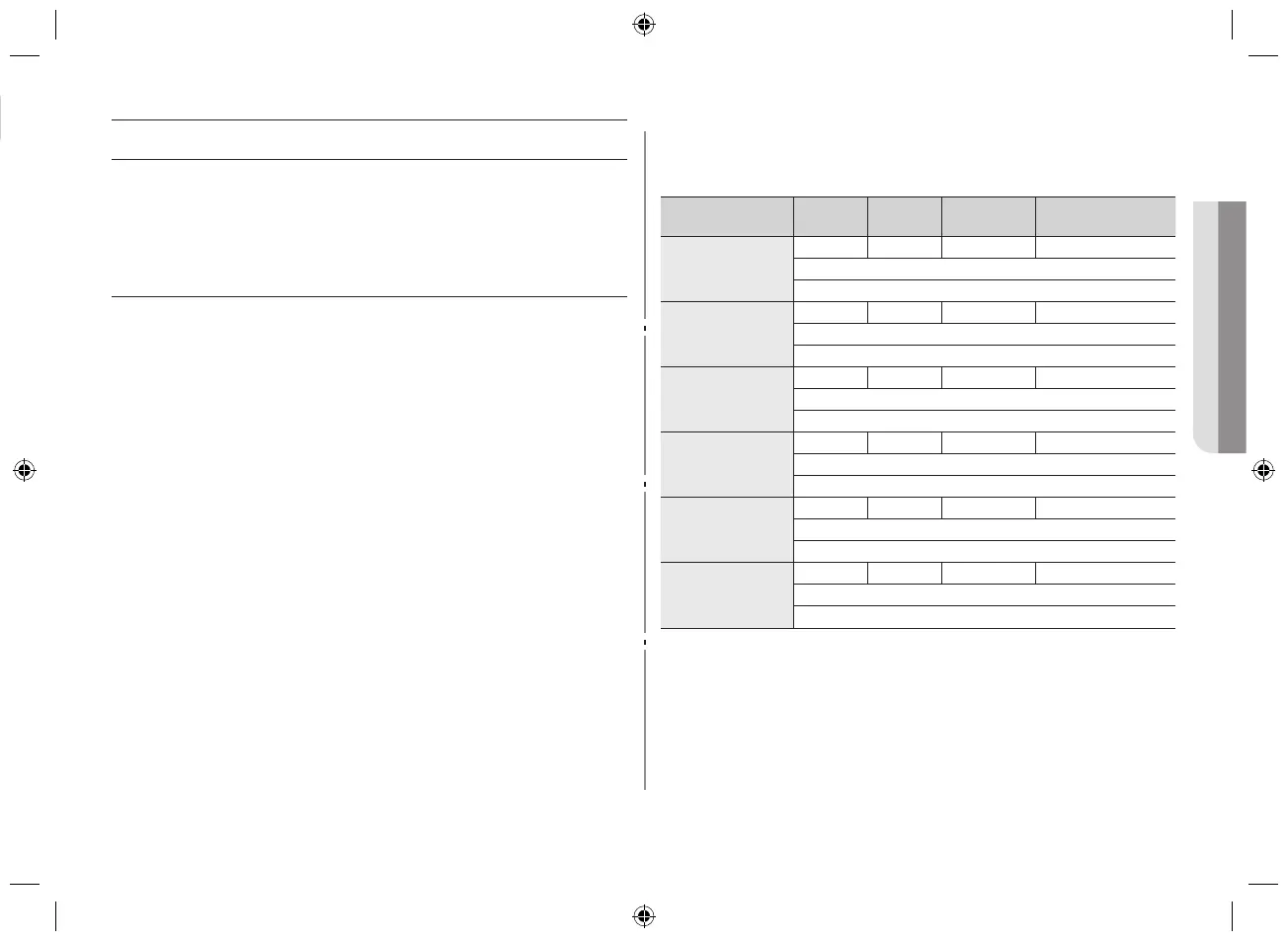
Cooking Guide for frozen vegetables
Use a suitable glass pyrex bowl with lid. Cook covered for the minimum
time – see table. Continue cooking to get the result you prefer.
Stir twice during cooking and once after cooking. Add salt, herbs or butter
after cooking. Cover during standing time.
Food Portion Power Time (min.) Standing time
(min.)
Spinach 150 g 600 W 5-6 2-3
Instructions
Add 15 ml (1 tablespoon) cold water.
Broccoli 300 g 600 W 9-10 2-3
Instructions
Add 30 ml (2 tbsp.) cold water.
Peas 300 g 600 W 7-8 2-3
Instructions
Add 15 ml (1 tbsp.) cold water.
Green Beans 300 g 600 W 8-9 2-3
Instructions
Add 30 ml (2 tbsp.) cold water.
Mixed Vegetables
(carrots/peas/corn)
300 g 600 W 7½-8 ½ 2-3
Instructions
Add 15 ml (1 tbsp.) cold water.
Mixed Vegetables
(Chinese style)
300 g 600 W 8-9 2-3
Instructions
Add 15 ml (1 tbsp.) cold water.
CE74JD-CR_XTL_DE68-04168A-01_EN.indd 33 2014-05-16 �� 9:09:33


 To Next Page