EasyManua.ls Logo

Sansui T-700 - Useful Hints for Reception; FM Antennas and Directionality; FM Antenna Installation; Multipath Reflections

Sansui T-700
8 pages
Print Icon
To Next Page IconTo Next Page
To Previous Page IconTo Previous Page
Loading...
Il
Some
useful
hints
vad
FM
antennas
and
directionality
Install
an
outdoor
FM
antenna
to
achieve
FM
reception
with
better
sound
quality
and
less
noise.
Outdoor
antennas
are
especially
recom-
mended
in
areas
where
high
buildings
or
moun-
tains
interfere
with
good
reception.
The
more
elements
an
FM
antenna
has,
the
sharper
its
directionality
becomes.
Since
antennas
with
high
directionality
receive
only
those
signals
in
one
direction,
and
not
those
from
other
direc-
tions,
FM
antennas
can
greatly
reduce
the
ef-
fect
of
multipath
refiection.
An
antenna
with
many
elements
has
greater
gain
or
higher
sen-
sitivity;
therefore,
it
is
strongly
recommended
for
reception
of
distant
broadcasts.
Select
your
antenna
after
considering
the
recep-
tion
conditions
in
your
area
and
the
distance
from
the
desired
broadcast
stations.
FM
antenna
installation
FM
antennas
must
be
carefully
located
to
en-
sure
the
stable
signal
reception.
Consider
the
following
when
selecting
the
best
place
to
in-
stall
your
antenna.
The
ideal
place
for
an
FM
antenna
is
one
un-
shadowed
by
high
buildings
that
allows
direct,
unblocked
reception
of
signals
from
the
FM
station.
*
Place
the
antenna
away
from
streets
and
driveways,
soas
to
avoid
the
effects
of
au-
tomobile
ignition
noise.
Also,
keep
the
an-
tenna
away
from
high-power
electric
lines.
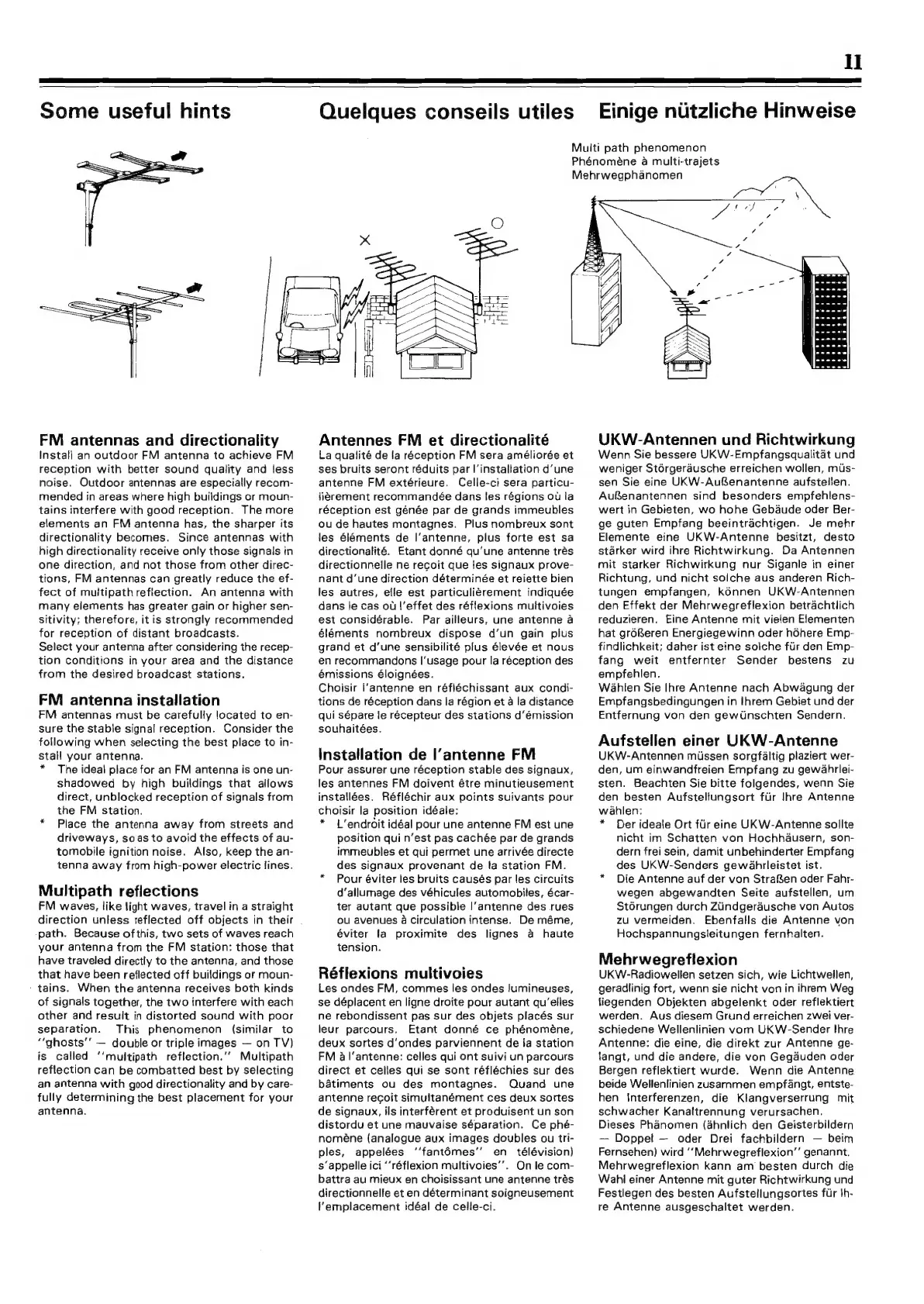
Multipath
reflections
FM
waves,
like
light
waves,
travel
in
a
straight
direction
unless
reflected
off
objects
in
their
.
path.
Because
ofthis,
two
sets
of
waves
reach
your
antenna
from
the
FM
station:
those
that
have
traveled
directly
to
the
antenna,
and
those
that
have
been
reflected
off
buildings
or
moun-
-
tains.
When
the
antenna
receives
both
kinds
of
signals
together,
the
two
interfere
with
each
other
and
result
in
distorted
sound
with
poor
separation.
This
phenomenon
(similar
to
“‘ghosts’’
double
or
triple
images
on
TV)
is
called
‘‘multipath
reflection.’’
Multipath
reflection
can
be
combatted
best
by
selecting
an
antenna
with
good
directionality
and
by
care-
fully
determining
the
best
placement
for
your
antenna.
Quelques
conseils
utiles
Einige
nitzliche
Hinweise
Muiti
path
phenomenon
Phénoméne
a
multi-trajets
Antennes
FM
et
directionalité
La
qualité
de
la
reception
FM
sera
améliorée
et
ses
bruits
seront
réduits
par
l’installation
d'une
antenne
FM
extérieure.
Celle-ci
sera
particu-
hiérement
recommandée
dans
les
régions
ou
la
réception
est
génée
par
de
grands
immeubles
ou
de
hautes
montagnes.
Plus
nombreux
sont
les
éléments
de
l’antenne,
plus
forte
est
sa
directionalité.
Etant
donné
qu’une
antenne
trés
directionnelle
ne
recoit
que
les
signaux
prove-
nant
d'une
direction
déterminée
et
reiette
bien
les
autres,
elle
est
particuligrement
indiquée
dans
le
cas
ou
|’effet
des
réflexions
multivoies
est
considérable.
Par
ailleurs,
une
antenne
a
éléments
nombreux
dispose
d’un
gain
plus
grand
et
d’une
sensibilité
plus
élevée
et
nous
en
recommandons
|’usage
pour
la
réception
des
émissions
éloignées.
Choisir
t'antenne
en
réfléchissant
aux
condi-
tions
de
réception
dans
la
région
et
a
la
distance
qui
sépare
le
récepteur
des
stations
d’émission
souhaitées.
Installation
de
I’antenne
FM
Pour
assurer
une
réception
stable
des
signaux,
les
antennes
FM
doivent
étre
minutieusement
installées.
Réfléchir
aux
points
suivants
pour
choisir
la
position
idéale:
L’endroit
idéal
pour
une
antenne
FM
est
une
position
qui
n’est
pas
cachée
par
de
grands
immeubles
et
qui
permet
une
arrivée
directe
des
signaux
provenant
de
la
station
FM.
Pour
éviter
les
bruits
causés
par
les
circuits
d’allumage
des
véhicules
automobiles,
écar-
ter
autant
que
possible
l’antenne
des
rues
ou
avenues
a
circulation
intense.
De
méme,
éviter
la
proximite
des
lignes
a
haute
tension.
Réflexions
multivoies
Les
ondes
FM,
commes
les
ondes
Ilumineuses,
se
déplacent
en
ligne
droite
pour
autant
qu’elles
ne
rebondissent
pas
sur
des
objets
placés
sur
leur
parcours.
Etant
donné
ce
phénoméne,
deux
sortes
d’ondes
parviennent
de
ja
station
FM
al‘antenne:
celles
qui
ont
suivi
un
parcours
direct
et
celles
qui
se
sont
réfléchies
sur
des
batiments
ou
des
montagnes.
Quand
une
antenne
recoit
simultanément
ces
deux
sortes
de
signaux,
ils
interférent
et
produisent
un
son
distordu
et
une
mauvaise
séparation.
Ce
phé-
noméne
(analogue
aux
images
doubles
ou
tri-
ples,
appelées
‘‘fantémes’’
en
télévision)
s‘appelle
ici
‘’réflexion
multivoies’’.
On
le
com-
battra
au
mieux
en
choisissant
une
antenne
trés
directionnelle
et
en
déterminant
soigneusement
emplacement
idéal
de
celle-ci.
Mehrwegphanomen
UKW-Antennen
und
Richtwirkung
Wenn
Sie
bessere
UKW-Empfangsqualitat
und
weniger
Stérgerausche
erreichen
wollen,
mus-
sen
Sie
eine
UKW-Aufenantenne
aufstellen.
Aufenantennen
sind
besonders
empfehlens-
wert
in
Gebieten,
wo
hohe
Gebaude
oder
Ber-
ge
guten
Empfang
beeintrachtigen.
Je
mehr
Elemente
eine
UKW-Antenne
besitzt,
desto
starker
wird
ihre
Richtwirkung.
Da
Antennen
mit
starker
Richwirkung
nur
Siganle
in
einer
Richtung,
und
nicht
soiche
aus
anderen
Rich-
tungen
empfangen,
kénnen
UKW-Antennen
den
Effekt
der
Mehrwegreflexion
betrachtlich
reduzieren.
Eine
Antenne
mit
vielen
Elementen
hat
gr6Reren
Energiegewinn
oder
héhere
Emp-
findlichkeit;
daher
ist
eine
solche
fiir
den
Emp-
fang
weit
entfernter
Sender
bestens
zu
empfehlen.
Wahlen
Sie
Ihre
Antenne
nach
Abwagung
der
Empfangsbedingungen
in
Ihrem
Gebiet
und
der
Entfernung
von
den
gewdnschten
Sendern.
Aufstellen
einer
UKW-Antenne
UKW-Antennen
missen
sorgfaltig
plaziert
wer-
den,
um
einwandfreien
Empfang
zu
gew&hrlei-
sten.
Beachten
Sie
bitte
folgendes,
wenn
Sie
den
besten
Aufstelfungsort
fir
Ihre
Antenne
wahlen:
*
Der
ideale
Ort
flr
eine
UKW-Antenne
sollte
nicht
im
Schatten
von
Hochhausern,
son-
dern
frei
sein,
damit
unbehinderter
Empfang
des
UKW-Senders
gewé€ahrleistet
ist.
*
Die
Antenne
auf
der
von
Straf&en
oder
Fahr-
wegen
abgewandten
Seite
aufstellen,
um
St6rungen
durch
Ztindgerausche
von
Autos
zu
vermeiden.
Ebenfalls
die
Antenne
von
Hochspannungsieitungen
fernhalten.
Mehrwegreflexion
UKW-Radiowellen
setzen
sich,
wie
Lichtwellen,
geradlinig
fort,
wenn
sie
nicht
von
in
ihrem
Weg
fiegenden
Objekten
abgelenkt
oder
reflektiert
werden.
Aus
diesem
Grund
erreichen
zwei
ver-
schiedene
Wellenlinien
vom
UKW-Sender
thre
Antenne:
die
eine,
die
direkt
zur
Antenne
ge-
{angt,
und
die
andere,
die
von
Gegduden
oder
Bergen
reflektiert
wurde.
Wenn
die
Antenne
beide
Wellenlinien
zusammen
empfangt,
entste-
hen
Interferenzen,
die
Klangverserrung
mit
schwacher
Kanaltrennung
verursachen.
Dieses
Phanomen
(ahnlich
den
Geisterbildern
Doppel
oder
Drei
fachbildern
beim
Fernsehen)
wird
‘‘Mehrwegreflexion’’
genannt.
Mehrwegreflexion
kann
am
besten
durch
die
Wahl
einer
Antenne
mit
guter
Richtwirkung
und
Festlegen
des
besten
Aufstellungsortes
fiir
!h-
re
Antenne
ausgeschaltet
werden.

Related product manuals