
 Need help?
Do you have a question about the Sargent and Greenleaf 8077 and is the answer not in the manual?
Details the one-year guarantee against defects and provides contact information for returns and technical assistance.
Instructions for opening the lock when it is set to the factory default combination of 25.
Instructions for opening the lock when it has a user-defined three-number combination.
Steps to open the lock and prepare for changing the combination, including using the change key and removing the cover.
Instructions for using the change key to access the mechanism and begin setting the new combination.
Steps to dial the new combination numbers and secure the mechanism using the change key.
Steps to verify the new combination, re-secure the lock, and test its functionality.
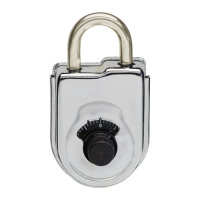
The Sargent and Greenleaf 8077 Exposed Shackle Padlock is a robust security device designed for reliable protection, meeting Federal Specification FF-P-110. This padlock is engineered for straightforward operation and offers the flexibility of combination changes, making it suitable for various security needs.
The primary function of the 8077 padlock is to secure property through a combination-based locking mechanism. It features an exposed shackle design, which is a common and recognizable form factor for padlocks. The lock operates by aligning a series of numbers on a dial with a designated index mark, thereby releasing the shackle and allowing the lock to open. The combination can be a single number, as shipped from the factory, or a more secure three-number combination set by the user. This combination system provides a keyless security solution, eliminating the need for physical keys that can be lost or duplicated. The internal mechanism is designed to prevent opening unless the correct sequence of turns and numbers is precisely entered, ensuring a high level of security against unauthorized access.
Upon receiving a new 8077 padlock, it is factory-set to a single combination number of 25. Before initial use, it is recommended to set a new, personalized combination. The padlock comes in various models, distinguished by their dial color: the 8077, 8077A, and 8077AB models feature a green dial, while the 8077AC and 8077AD models come with a black dial.
Opening the lock, especially when it's set to the factory combination, involves a specific procedure. For a new lock, the user must turn the dial counterclockwise four complete revolutions, aligning the number 25 with the padlock's opening index on the fourth revolution. Subsequently, the dial is turned clockwise to align zero with the opening index, and then the shackle is pulled sharply to open the lock. If the lock fails to open, a slight adjustment of ½ number lower or higher (e.g., 24½ or 25½) may be necessary to compensate for minor manufacturing variations.
For a lock already set to a true, three-number combination, the opening procedure is more intricate. It requires turning the dial left (counterclockwise) until the first number aligns with the opening index the fourth time. Then, the dial is turned right (clockwise) until the second number aligns with the opening index the third time. Next, the dial is turned left until the third number aligns with the opening index the second time. Finally, the dial is turned right until zero aligns with the opening index the first time, followed by a sharp pull on the shackle. Precision in aligning the numbers with the index is crucial for successful operation; misalignment can cause difficulties in opening. After re-locking the padlock, it is important to turn the dial at least five complete revolutions in either direction to ensure the mechanism is fully locked.
The padlock's design includes a shackle, an opening index for dialing the combination, and a changing index used specifically for setting or changing the combination. Users are advised to familiarize themselves with these parts and the opening procedure before attempting any combination changes. For additional guidance and tips, Sargent and Greenleaf provides resources on their website, specifically "8077 Dialing Tips" in the Support section.
The 8077 padlock is designed for durability and ease of maintenance, particularly concerning its combination-changing capability. The combination changing procedure is a key maintenance feature, allowing users to update their security settings as needed. This process involves several steps, beginning with opening the lock using the existing combination.
To change the combination, a change key is utilized. The screwdriver end of the change key is used to turn the cover locking screw clockwise until it stops, after which the padlock's rear cover plate can be slid upward and removed. The cover locking screw is then turned counterclockwise as far as possible. The shackle must be closed, and the opening index mark should be covered (e.g., with tape or a thumb) to prevent accidental dialing to the opening index during the change process.
The existing combination, including the final turn to zero, is then dialed to the changing index. If the lock is new and set to 25, the dial is turned left (counterclockwise) until 25 aligns with the changing index the fourth time, followed by a one-half revolution clockwise until zero aligns with the changing index the first time. It is critical not to pull on the shackle during this step. If the lock has an existing combination, the same opening procedure is followed, but the numbers are dialed to the changing index instead of the opening index.
Next, the elbow of the change key is used to turn the keyhole screw on the back of the lock clockwise to the open position. If it doesn't turn, the previous step (dialing the existing combination to the changing index) should be repeated. The change key is then inserted tip-first into the change key hole in the back of the lock, ensuring it is fully seated when the tab on the key is inside the lock. The key is then turned clockwise one-quarter turn.
To set the new combination, the user dials the first number of the new combination left (counterclockwise) until it aligns with the changing index the fourth time. The second number is dialed right (clockwise) until it aligns with the changing index the third time. The third number is dialed left until it aligns with the changing index the second time. Finally, the dial is turned clockwise until zero aligns with the changing index the first time.
Once the new combination is set and zero is aligned with the changing index, the change key is turned counterclockwise one-quarter turn and removed. The keyhole screw should not be turned at this point. To verify the new combination, it should be re-dialed as directed in the setting procedure, and the change key re-inserted fully into the lock without turning it. If the key fully inserts, the new combination is correctly set.
After verification, the change key is removed, and the new combination (including the final turn to zero) is dialed to the changing index again. The change key elbow is used to turn the keyhole screw to the closed position, and the shackle is closed. If the keyhole screw does not return to the closed position, it indicates an incorrect combination dialing, and the process must be repeated.
Finally, the tape or thumb is removed from the opening index, and the new combination is dialed to the opening index following the standard opening procedure, pulling sharply on the shackle to open the lock. The cover locking screw is turned clockwise until it stops, the rear cover is slid into place, and the lock's cover locking screw is turned counterclockwise as far as possible. The shackle is then closed. After any combination change, it is advisable to operate the lock at least three times to ensure proper function before putting it into service.
The product comes with a one-year warranty, guaranteeing repair or replacement for defects in materials and workmanship. For warranty claims or technical assistance, customers can contact Sargent and Greenleaf directly.
 General
| Type | Electronic Safe Lock |
|---|---|
| Access Method | Keypad |
| Locking Mechanism | Motorized bolt |
| Manipulation Resistance | High |
| Keylocking Dial | No |
| Relock Timer | Yes |
| Battery Life | Approximately 5 years |
| UL Listing | UL Group 1 |
| Battery | 9V Alkaline |
| Compliance | UL |


 To Next Page