Need help?
Do you have a question about the Scania DI13 XPI and is the answer not in the manual?
Warns about serious risks when working on the engine.
Overview of the operator's manual content.
Details engine certification and compliance requirements.
Scania's environmental commitment and types of advisories.
Safety for engine operation, including warnings and advisories.
Covers smoking, refuelling, gases, materials, and running.
Safety for maintenance, chemicals, hot parts, electrical, welding, batteries.
Warranty for emission control systems.
Defines emission warranty duration and parts covered.
Conditions, limitations, and exclusions for the emission warranty.
Contact information for warranty service.
Checks before first start and before daily operation.
Procedure and warnings for starting the engine.
Speed range, temperatures, oil pressure, and indicators.
Correct engine shutdown and post-operation checks.
Overview of lubrication, air cleaner, cooling, fuel, and misc. systems.
Table detailing maintenance tasks and intervals.
Oil grade recommendations, quality, and analysis.
Checking oil level, changing oil, and replacing oil filter.
Steps to clean and test the centrifugal oil cleaner.
Reading indicator and renewing air filter elements.
Coolant types, antifreeze, freezing, and hot climate considerations.
Steps to check coolant level and antifreeze content.
Inspecting anodes, impeller, and cleaning the system.
Removing and cleaning air cooler and heat exchanger.
Procedure for filling and draining the cooling system.
Importance of cleanliness and checking fuel level.
Renewing fuel filters and water separating prefilters.
Procedure for bleeding the fuel system.
Inspecting drive belt wear and checking for leaks.
Tools and steps for checking and adjusting valve clearance.
Quality requirements for diesel, biodiesel, HVO, and GTL fuels.
Using preservative products and preparing for storage.
Steps to return the engine to operation after storage.
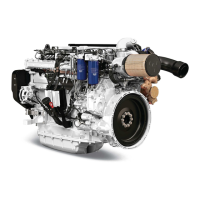
Key engine specs, lubrication, intake, cooling, fuel, electrical data.
Engine material composition and recycling methods.
Tightening torques for various screw joints and hose clamps.
 General
| Engine Model | DI13 XPI |
|---|---|
| Displacement | 12.7 liters |
| Compression Ratio | 17.3:1 |
| Bore x Stroke | 130 mm x 160 mm |
| Fuel System | XPI (Extra High Pressure Injection) Common Rail |
| Cooling System | Liquid-cooled |

 To Next Page