137
Appendix
SP 500 / 750-15 / 750-18 / 1000 / 1250 Operation Manual
The maximum output (abbreviated as max Q) is deter-
mined by the size of the hydraulic pumps, the number of
strokes per minute, and the size of the dierential and
material cylinders. The unit is usually designed so max-
imum output can be achieved only at less than maxi-
mum pressure.
Maximum pressure (abbreviated as max P) is deter-
mined by the size of the dierential and material cyl-
inders and the setting of the main relief valve. To be
sure that the unit will handle the job, be careful to notice
max P and max Q. Here is an example of why that is
important: You contract to pump a job that requires only
20 yards per hour, but you calculate that you will need
2100 PSI pressure. The PF of this job is 42,000 (20
x 2100). The pump shown in Figure 224 has a TK of
72,600, so there is enough power available. However,
the maximum pressure available from the pump is only
1570 PSI. This pump would not do the job.
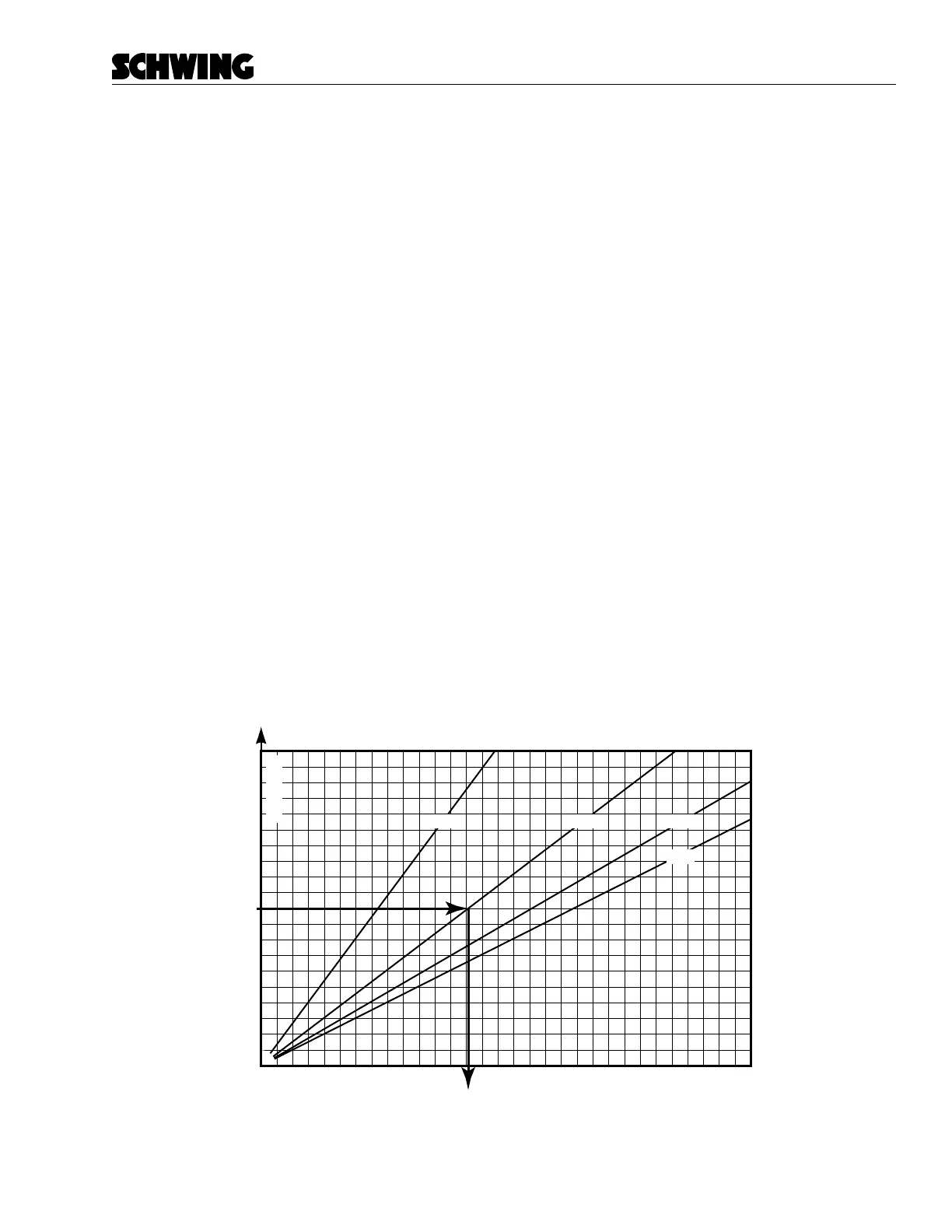
2. Follow the chart in a straight line from required out-
put into the upper right quadrant until you come to
the size of the pipeline that you will use. A good
rule of thumb for sizing pipeline is to use the larg-
est diameter pipeline that you can. It takes less
force to move concrete through a 6-inch pipeline
than, for example, a 4-inch pipeline. When
pressure is exerted on concrete in a pipeline, a
paste of water and cement nes coats the inside of
the pipeline and forms a slippery layer on which
the bulk of the concrete slides. While it is true that
a 6-inch pipeline has 49 percent more surface area
to coat than a 4-inch pipeline, the volume of con-
crete that can move on the layer is increased by
125 percent, which results in lower velocity of the
concrete (in feet per second), lower friction, and,
therefore, lower pressure. A pump that may not be
capable of completing a dicult job through 4- or
5-inch pipe may be able to do it easily through 6-
inch pipe. Experience has taught us that 5-inch is
the optimum pipeline size for lengthy vertical runs,
such as those found on high-rise buildings. It is
large enough for most aggregate but small enough
that you minimize the amount of concrete that
slides back into the hopper when the concrete
valve cycles, which we call backwash. You must
also consider the people at the point of placement.
Very few hose handlers, if any, can move 6-inch
hose on a slab all day. There is no provision in the
nomograph for mixing pipeline sizes. For example,
if you will be reducing from 5-inch to 4-inch pipe,
you should calculate the chart as if you were using
4-inch pipe for the entire distance. This will not be
completely accurate, but you will be safe in your
pressure calculation. In our example, we use
5-inch pipeline.
Q in yd
3
/hr.
Pipeline diameter in inches
6" 5" 4.5"
4"
uppr rght quad-eps



 To Next Page