138
Appendix
SP 500 / 750-15 / 750-18 / 1000 / 1250 Operation Manual
When the output line intersects the pipeline diameter
that corresponds to your job, draw a line straight down
into the lower right quadrant, as shown in Figure 225.
3. The lower right quadrant refers to the propor-
tional value of your pipeline. It is a way of taking
into account not only the length of the pipeline,
but also the number of bends, the increased resis-
tance of ow in rubber hose, and other factors. It
is more a measure of the resistance to ow than a
measure of length. In calculating the proportional
value of your pipeline, always apply the following
criteria:
• each 90° bend with a radius of 250 mm (boom el-
bow) = 3.5 feet
• each 90° bend with a radius of 1 meter (long
sweep) = 10 feet
• each 30° or 45° bend with a radius of 1 meter or
250 mm = 3 feet
• each section of rubber hose causes three times
as much resistance as the same length of steel
pipe (e.g., 12 ft. of rubber hose has the same re-
sistance as 36 ft. of pipeline)
• Figure all horizontal and vertical distances equally.
The increased pressure required to push con-
crete vertically is accounted for by adding pres-
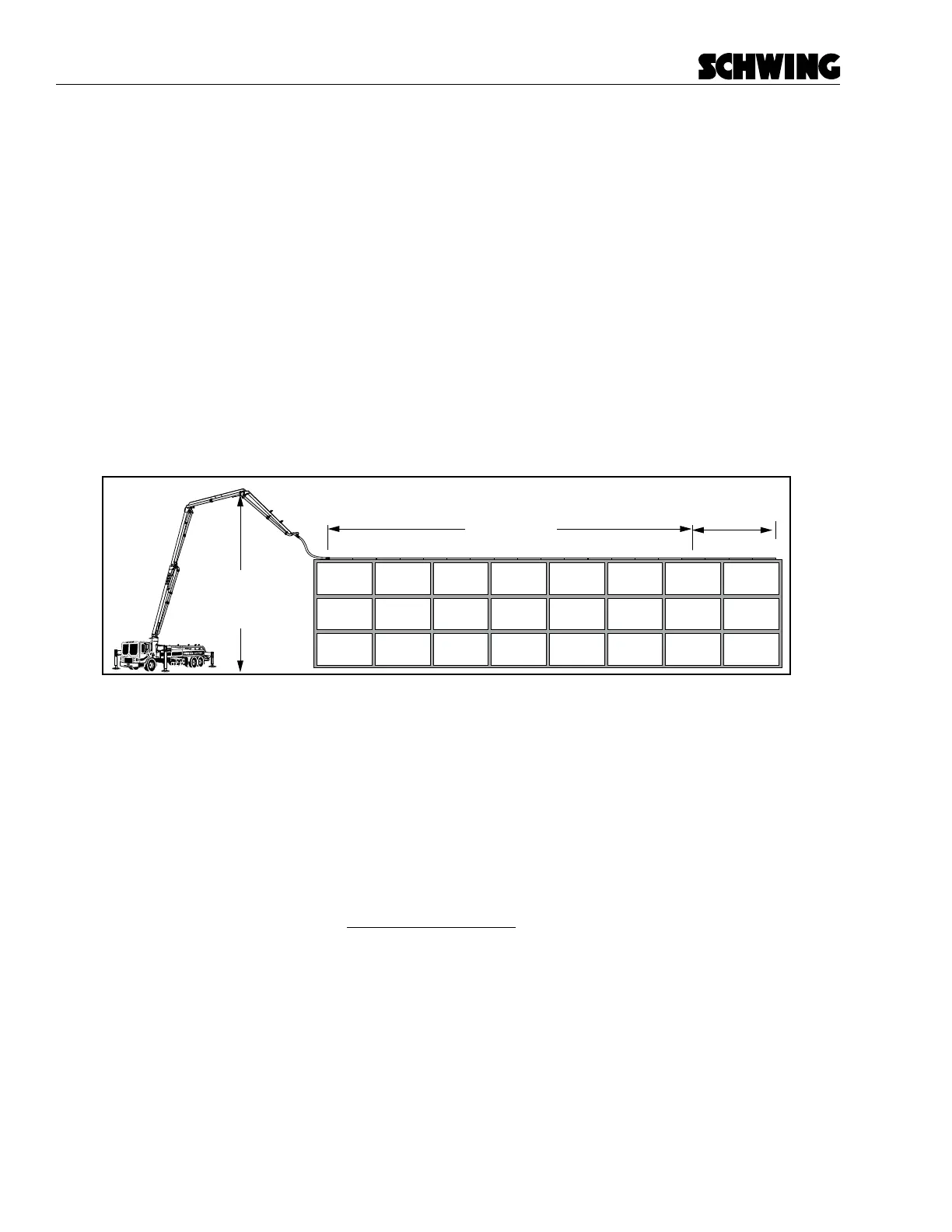
sure, not distance. An example pipeline is shown
below.
40 ft.
hose
150 ft. pipe
70 ft.
level
difference
boom 4 nomo.eps
elbow - 90°, r = 250 mm...3.5 feet
elbow - 90°, r = 1 meter...10 feet
elbow - 30° or 45°, r = 250mm or 1 meter...3 feet
Example: You must go 150 feet out through the deck and boom pipe, including the tip hose,
then through 40 feet of rubber hose. Calculate the proportional value as follows:
Round down to 500 feet to make it easy to use the chart.
all boom system = 260.0 feet (includes a 12-ft long, 5-in. tip hose)
15 10-foot pipe sections = 150.0 feet
40 x 3 = 120.0 feet (for the rubber hose)
Total = 530.0 feet
Proportional value of the 41 meter boom and deck pipe system is 260
feet. This value includes elbows, reducer, and tip hose.
NOTE:



 To Next Page