139
Appendix
SP 500 / 750-15 / 750-18 / 1000 / 1250 Operation Manual
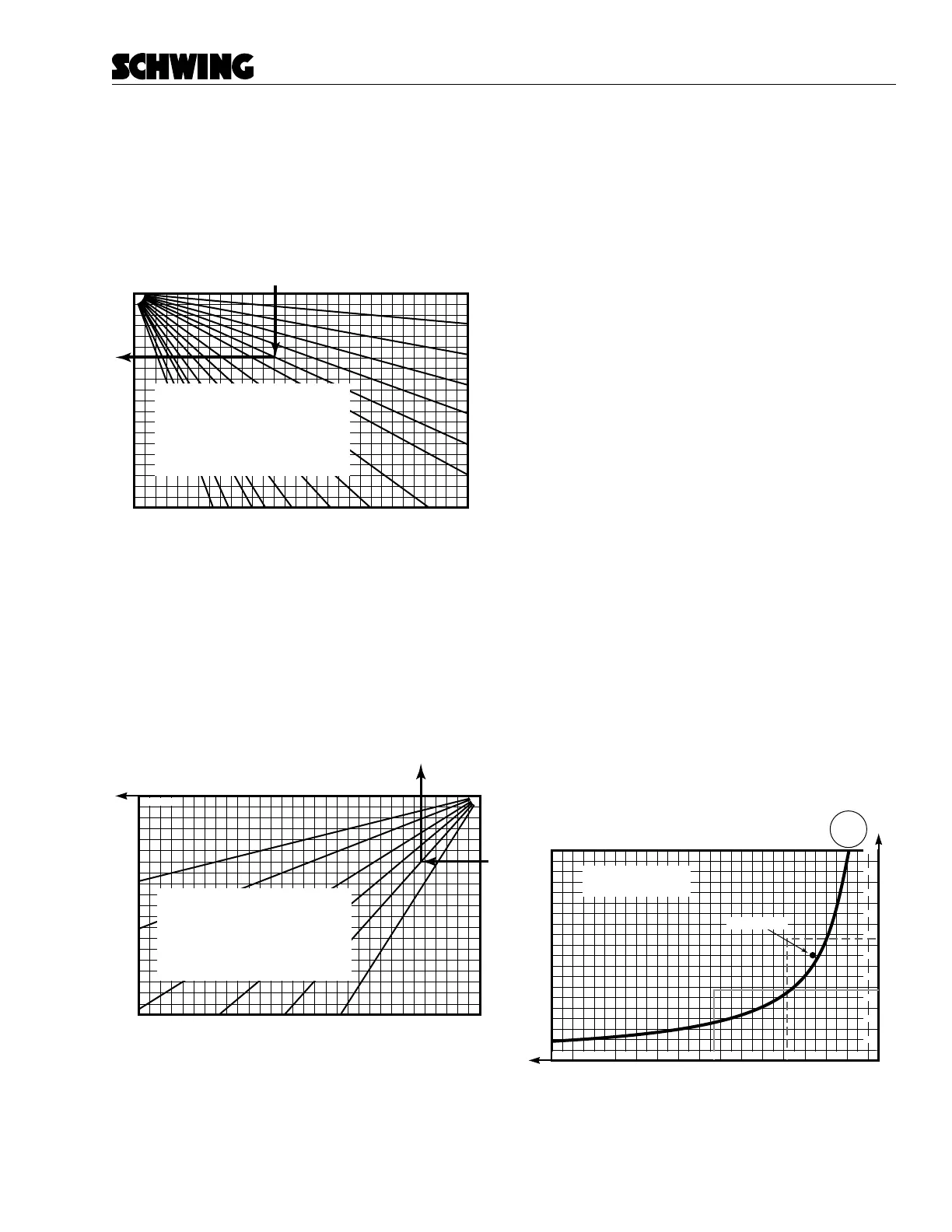
Once you have calculated the proportional value of your
pipeline, extend your line down from the upper right
quadrant until it intersects with the line that represents
your pipeline. When you reach the intersection,
make a 90° turn clockwise into the lower left quadrant.
As noted previously, we are using 500 feet as our pro-
portional value.
100
2000
200
300
400
500
600
80010001200
1500180025003000
Proportional value of pipeline in feet
lwr rght quad-eps
Make a 90° turn when
you intersect with the
proportional value that
applies to your job.
4. The lower left quadrant refers to the pumpability of
the concrete. If the concrete specications allow a
range in slump (for example 5–6 in.), always use
the lower end to be safe. In our example, we use
5- inch slump. Extend the line from the lower right
quadrant until it intersects with the 5-inch slump
line, and then make a 90° turn clockwise. This will
lead you back into the upper left quadrant through
the pressure scale.
2"
2.5"
3"
4" 5" 6"
P in PSI
Slump of fresh concrete in inches
3000 2800 2600 2400 2200 2000 1800 1600 1400 1200 1000 800 600 400 200
lwr left quad-eps
Make a 90° turn when
you intersect with the
slump that applies to
your job.
As you can see we are re-entering the upper left quad-
rant through the pressure scale at about 550 PSI. Re-
member, we now have to add the head pressure for our
vertical rise. At 1.1 PSI per foot of level dierence and
our 70-foot vertical run, we must now add 1.1 x 70 = 77
PSI to the 550 PSI from the chart.
550 PSI + 77 PSI = 627 PSI
When calculating the head pressure from ver-
tical runs, it doesn’t matter if the pipeline runs
straight up and down or if it runs uphill at an
angle. Only the level dierence (in feet) is need-
ed for the pressure calculation. If the pipeline is
running downhill, the operator will need special
knowledge, but you don’t need to add any head
pressure to the nomograph.
The nomograph is now complete. The PF of our job can
be calculated like this:
PF = PSI x yd3/hr
We need a unit that is capable of 627 PSI and 100 yd
3
/
hr. The PF of this job is:
PF = (627 x 100)
PF = 62,700
The unit must have a PF over 62,700, and it must be
able to pump 100 yd3/hr and 627 PSI simultaneously.
Look at the pump shown in our sample nomograph.
• Can the unit pump at 627 PSI? Yes
• Can the unit pump 100 yd3/hr? Yes
• Can the unit pump both simultaneously? No!
This unit will not do the job.
P in PSI
Q in. yd
3
/hr.
Power factor number (PF)
)
For vertical placing,
add 1.105 PSI per foot
of level difference.
56,650
English to Metric Conversion Factor is PF 18.966
3000 2800 2600 2400 2200 2000 1800 1600 1400 1200 1000 800 600 400 200
200
180
160
140
120
100
80
60
40
20
Example Job
upper left quad-eps
The engine is a little too small. The intersection of 100


 To Next Page