10
Visual Inspection
First, listen for air escaping, you may be able to identify the leak
immediately.
Visually inspect the cover for rips, tears or punctures. Check top
and bottom. Mark the inner bladder with pen or pencil when
the leak if found.
Listen
If you have a rough idea of where your leak is but can’t see it,
you may want to try listening for it as you may be able to hear
the air escaping and pinpoint the leak.
PackFish7™| Trouble Shooting: Air Leak
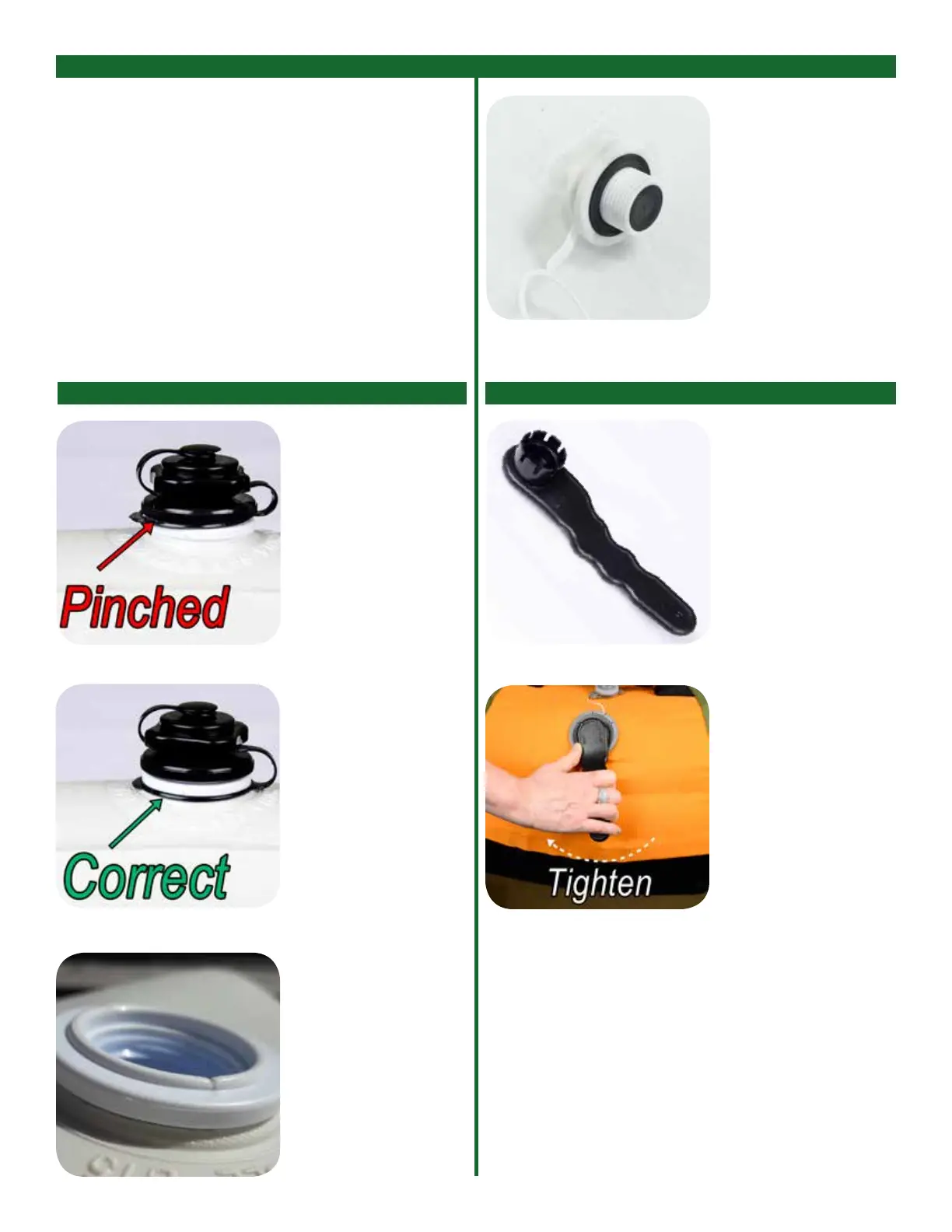
Retainer Ring
The valve base has a groove
for the retainer ring. Check
that the retainer ring is in its
groove.
PackFish7™ | Trouble Shooting: Seat Valves
A common error is to pinch
the retainer ring between
the valve body and base.
Trapping the ring breaks
the air tight seal.
If excess material covers
the groove, the ring will go
over if stretched slightly.
Denting
Check the O-Ring base for
dents. Denting can occur
when the valve body lies
across the O-Ring during
storage. Heat the O-Ring
with a hairdryer for about a
minute or so until the dent
eases itself out.
Debris & Diaphragm
Check the black
diaphragm at the
bottom of the inner valve
for sand or other debris.
Also check the threads on
the base, body and cap for
sand or debris that might
break the seal.
The repair kit contains
a valve tool. Valves are
tightened at the factory
and should not need to be
adjusted.
If you suspect a valve is
loose, inflate boat to full
pressure, insert tool in
valve and turn clockwise.
Valve has a base which is
inside the chamber.
Inflating boat will hold
base in place while turning
valve.
PackFish7™ | Trouble Shooting: Boat Valves


 To Next Page