Troubleshooting
Leakage of air: If your boat appears a bit soft, it might not
be because of a leak. If the boat was inflated late in the day
with 90 degree air, that air might cool 20 degrees overnight.
The cooler air exerts less pressure on the hull, so it could
appear soft the next morning.
If there has been no temperature variation, you need to start
looking for a leak. Below are the three best methods.
1) Visual inspection. Get a good look at your boat from just
a few feet away. Flip it over and closely check over the
outside. Any large leaks should be clearly visible.
2) Listening. If you have a rough idea where your leak is,
you can sometimes hear it in a quiet room.
3) Soapy water. Use a mix of dishwashing liquid & water in
a spray bottle, and spray over suspicious areas. Any leak
will produce bubbles that will pinpoint the location of the
leak.
4) Check your valves: Look, listen, and if necessary, spray
soapy water around your valve and the valve base. If you do
find that it is leaking at the valve please call our service
department to get a replacement valve.
Repairs
Through use you may occasionally puncture your boat.
Most leaks only take a few min utes to repair. Your boat
comes with a repair kit, and additional repair supplies can
be ordered from our website.
Small Repairs: Deflate your boat. Thoroughly clean and
dry area to be repaired. For a small puncture (less than
1/8th") apply a small drop of glue. Let dry 12 hours. If you
need to get on the water sooner, let dry 30 minutes and then
inflate the boat, inflating the compartment with the repair
only 3/4 full. Be sure to make a permanent repair later.
Patches: Leaks larger than a pinhole can be patched. Most
patches can be done in a few minutes, but we do offer a
repair service for more complex jobs out of warranty. Our
minimum repair fee is $75. and you will be responsible for
freight expenses to our facility in Port Jefferson and return
freight to your destination.
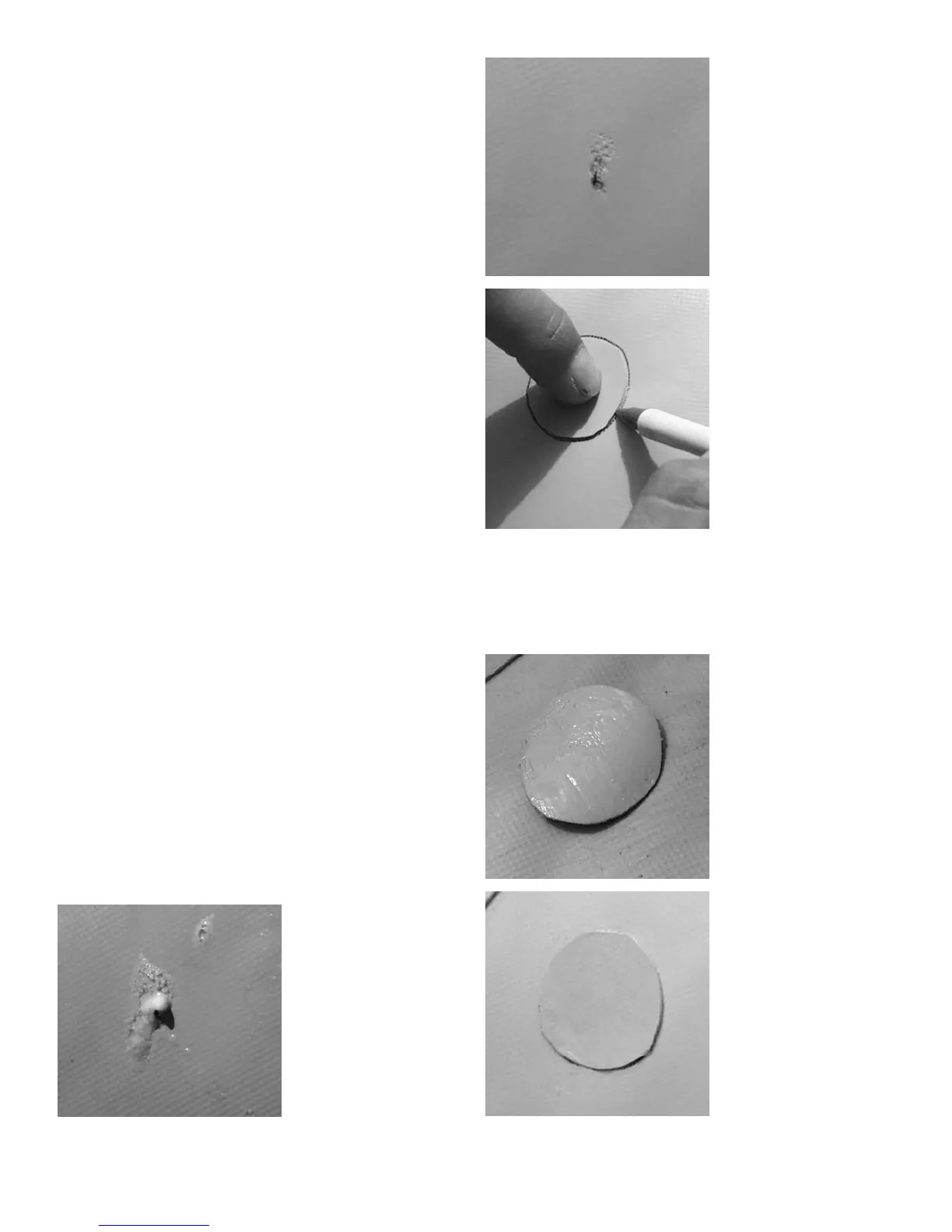
First locate the leak by
the methods above.
Soapy water will bubble
out from the source of
the leak.
Thoroughly clean the
area surrounding the
leak to remove any dirt
or grime.
Cut a piece of repair
material large enough to
over lap the damaged
area by approximately
1/2". Round off the
edges, and place over
the damaged area.
Using a ball point pen,
trace the outline of the
patch. Angle the pen
inward a bit so that the
ink will be covered by
the patch later.
Ap ply ad he sive to the underneath side of patch and around
the area to be repaired. Coat the affected area lightly but
completely with glue.
Let the glue sit for 2-4
minutes until it appears
tacky.
Place the patch on the
damaged area and
press down firmly. Place
a 3-5 pound weight over
the patch and allow 12
hours for repair to dry.
After patch dries, apply
glue around the edges
for a com plete seal (dry
4 hours).




 To Next Page