
 Need help?
Do you have a question about the Seaflo 42 Series and is the answer not in the manual?
Lists all components and tools needed for pump installation.
Step-by-step instructions for mounting and connecting the pump.
Diagnoses issues causing pump cycles on and off.
Identifies causes and solutions for pump noise.
Addresses issues where the motor runs but no discharge occurs.
Resolves problems related to the motor failing to turn on.
Diagnoses why the pump fails to turn off after fixtures are closed.
Identifies causes for reduced flow rate and pressure.
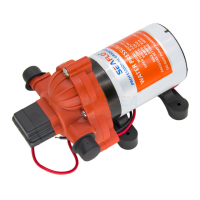
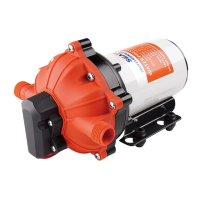
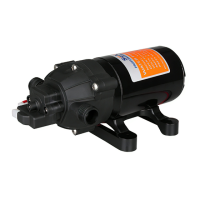
This document provides a comprehensive manual for the 42 & 43 Series diaphragm pumps, detailing their function, applications, installation, troubleshooting, and repair. The pumps are designed to offer robust power and pressure while being adaptable to situations that do not require exceptionally high flow rates. Their compact size makes them suitable for installations in confined spaces. The design also allows for configuration with various inlet types, each equipped with specific fittings to ensure compatibility with a wide range of applications.
The 42 & 43 Series diaphragm pumps are primarily designed for fluid transfer and pressurization in various systems. They operate by using a diaphragm to create pressure, moving fluid through the system. The pumps are capable of handling different types of fluids, making them versatile for both domestic and industrial applications. A key feature of these pumps is their ability to maintain consistent pressure and flow, which is crucial for the efficient operation of connected systems.
The pumps are highly versatile and find application in numerous scenarios:
For optimal performance, specific installation guidelines must be followed. The pump can be mounted in any position, but vertical mounting should position the pump head downwards to prevent leakage into the motor casing in case of a malfunction. The mounting feet should be secured without over-compressing them, as this can reduce their ability to dissipate noise and vibration.
The intake hose must be a flexible, reinforced hose with a minimum ID of 1/2" (13 mm) for the 42 series and 3/4" (19 mm) for the 43 series. The main distribution line from the pump outlet should also be 1/2" (13mm) ID for both series, with branch and individual supply lines to outlets no smaller than 3/8" (10 mm). The system should be plumbed using high-pressure, braided, flexible tubing to minimize vibration and noise.
It is crucial not to apply inlet pressure exceeding 30psi, and ideally, no inlet pressure at all. Kinks or fittings that cause excessive restrictions should be avoided. A strainer should always be attached to the inlet side, and all fittings must be securely fastened to prevent leaks. Clamps should be used at both ends of the hose to prevent air leaks. If a check valve is installed, its cracking pressure should not exceed 2 psi. When using sealers or plumbing tape, care must be taken not to overtighten, as they can be sucked into the pump.
The pump should be wired on its own dedicated circuit, with the positive lead connected to the positive terminal of the battery and the negative wire to the negative terminal. An easily accessible switch should be installed to control electricity to the pump, allowing it to be turned off when not in use for extended periods or when the tank is empty. The electrical circuit must be protected with an over-current protection device (fuse) in the positive lead, with a 15 amp fuse recommended for this pump. The pump circuit should not include any other electrical loads. Proper wire sizing, as per the electrical information chart, is essential for the length of wire used. After installation, the voltage at the pump motor should be checked while the pump is operating to ensure full voltage availability.
Proper maintenance is crucial for the longevity and optimal performance of the diaphragm pump. The manual emphasizes several key aspects of maintenance:
The manual also includes a caution against deviating from the installation instructions, as any action outside the recommended guidelines may damage the pump, and such damage caused by inappropriate installation or operation will not be covered by warranty. This underscores the importance of adhering strictly to the provided instructions for both installation and maintenance.
 General
| Model | 42 Series |
|---|---|
| Voltage | 12V DC |
| Dry Run Protection | Yes |
| Housing Material | Polypropylene |
| Impeller Material | Santoprene |
| Operating Temperature | 32°F to 140°F (0°C to 60°C) |
| Type | Diaphragm Pump |
| Chamber | 4 |
| Self-Priming | Yes |


 To Next Page