AFTER USE
SHUT THE FLUSH CONTROL.
( )
SHUT BOTH SEACOCKS
If the toilet is connected to ANY through-hull fittings that are below the waterline at any time, and if the toilet
or pipework is damaged, water may flood in, causing the craft to sink, which may result in loss of life.
Therefore, after every usage, both seacocks (or secondary valves) MUST be shut.
Whenever your craft is unattended, even if only for a very short period of time, both seacocks (even if
secondary valves are fitted) MUST be shut.
Ensure that ALL users understand how to operate
the toilet system correctly and safely, including
seacocks and secondary valves.
Take special care to instruct children, the elderly
and visitors.
SHUT SEACOCKS!
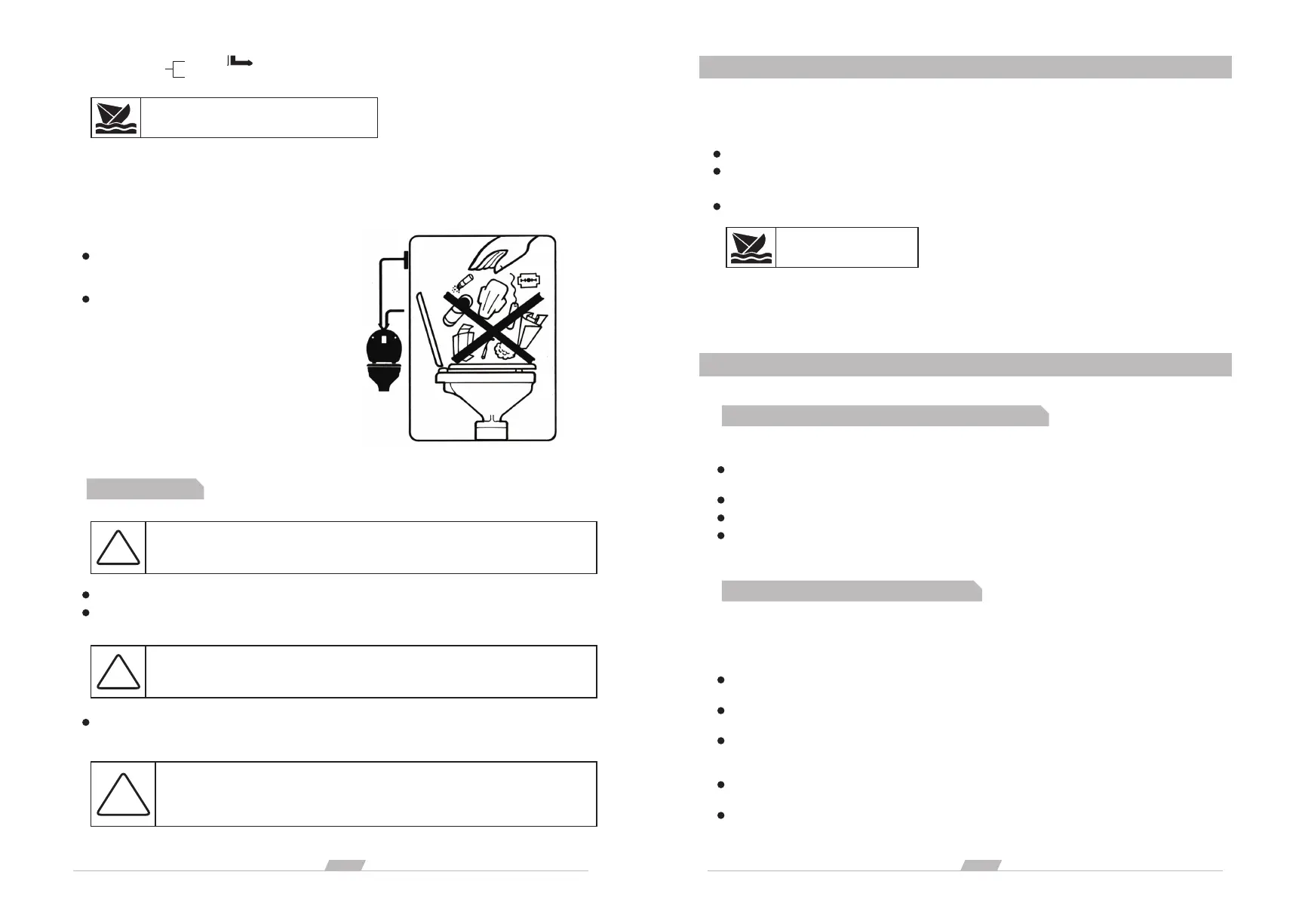
NOTE: Do not put anything in the toilet unless you
have eaten it first, except toilet paper. Do not put
in: Sanitary Towels, Wet Strength Tissues, Cotton
Wool, Cigarettes, Matches, Chewing Gum or any
solid objects, Petrol, Diesel, Oil, Solvents of any
kind or water more than hand hot.
To clean the bowl, use any liquid or cream ceramic cleaner.
To clean the rest of the toilet, including the seat and lid, use a non-abrasive liquid cleaner. Polish with a dry
cloth only.
3. CLEANING
To disinfect the toilet, use a liquid disinfectant diluted in accordance with the manufacturer's instructions.
You may apply it to all parts of the toilet using a sponge or soft brush as necessary.
10
page
9
page
SERVICING INSTRUCTIONS
Thorough flushing - refer to OPERATING INSTRUCTIONS for NORMAL USE.
FIRST USE.
Regularly check all fastenings for tightness and leaks.
Regular use - if not used regularly lubrication is beneficial - refer to OPERATING INSTRUCTIONS for
SEAFLO manual toilets do not normally require maintenance during the season, provided that they are
winterised in the autumn and overhauled in the spring. However, any toilet will benefit from:
If the toilet is connected to ANY through-hull fittings and, if the toilet or the pipework develops a minor
leak, it can suddenly become a major leak that allows water to flood in, causing the craft to sink, which may
result in loss of life. Therefore, if ANY leak develops you MUST repair it immediately.
REPAIR LEAKS IMMEDIATELY!
CLOSE BOTH SEACOCKS (even if secondary valves are fitted)
Be ready to mop up any water that may come out of the system.
If the vessel is being wintered afloat, WIRE SEACOCKS SHUT
Flush the toilet in accordance with the OPERATING INSTRUCTIONS for NORMAL USE and, in particular,
ensure that all waste has left the discharge pipework and that the bowl is empty.
SEAFLO manual toilets are designed to be user serviceable and no special skills or tools are required.
1. SERVICING & WINTERISATION - PREPARATION
Unscrew the seal housing assembly (key 18) using a 24mm (15/16") spanner and remove the entire piston
rod assembly from the toilet.
Wrap some tape around the piston rod within 16mm (5/8") of the handle. Grip the piston rod through the
tape, unscrew the handle and remove the bumper washer (key25). Remove the tape.
Slide the old seal assembly off the piston rod. Wrap one turn of tape around the thread at the top of the
piston rod to protect the new seal and slide the new seal assembly onto the piston rod. Remove the tape
from the thread.
Wrap some tape around the piston rod within 16mm (5/8") of the handle. Grip the piston rod through the
tape and replace the bumper washer and handle. Remove the tape from the piston rod.
Slide the whole assembly back into the pump cylinder and tighten in place.
If water begins to leak around the piston rod (key 28,29) at the top of the pump, the seal assembly
(key 32.33.34) is worn and must be replaced.
2. SERVICING - SEAL REPLACEMENT
YOU WILL NEED:
HAZARD RISK - Accidental Damage
!
CAUTION: Do NOT use aggressive chemical agents such as Acetone or
Bleach because plastic parts may crack and the enamel coating on the
seat and lid may blister.
!
!
CAUTION: Do not use abrasive pads on any part of the toilet and do not
use cream cleaners except for the bowl.
CAUTION: Do not use thick liquid toilet cleansers or neat bleach. They
may damage the valves, gaskets, seals and the enamel coating of the
seat and lid.
HAZARD RISK - Leaks



 To Next Page
 Loading...