
 Need help?
Do you have a question about the Security Brands Advantage DKE and is the answer not in the manual?
Identifies key parts of the keypad unit, including reset button and terminals.
Steps for carefully unpacking the unit and attaching it to a pedestal.
Alerts users to serious injury risks from automatic gates and the need for safety devices.
Connects the keypad to a gate operator or door opener using power and relay terminals.
Connects the keypad to an electric door strike and exit device for access control.
Connects the keypad to a magnetic lock and exit device for secure access.
Procedure to assign access codes that trigger Relay A for gate or door operation.
Instructions for deleting existing access codes and changing the master code.
Configures a specific code to keep a relay activated until deactivated.
Explains keypad functions (Star/Pound keys) and lists available programming sub modes.
Adjusts the duration (seconds) for which a relay remains active after code entry.
Assigns access codes that trigger Relay B, typically for a second device.
Sets modes for external devices to control keypad operation or trigger relays.
Procedure to erase all stored access codes, returning the unit to a default state.
Restores the master code to default if forgotten, retaining other codes.
Resets the entire unit to factory settings, erasing all codes and configurations.
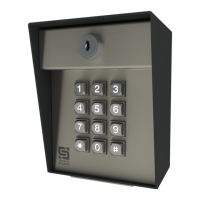
The provided document is a Quick Start Guide for the ADVANTAGE DKE Model 26-500, a keypad unit designed for access control systems, primarily for gate operators, door openers, electric door strikes, and magnetic locks.
The ADVANTAGE DKE Model 26-500 is a keypad-based access control system that allows users to enter a programmable access code to trigger a relay, thereby controlling a connected device such as a gate operator or door opener. It supports multiple access codes and offers various programming modes to customize its operation, including setting relay output times, configuring event inputs, and managing user codes. The unit is designed for outdoor installation, typically on a pedestal, and integrates with other security devices like exit devices and power sources.
The system operates with a power source of 12-24 VAC/DC. It features two independent relays (Relay A and Relay B), each with Normally Open (N/O), Normally Closed (N/C), and Common (COM) terminals, allowing for flexible wiring configurations with different types of access control devices. The keypad unit includes terminals for power, relay outputs, and event inputs. The event input terminals are used for wiring to an exit device, enabling external control over the keypad's operation or triggering a relay. The unit's programming allows for 4-digit access codes and offers a relay output time configurable from 000 to 999 seconds.
Installation:
Programming: The system uses a Master Code (default: 1251) to enter programming mode. A "good" tone indicates a successful entry, while a "bad" tone signifies an incorrect entry. The Star Key (*) deletes the current entry, and the Pound Key (#) exits programming mode.
Master Code + 1 + Access Code(s) + # (4 digits, numbers only). Multiple codes can be entered before pressing the pound key.Master Code + 2 + Code(s) to Be Deleted + # (4 digits, numbers only). Multiple codes can be deleted.Current Master Code + 3 + New Master Code + # (4 digits, numbers only).Master Code + 5 + Latch Code + # (4 digits, numbers only).Master Code + 6 + Relay (1 for A, 2 for B) + Seconds (000-999) + #.Master Code + 7 + Access Code(s) + # (4 digits, numbers only).Master Code + 9 + Mode or Exit (0-2 or # to leave mode unchanged) + #. The unit beeps the mode number or makes no beep when disabled.Master Code + 9 + 3 + Relay (1 for A, 2 for B) + #.Master Code + 0 + Master Code Again. This action cannot be undone and will sound a "good" tone when complete.Reset Procedures: The guide outlines two reset procedures, emphasizing that an "error" tone will sound if a mistake is made, requiring the user to start over.
Master Reset: Used if the Master Code, Latch Code, or Sleep Code is unknown, or if the unit is in Latch Mode or Sleep Mode. Other codes are retained.
Unit Reset: Resets the unit to factory default settings, erasing all codes.
Reset Button: The unit includes a dedicated Reset Button for performing these reset procedures.
Safety Warnings: The guide includes a prominent warning about automatic gates causing serious injury or death, advising users to always check that the gate path is clear and to use reversing or other safety devices.
Support: Contact information for technical support is provided: Call (972) 474-6390 or email techsupport@securitybrandsinc.com, available Monday-Friday, 8 am-5 pm Central.
 General
| Brand | Security Brands |
|---|---|
| Model | Advantage DKE |
| Category | Keypad |
| Language | English |

 To Next Page
