8
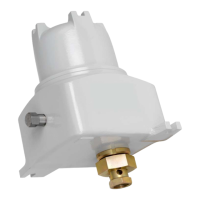
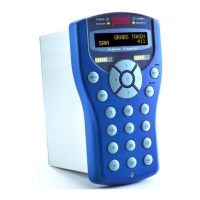
CD-20 Sample Probe Controller
Note The input pulse contact must be closed for at least 5 msec to produce a start pulse. An electronic
square wave input must have a pulse amplitude of 12VDC. A 5VDC square wave will not work.
1TB-6 = Pulse Input (Emitter) ( )-
1TB-5 = Pulse Input (Collector) (+)
1TB-4 = Jumper E1 (Repeat)
1TB-9 = Transistor Output (Emitter) ( )-
1TB-8 = Transistor Output (Collector) (+)
1TB-3 = (External Pulsed)
1TB-7 = +12VDC Output
1TB-2 (N)
1TB-1 (H)
115VAC or
230VAC Power
W1 and W2
jumpers
1TB-2 (-)
1TB-1 (+)
12VDC or
24VDC Power
Figure 2.2—Field wiring of CD-20 controller
3. Congure the on-board jumper E1 to select the source of “start” pulses for the CD-20 control logic.
– For external pulsed mode, connect jumper E1 to 1TB-3.
– For the repeat mode (time-proportional sampling), connect jumper E1 to 1TB-4, as shown in Figure
2.2.
4. To power an external ow pulse circuit such as a turbine meter pre-amplier, connect the instrument to
the +12VDC output at 1TB-7. Maximum current from this supply is 50 mA.
5. If a signal verifying the rotation of the motor is desired in a control room, connect the transistor output
contact to 1TB-8 (collector) and 1TB-9 (emitter). Check the position of jumpers W1 and W2 to designate
whether the transistor will turn on or off when the proximity switch is opposite the high point on the cam
(Figure 2.3, page 9).


 To Next Page
 Loading...