High-Power Stereo Class-D Audio Power Amplifier
SGM4703 with Adjustable Power Limit and Automatic Level Control
25
DECEMBER 2022
SG Micro Corp
www.sg-micro.com
APPLICATION INFORMATION (continued)
Table 8. DC-Detect Threshold Voltages
PVDD (V) Output Offset Voltage V
OS
(V)
6.5 1.3
12 2.4
15 3.0
18 3.6
If automatic recovery from the DCP fault is desired,
connect the FAULTB pin directly to the EN pin, as
shown in Figure 13. It allows the FAULTB pin to
automatically drive the EN pin low, which clears the
DCP latch.
Figure 13. Automatic Recovery from OCP or DCP Fault
Latch
Class-D Audio Amplifier
The audio power amplifiers in SGM4703 operate in
much the same way as traditional Class-D amplifiers
and similarly offer much higher power efficiency.
Fully Differential Amplifier
The SGM4703 includes a pair of fully differential
amplifiers with differential inputs and outputs. The fully
differential amplifiers ensure that the differential output
voltages are equal to the differential input voltages
times the amplifier gain. Although the SGM4703
supports for a single-ended input, differential inputs are
much preferred for applications where the environment
can be noisy in order to ensure maximum SNR.
Low-EMI Filterless Output Stage
Traditional Class-D audio amplifiers require for the use
of external LC filters, or shielding, to meet EN55022B
electromagnetic-interference (EMI) regulation standards.
The SGM4703 applies an edge-rate control circuitry to
reduce EMI emissions, while maintaining high power
efficiency.
Filterless Design
The SGM4703 does not require an output filter. The
device relies on the inherent inductance of the speaker
coil and the natural filtering of both the speaker and the
human ear to recover the audio component of the
square-wave output. By eliminating the output filter, a
smaller, less costly, and more efficient solution can be
accomplished.
Because the frequency of the audio outputs is well
beyond the bandwidth of most speakers, voice coil
movement due to the square-wave frequency is very
small. Although this movement is small, a speaker not
designed to handle the additional power can be
damaged. For optimum performance, use speakers
with series inductances greater than 10μH. Typical 4Ω
speakers exhibit series inductances from 10μH to
47μH.
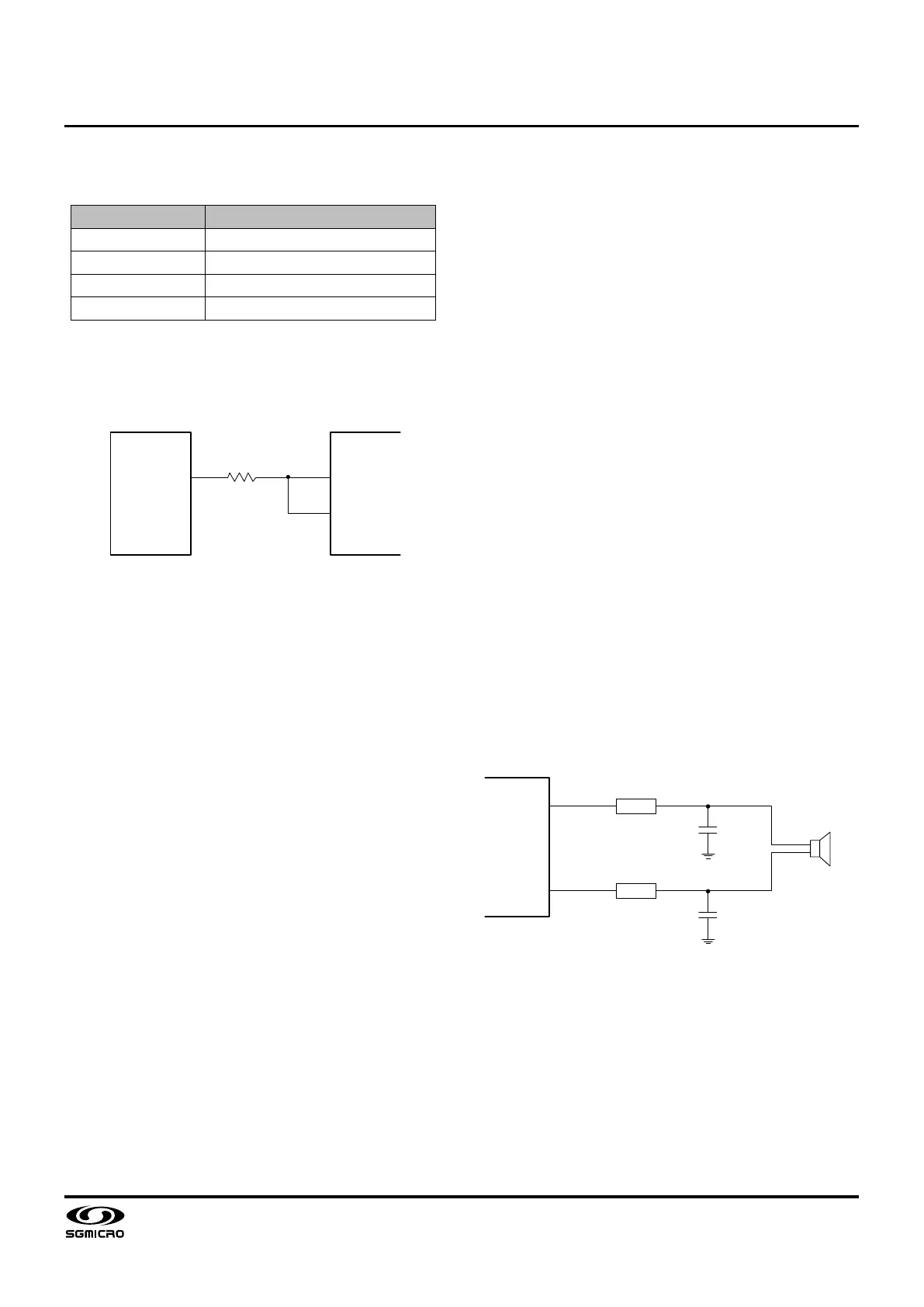
Ferrite Bead Output Filter
With an edge-rate control circuitry in SGM4703, it is
possible to design a low EMI, highly efficient Class-D
audio amplifier without the need for classic LC
reconstruction filters when the amplifier drives speaker
loads with short speaker wires (less than 10cm).
However, EMI suppression can be further reduced by
use of a low-cost ferrite bead filter comprising a ferrite
bead and a capacitor, as shown in Figure 14. The
ferrite bead filter is applied to block radiation in the
range of 30MHz and above from appearing on the
speaker wires and the power supply lines. The
impedance of the ferrite bead is used with a small
capacitor in the range of 1nF to reduce the frequency
spectrum of the signal to an acceptable level. For best
performance, the resonant frequency of the ferrite bead
filter should be less than 10MHz.
SPEAKER
FB
1
C
1
C
2
FB
2
VOP
VON
Ferrite Chip Bead
Ferrite Chip Bead
Figure 14. Ferrite Bead Filter for EMI Reduction
Choose a ferrite bead with low DC resistance (DCR)
and high impedance (100Ω ~ 330Ω) at high frequencies
(>100MHz). The current flowing through the ferrite
bead must be also taken into consideration. The
effectiveness of ferrites can be greatly aggravated at
much lower than their rated current values. Choose a
ferrite bead with a rated current no less than 4A for 8Ω
loads, 7A for 4Ω loads, and 9A for 3Ω loads (in PBTL
configuration).


 To Next Page
 Loading...