EasyManua.ls Logo

Sharp GF-7500H - TRANSFORMERS; FILTERS

Sharp GF-7500H
24 pages
Print Icon
To Next Page IconTo Next Page
To Previous Page IconTo Previous Page
Loading...
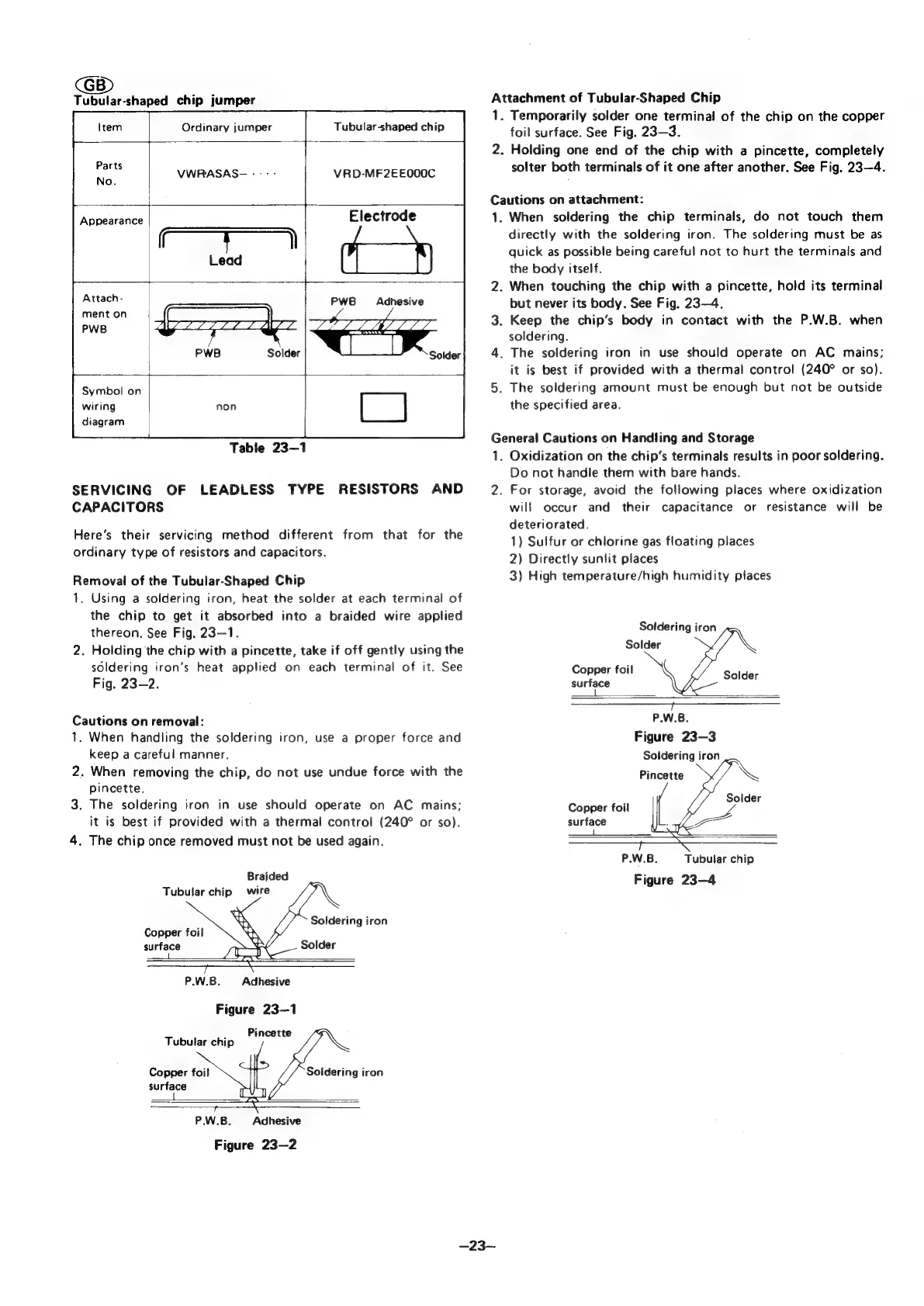
CGB)
Tubular-shaped
chip
jumper
Ordinary
jumper
Tubular-shaped
chip
VWRASAS-—
----
VRD-MF2EE000C
Electrode
Appearance
Attach-
PWB
ment
on
PWB
Adhesive
Solder
Symbol
on
wiring
diagram
LJ
Table
23-1
SERVICING
OF
LEADLESS
TYPE
RESISTORS
AND
CAPACITORS
Here’s
their
servicing
method
different
from
that
for
the
ordinary
type
of
resistors
and
capacitors.
Removal
of
the
Tubular-Shaped
Chip
1.
Using
a
soldering
iron,
heat
the
solder
at
each
terminal
of
the
chip
to
get
it
absorbed
into
a
braided
wire
applied
thereon.
See
Fig.
23-1.
2.
Holding
the
chip
with
a
pincette,
take
if
off
gently
using
the
soldering
iron’s
heat
applied
on
each
terminal
of
it.
See
Fig.
23-2.
Cautions
on
removal:
1.
When
handling
the
soldering
iron,
use
a
proper
force
and
keep
a
careful
manner.
2.
When
removing
the
chip,
do
not
use
undue
force
with
the
pincette.
3.
The
soldering
iron
in
use
should
operate
on
AC
mains;
it
is
best
if
provided
with
a
thermal
contro!
(240°
or
so).
4.
The
chip
once
removed
must
not
be
used
again.
Brajded
Tubular
chip
wire
Soldering
iron
Copper
foil
surface
Solder
is)
~—
P.W.B.
Adhesive
Figure
23—1
Pincette
Tubular
chip
Copper
foil
Soldering
iron
surface
r
P.W.B.
Adhesive
Figure
23-2
Attachment
of
Tubular-Shaped
Chip
1.
Temporarily
solder
one
terminal
of
the
chip
on
the
copper
foil
surface.
See
Fig.
23—3.
2.
Holding
one
end
of
the
chip
with
a
pincette,
completely
solter
both
terminals
of
it
one
after
another.
See
Fig.
23—4.
Cautions
on
attachment:
1.
When
soldering
the
chip
terminals,
do
not
touch
them
directly
with
the
soldering
iron.
The
soldering
must
be
as
quick
as
possible
being
careful
not
to
hurt
the
terminals
and
the
body
itself.
2.
When
touching
the
chip
with
a
pincette,
hold
its
terminal
but
never
its
body.
See
Fig.
23—4.
3.
Keep
the
chip’s
body
in
contact
with
the
P.W.B.
when
soldering.
4.
The
soldering
iron
in
use
should
operate
on
AC
mains;
it
is
best
if
provided
with
a
thermal
control
(240°
or
so).
5.
The
soldering
amount
must
be
enough
but
not
be
outside
the
specified
area.
General
Cautions
on
Handling
and
Storage
1.
Oxidization
on
the
chip’s
terminals
results
in
poor
soldering.
Do
not
handle
them
with
bare
hands.
2.
For
storage,
avoid
the
following
places
where
oxidization
will
occur
and
their
capacitance
or
resistance
will
be
deteriorated.
1)
Sulfur
or
chlorine
gas
floating
places
2)
Directly
sunlit
places
3)
High
temperature/high
humidity
places
Soldering
iron
Solder
Copper
foil
surface
as
P.W.B.
Figure
23-3
Soldering
iron
Pincette
NS
Solder
Copper
foil
surface
+
P.W.B.
Tubular
chip
Figure
23—4
—23—

Related product manuals