13
2. Testing procedure
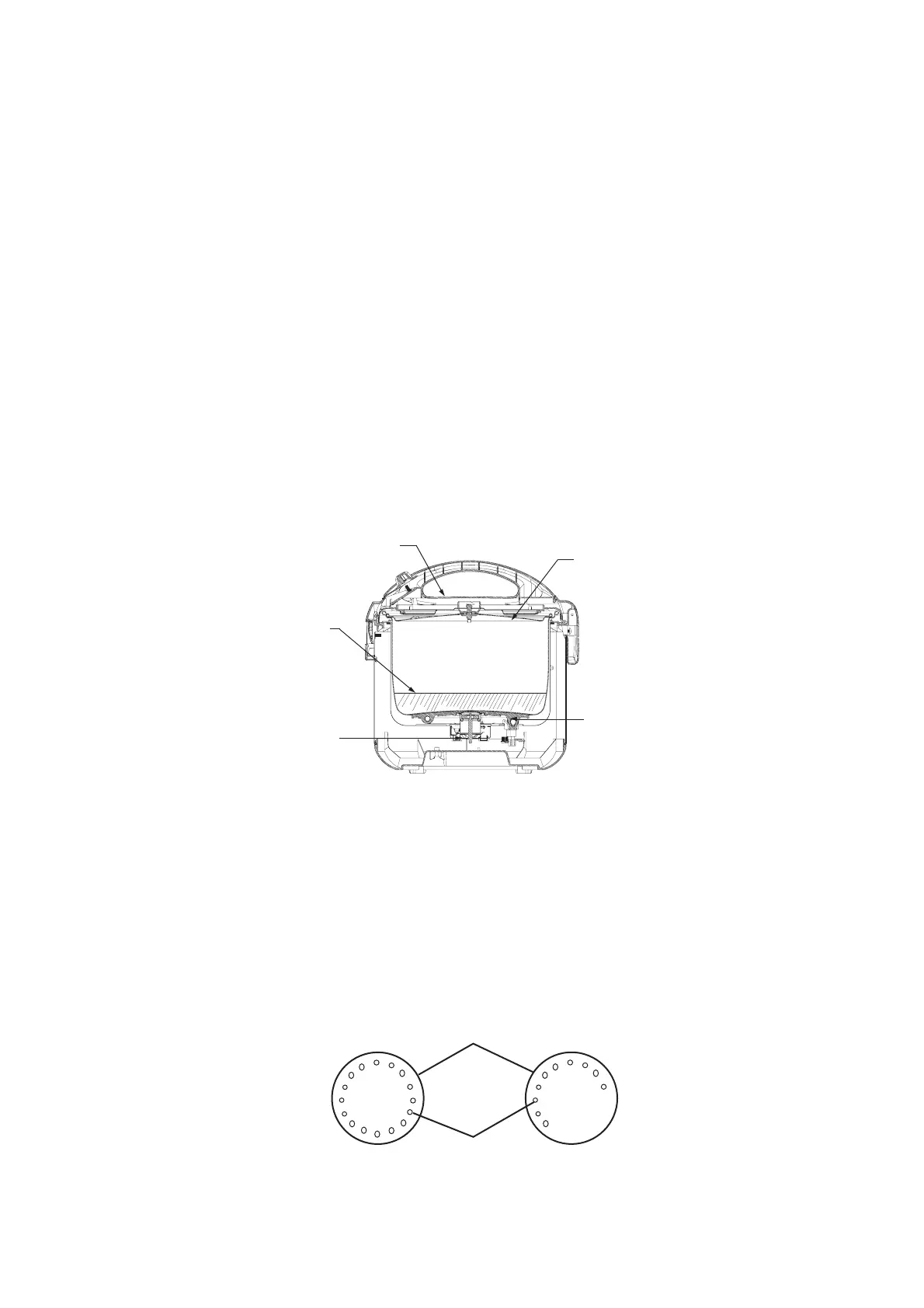
a. Fill the inner pot with 80 ml. of water turn ON the cook switch (for cooking purpose) to energize the
cooker, and measure the time for cooking.
b. When steam comes out of the steam vent, open the lid and check the bubbling state on the bottom of
inner pot. (Check if the inner pot is allowed to be in close and stable contact with the heater plate ass’y.
Conduct checking within a short period of time so as not to infl uence over the operating time.)
c. Where the bubbling state is satisfactory, close the lid again and energize the cooker.
3. Judgment criteria
During the course of the simulated cooking with water conducted under the conditions as above, if meeting
the following requirements, will be considered acceptable.
a. If the bubbling state is such that bubbles occur evenly around the bottom of inner pot as shown in
Fig. 19(A), the inner pot is satisfactorily in contact with the heater plate ass’y. Where bubbles do not occur
more than 1/3 of the bottom periphery as shown in Fig. 19(B), contaminant deposits on the heater plate
ass’y or deformation or damage on the inner pot may be existing. (Though such containment deposits can
be removed by cleaning, the inner pot deformed to the extent hardly rectifi ed should be replaced with new
one. The same applies to the heater plate deformed.)
In case satisfactory cooking of rice is not accomplished (excessively overdone or underdone), conduct the
temperature test in accordance with the following procedure.
Simplifi ed Testing Method (Simulated Rice-Cooking)
1. Testing conditions
a. Power voltage 220V.
b. Fill inner pot with 80 ml. of water. (Water temperature to be the same as ambient temperature.)
c. Ambient temperature to be 20 to 30
o
C.
d. JAR RICE COOKER to be suffi ciently kept cooled (Cooker body temperature to be the same as ambient
temperature.)
e. Never fail to set the inner lid.
SIMPLIFIED TESTING METHOD
Fig. 18
Good State of Bubbling
(A)
Pot bottom
Bubbles
Poor State of Bubbling
(B)
Fig. 19
Lid
Inner pot
Water for testing
Thermostat ass’y
Inner lid
Heater plate ass’y


 To Next Page