EasyManua.ls Logo

Sharp MZ-800 - Page 110

Sharp MZ-800
221 pages
Print Icon
To Next Page IconTo Next Page
To Previous Page IconTo Previous Page
Loading...
INPUT
#
Format
INPUT
#
<logical
number>,
<variable>
[,
<variable>]
...
Abbreviated
Format
Explanation
Example
See
also
l.#
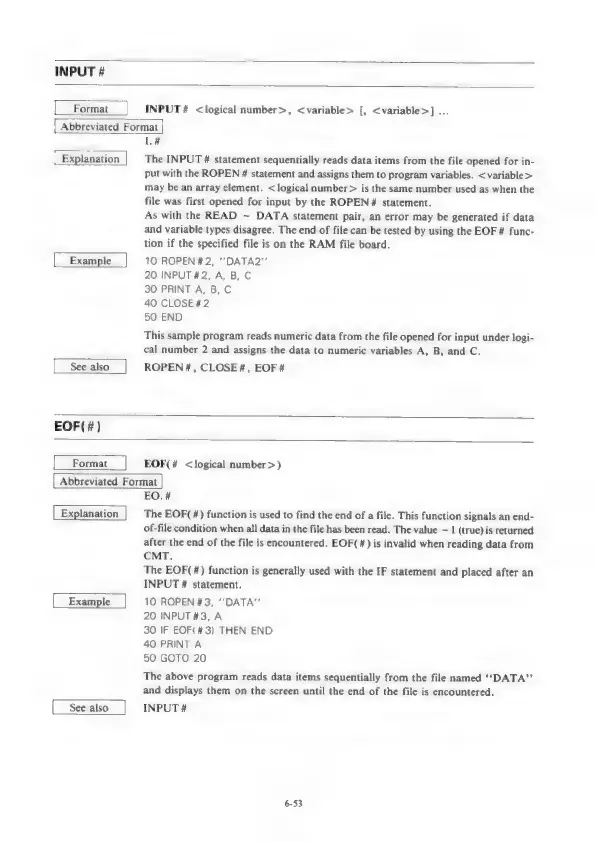
The
INPUT
#
statement
sequentially
reads
data
items
from
the
file
opened
for
in-
put
with
the
ROPEN
#
statement
and
assigns
them
to
program
variables.
<variable>
may
be
an
array
element.
<logical
number
>
is
the
same
number
used
as
when
the
file
was
first
opened
for
input
by
the
ROPEN
#
statement.
As
with
the
READ
~
DATA
statement
pair,
an
error
may
be
generated
if
data
and
variable
types
disagree.
The
end
of
file
can
be
tested
by
using
the
EOF
#
func-
tion
if
the
specified
file
is
on
the
RAM
file
board.
10
ROPEN
#2,
““DATA2"
20
INPUT
#2,
A,
B,
C
30
PRINT
A,
B,
C
40
CLOSE
#2
50
END
This
sample
program
reads
numeric
data
from
the
file
opened
for
input
under
logi-
cal
number
2
and
assigns
the
data
to
numeric
variables
A,
B,
and
C.
ROPEN#,
CLOSE
#,
EOF
#
EOF(#)
Format
Explanation
Example
See
also
EOF(#
<logical
number>)
Abbreviated
Format
EO.
#
The
EOF(
#)
function
is
used
to
find
the
end
of
a
file.
This
function
signals
an
end-
of-file
condition
when
all
data
in
the
file
has
been
read.
The
value
1
(true)
is
returned
after
the
end
of
the
file
is
encountered.
EOF(#)
is
invalid
when
reading
data
from
CMT.
The
EOF(#)
function
is
generally
used
with
the
IF
statement
and
placed
after
an
INPUT
#
statement.
10
ROPEN
#3,
“DATA”
20
INPUT
#3,
A
30
IF
EOF(
#3)
THEN
END
40
PRINT
A
50
GOTO
20
The
above
program
reads
data
items
sequentially
from
the
file
named
““DATA”’
and
displays
them
on
the
screen
until
the
end
of
the
file
is
encountered.
INPUT
#
6-53

Other manuals for Sharp MZ-800

Related product manuals