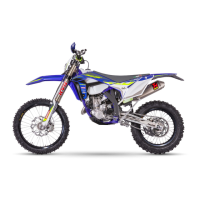
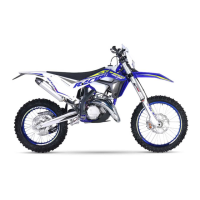
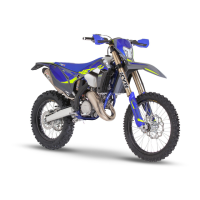
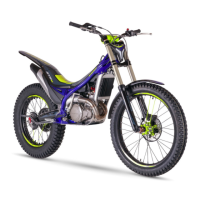
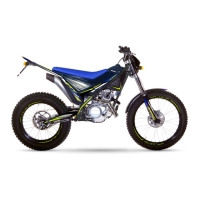
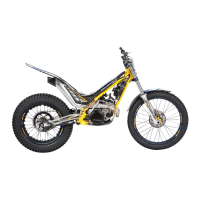
This document is an owner's manual for the Sherco ST Series motorcycles, covering 125cc, 250cc, and 300cc models. It provides detailed information on the motorcycle's technical specifications, controls, driving instructions, and maintenance procedures.
Function Description
The Sherco ST Series motorcycles are designed for trial riding, emphasizing maneuverability, balance, and precise control for navigating challenging off-road terrains. The manual guides users on how to operate, maintain, and troubleshoot their motorcycle to ensure optimal performance and longevity.
Important Technical Specifications
The manual provides detailed technical specifications for the 125cc, 250cc, and 300cc models, highlighting differences where applicable.
Dimensions:
- Overall length: 2040 mm
- Overall width: 817 mm
- Saddle height: 685 mm
- Wheelbase: 1322 mm
- Ground clearance: 310 mm
Engine (2-stroke single cylinder):
| Model |
Cubic Capacity |
Bore / Stroke |
| 125cc |
124.7 cc |
56 x 50.7 mm |
| 250cc |
249 cc |
72.8 x 60 mm |
| 300cc |
300 cc |
76 x 60 mm |
- Carburettor: KEIHIN 28 for all models.
- Cooling: Forced-circulation liquid.
- Starting system: Gear system and retractable kickstand.
- Lighting system: Hidria Digital.
- Spark plug: W16FPR-U (Denso).
- Distance between spark plug electrodes: 0.7 mm.
- Alternator: ≈ 100-120 W.
- Engine oil capacity: 580 ml.
Carburettor Settings (KEIHIN 28):
| Setting |
125cc |
250cc |
300cc |
| Needle position |
P5 |
P2+0.5 |
P4+0.5 |
| Jet needle |
JJH |
JJH |
JJH |
| Main jet |
KEA 122 |
KEA 125 |
KEA 125 |
| Idle jet |
KEP 50 |
KEP 45 |
KEP 45 |
| Air regulation control opening |
Between 0.5 and 1 rotation for all models |
|
|
| Valve close |
N°4 |
N°3,5 |
N°3,5 |
Transmission:
- Type: Manual.
- Clutch: Diaphragm system, hydraulic control.
- Gearbox: 5-speed.
- Primary drive: 20 x 76 (125cc), 24 x 70 (250cc & 300cc).
- Secondary drive: 9 x 42 (125cc), 9 x 44 (250cc & 300cc).
Cycle Part:
- Frame: Chromium-molybdenum steel tube.
- Front suspension: Tech Fork Ø39mm Aluminium.
- Rear suspension: Reiger 2-way hydraulic shock absorber, Aluminium swingarm.
- Front/rear stroke: 165/175mm.
- Front brake: Ø 185mm disc.
- Rear brake: Ø 145mm disc.
- Disc brake wear limit: Front 2.5mm, Rear 2.3mm.
- Front tyre: Michelin Trial competition 275X21.
- Rear tyre: Michelin Trial competition X11 tubeless type 400X18.
- All-terrain AV/AR pressure: 0.4/0.3 bar.
- Fuel tank capacity: 2.4L.
- Fuel: Unleaded super gasoline (Octane 95) mixed with 2-stroke oil (2%).
Electric Devices:
- Headlight: 12728.
- Sidelight: W5W.
- Reverse/brake light: LED.
- Blinker: R10W.
- Metre battery: CR2032.
- Plate light: LED.
Usage Features
Controls:
- Clutch lever: Located on the left handlebar grip, adjustable for position and distance.
- Hand brake lever: Located on the right handlebar grip, adjustable for tension and distance.
- Rear brake pedal: Located in front of the right footrest, adjustable for position.
- Gearshift lever: Located in front of the left footrest, 5 positions plus neutral.
- Mechanical start-up pedal (kick choke): Located in front of the right footrest, activated with a forceful kick.
- Dashboard: Located in the center of the handlebars.
- Light, blinker, and horn control: Located on the left handlebar grip, includes road light switch, blinker switch, and horn button.
- Choke: Located to the right of the carburettor, used for cold starts (ACTIVATED increases mixture flow, DEACTIVATED maintains adequate mixture flow).
- Fuel tap: Located on the bottom left of the fuel tank, with ON, CLOSED, and RES (0.5 litre reserve) positions.
- Kickstand: Located behind the right footrest, with a spring for retraction.
Driving Instructions:
- Breaking in the engine: Gentle use is advised for the first hour.
- Starting the engine (cold): Set gear selector to neutral, activate choke, set fuel tap to ON, use kick start pedal, deactivate choke after 1 km.
- Starting the engine (hot): Set gear selector to neutral, ensure choke is DEACTIVATED, set fuel tap to ON, start engine.
- Shifting gears: Press clutch, turn accelerator grip forward, press gearshift lever to shift to first, gently release clutch. For higher gears, place foot tip below lever and push up.
- Braking: Use front and rear brakes simultaneously. For quicker braking, use engine brake without accelerating. Avoid abrupt braking.
- Parking: Brake motorcycle, turn off engine, put gear lever in first, put kickstand down on a flat, firm surface. Avoid parking near flammable materials due to hot exhaust.
- Filling the tank: Park motorcycle, turn cap left to remove, fill with unleaded 95 octane fuel, turn cap right to close. Stop engine before filling.
Maintenance Features
The manual outlines a comprehensive maintenance schedule and processes to ensure the motorcycle remains in perfect condition.
Maintenance Schedule (Key intervals):
- After each ride: Check frame, tyre pressure, swingarm, shock absorber attachments, steering column slack, tyre condition, rim condition, spoke tension, wheel hubs, wheel hub slack, brake pads (front and rear), brake discs, brake lines, free clearance of brake pedals, brake fluid level, clutch fluid level, final drive components, chain tension, tubes and dust covers, coolant level, wires, headlight adjustments.
- Every 3 hours of use: Replace gearbox oil, check clutch, replace clutch spring, check flap valve, check spark plug, check interference filter, clean air filter and housing, check idle speed, check throttle cable condition, check accelerator grip play, replace muffler’s steel wool, conduct fork maintenance, check nuts and bolts tightness, check shock absorber leak tightness.
- Every 20 hours of use: (Same as 3 hours, but less frequent for some items).
- Every 60 hours of use: (Same as 3 hours, but less frequent for some items).
- Every 100 hours of use: (Same as 3 hours, but less frequent for some items).
- Every 40 hours competition use: Replace coolant, replace brake fluid, replace clutch fluid, lubricate steering column bearings, lubricate swingarm bearings, lubricate suspension rod bearings.
- Every 60 hours of use: (Same as 40 hours competition use, but less frequent for some items).
- Every 120 hours of use: (Same as 40 hours competition use, but less frequent for some items).
- Every year: (Same as 40 hours competition use, but less frequent for some items).
- Every 4 years: Engine maintenance (replace rod, needle basket, crank pin basket, piston; check cylinder, gearbox, shifting mechanism; replace all engine bearings).
Maintenance Processes (Detailed steps for common tasks):
- Adjusting brake and clutch levers: Involves loosening screws, positioning the lever, and tightening. Warnings are given about checking clearance and keeping hands relaxed.
- Replacing headlight and blinker bulbs: Involves disassembling the headlight/blinker unit, removing the old bulb, and installing a new one. Warnings about disconnecting ignition and proper disposal of used bulbs.
- Checking and adding brake/clutch fluid: Involves removing covers, checking fluid levels (between 3 and 4 mm from upper lip for clutch and front brake, between MINI and MAXI marks for rear brake), and refilling with specified fluid types (DOT 4 for brakes, Mineral oil for clutch). Warnings about corrosive nature of brake fluid.
- Purging brake fluid: Involves removing reservoir cover, loosening protective caps and drain devices, pressing brake handle, and repeating until air is drained. Warnings about corrosive fluid.
- Adjusting throttle cable: Involves removing the saddle and fuel tank to access the adjustment rod, or using the screw on the gas line. Warnings about ensuring no cable tension and proper free section (2-3 mm).
- Checking brake discs and pads: Visual inspection for wear. Warnings about minimum thickness (2.7 mm for discs, 1 mm for pads) to prevent damage.
- Checking tyres and chain tensioner: Visual inspection for condition and proper pressure/tension. Warnings about minimum pad thickness (for discs) and keeping tensioner clean and lubricated.
- Condition of springs: Notes that gear-shift lever and footrests are retractable and spring-loaded, requiring cleanliness and lubrication for proper function.
- Disassembling and assembling wheels (front and back): Detailed steps for removal and reinstallation, including loosening/tightening screws and nuts, aligning components, and tensioning the chain for the rear wheel. Warnings about damaging discs with brake pads and checking brake operation after assembly.
- Adjusting shock absorber (rebound, compression, preload, sag): Detailed steps for adjusting various settings using screws and knobs, with specified clicks/rotations and sag measurements (10-12mm no-load, 65-70mm riding sag). Includes a table for replacing the shock absorber spring based on pilot weight.
- Adjusting fork (rebound, spring preload, Hydrostop ring, compression): Detailed steps for adjusting various settings using screws and elements, with specified clicks/rotations.
- Adjusting the carburettor: Notes that factory settings may need minor adjustments based on altitude/weather. Provides tables for carburettor settings (needle position, main jet, idle jet, air screw adjustment) at different sea levels. Spark plug condition is used to check carburation richness.
- Spark plug condition: Visual inspection to determine carburation (dried-out for poor, clean for correct, dirty for excessive). Spark plug type: Denso W16FPR-U. Warnings about regularly checking condition and dimensions.
- Checking and cleaning the air filter: Steps for disassembly, cleaning, and assembly. Warnings about more frequent cleaning on dusty roads and lightly coating the filter with oil.
- Changing engine oil: Steps for draining old oil (from engine protector screws and drain screw) and filling with new oil (Motul® ATF VI, 580 ml). Warnings about performing when engine is stopped but warm.
- Changing coolant fluid: Steps for draining old fluid (from engine protector screws and drain screw) and filling with new fluid (Motul® Motocool Fact. Line -35°c, ≈ 480 cm³). Warnings about performing when engine is stopped and cold, and never opening radiator cap when engine is warm.
The manual also includes a warranty section with information on warranty terms, vehicle registration, obtaining services, conditions for coverage, and exclusions. It also provides pages for dealer stamps and maintenance records.

 Need help?
 General

 To Next Page