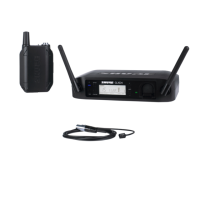
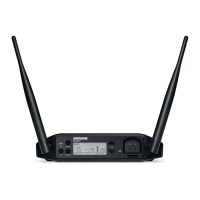
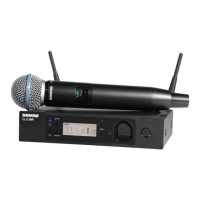
Shure U4D Dual Diversity UHF Receiver
4
25D1062 (AG)
Circuit Description
compared to an adjustable squelch level (a dc level). If either channel’s
noise is greater than the squelch threshold, its switch is shut off.
The outputs from the analog switches are connected at the audio
combining stage. This is a unity gain buffer stage where the audio from
channel A is combined with the audio from channel B. The output from
this stage splits into three paths.
The first path goes to a high Q tone key detection circuit. This circuit
is a crystal filter in which the tone key level is converted to dc and
compared to a fixed dc voltage. If the tone key is not present, the
comparator sends a logic high signal to an audio mute IC and mutes
the receiver output. If the tone key is present, a logic low signal is sent,
and the audio is allowed to pass.
The second path goes to a low Q bandpass filter centered around
32 kHz. This filter provides low battery detection in the receiver. The
lower Q allows for small frequency variation of tone key from various
transmitters, without large amplitude variations that the crystal filter
would have.
The filtered signal is then rectified and averaged. The resulting dc
signal is amplified and then enters the digital section of an analog to digi-
tal (A/D) converter. The A/D converter and the microcontroller
control the battery icon on the LCD display.
The third path goes into the compandor, via a 17 kHz low-pass filter.
Here the audio is expanded and de-emphasized. The compandor output
then goes off the audio board to a volume potentiometer on the front
panel board. Then the wiper is brought back to the audio board.
At this point, the audio signal takes two paths. The first path is
through the mute IC and into the output stage. The output stage consists
of an inverting amplifier stage, the output of which goes directly to one
pin of an XLR connector. A 180° phase-shifted version of the same sig-
nal is obtained by tapping off of this point and entering another inverting
stage. This phase-shifted version then goes to another pin on the XLR
connector.
Taking the output across the two XLR pins provides an electrically
balanced output signal. The unbalanced output is obtained by taking one
of the output stage amplifier’s outputs with respect to ground. Each side
of the balanced output goes through a pad that is switched in or out by
the user. This switch changes the balanced output level by approximate-
ly 30 dB.
The second path is through the headphone amplifier circuit. The
audio signal goes into a fixed gain amplifier, then off the board to the
monitor board. The monitor board can select between receiver 1 and
receiver 2. It also has a user-adjustable gain control, and a 1/4 inch jack
for headphones.
For the audio level meter, audio is tapped off from the 17 kHz filter
output and goes through a full wave precision rectifier and averaging cir-
cuit. This dc signal then enters a dc amplifier stage to adjust levels for


 To Next Page