EasyManua.ls Logo

Simplicity 759 3415H - Maintenance; Ordering Replacement Parts; Every 6 Hours of Operation; Every 25 Hours of Operation

Simplicity 759 3415H
44 pages
Print Icon
To Next Page IconTo Next Page
To Previous Page IconTo Previous Page
Loading...
MAINTENANCE
Your
Simplicity
tractor
has
been
designed
and
manufactured
to
give
you
many
years
of
dependable
operation-
In
order
for
it
to
give
you
efficient,
trouble
free
service
over
a
long
period
of
time
the
maintenance
operations
listed
here
must
be
performed
on
a
regular
basis,
The
optional
hour
meter
provides
an
accurate
method
of
determining
when
these
ser¬
vices
need
to
be
performed.
A
wide
variety
of
attachments
and
accessories
permit
use
of
your
tractor
throughout
the
year.
BECAUSE
YOUR
TRAC¬
TOR
IS
A
MULTI-SEASON
TOOL,
IT
IS
VERY
IMPORT¬
ANT
TO
SERVICE
THE
ENGINE
FOR
THE
SEASON
If
WHICH
IT
WILL
BE
OPERATED.
Be
sure
to
change
to
winter
grade
oil
before
making
cold
weather
starts.
Whenever
you
are
checking
fluid
levels
in
any
area
of
the
tractor,
the
readings
will
be
much
more
accurate
if
the
trac¬
tor
is
setting
on
level
ground.
We
have
provided
the
Scheduled
Maintenance
Chart
on
page
20
asa
convenient
means
for
you
to
know
.which
services
should
be
performed
at
various
times.
You
should,
of
course,
refer
to
the
detailed
explanation
of
how
to
perform
each
maintenance
task
until
you
are
familiar
enough
with
it
to
perform
it
correctly
from
memory.
Refer
to
your
Briggs
&
Stratton
operating
and
maintenance
instructions
for
more
specific
detail
on
servicing
the
engine.
ORDERING
REPLACEMENT
PARTS
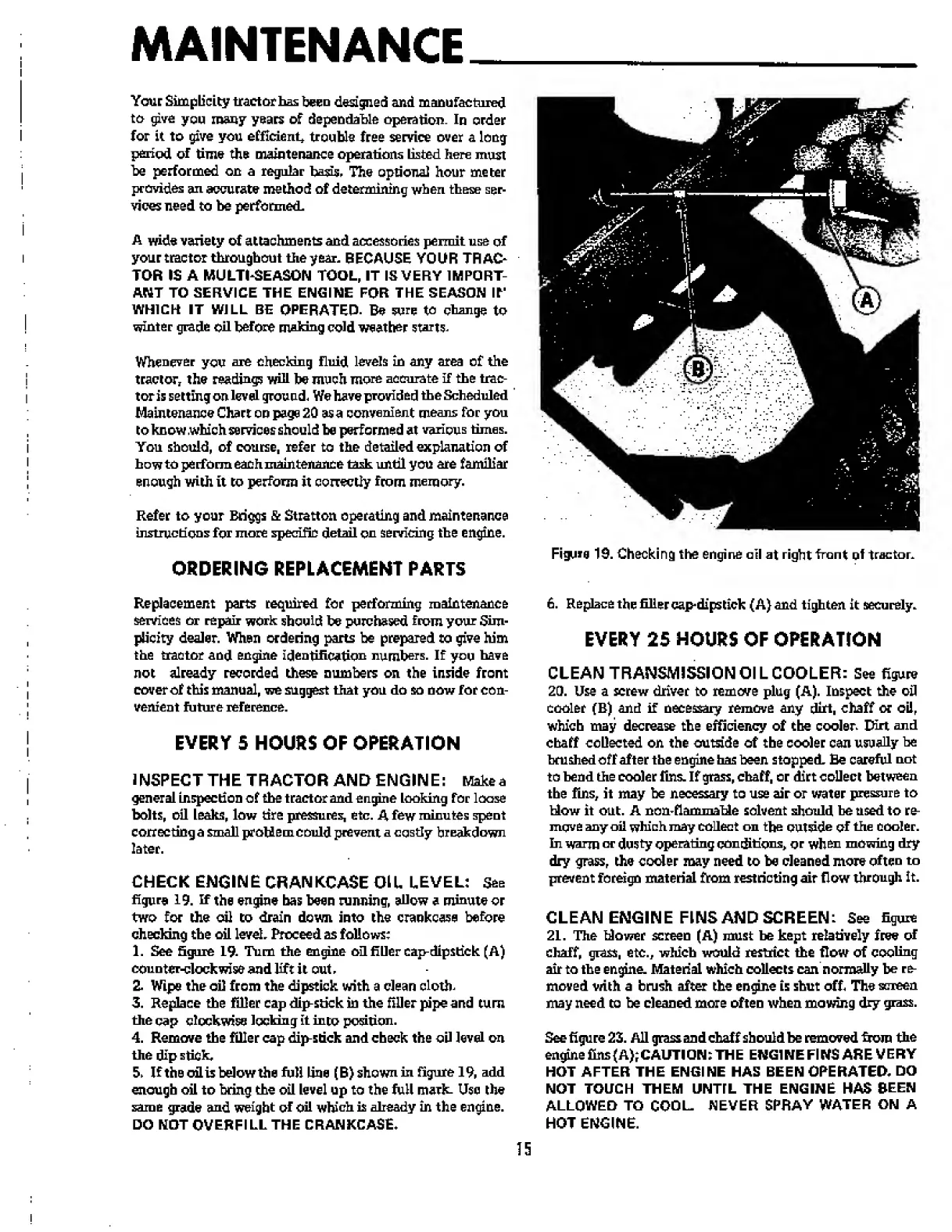
Figure
19.
Checking
the
engine
oil
at
ri^ht
front
of
tractor.
Replacement
parts
required
for
performing
maintenance
services
or
repair
work
should
be
purchased
from
your
Sim¬
plicity
dealer.
Whan
ordering
parts
be
prepared
to
give
him
the
tractor
and
engine
identification
numbers.
If
yog
have
not
already
recorded
these
numbers
on
the
inside
front
cover
of
this
manual,
we
suggest
that
you
do
so
now
for
con¬
venient
future
reference.
EVERY
5
HOURS
OF
OPERATION
INSPECT
THE
TRACTOR
AND
ENGINE:
Make
a
general
Inspection
of
the
tractor
and
engine
Looking
for
loose
bolts,
oil
Leaks,
low
tire
pressures,
etc.
A
few
minutes
spent
correcting
a
small
profflem
could
prevent
a
costly
breakdown
later.
CHECK
ENGINE
CRANKCASE
OIL
LEVEL:
See
figure
19.
If
the
engine
has
been
running,
allow
a
minute
or
two
for
the
oil
to
drain
down
into
the
crankcase
before
checking
the
oil
level.
Proceed
as
follows:
1.
See
figure
19.
Turn
the
engine
oil
filler
cap-dipstick
(A)
counter-clockwise
and
lift
it
out,
Z
Wipe
the
oil
from
the
dipstick
with
a
clean
cloth.
3.
Replace
the
filler
cap
dip-stick
in
the
filler
pipe
and
turn
the
cap
clockwise
locking
It
into
position.
4.
Remove
the
filler
cap
dip-stick
and
check
the
oil
level
on
the
dip
stick,
5.
If
the
oil
is
below
the
full
line
(B)
shown
in
figure
19,
add
enough
oil
to
bring
the
oil
Level
up
to
the
full
mark-
Use
the
same
grade
and
weight
of
Oil
which
is
already
in
the
engine.
DO
NOT
OVERFILL
THE
CRANKCASE.
6.
R
eplace
the
filler
cap-dipstick
(A)
and
tighten
it
securely.
EVERY
25
HOURS
OF
OPERATION
CLEAN
TRANSMISSION
01L
COOLER:
See
figure
20.
Use
a
screw
driver
to
remove
plug
(A).
Inspect
the
oil
cooler
(B)
and
if
necessary
remove
any
dirt,
chaff
or
oil,
which
may
decrease
the
efficiency
of
the
cooler.
Dirt
and
chaff
collected
on
the
outside
of
the
cooler
can
usually
be
brushed
off
after
the
engine
has
been
stopped.
Be
careful
not
to
bend
the
coaler
fins.
If
grass,
chaff,
or
dirt
collect
between
the
fins,
it
may
be
necessary
to
use
air
or
water
pressure
to
blow
it
out.
A
non-fl
amma
ble
solvent
should
be
used
to
re¬
move
any
oil
which
may
collect
on
the
outride
of
the
cooler.
In
warm
or
dusty
operating
conditions,
or
when
mowing
dry
dry
grass,
the
cooler
may
need
to
be
cleaned
more
often
to
prevent
foreign
material
from
restricting
air
flow
through
it.
CLEAN
ENGINE
FINS
AND
SCREEN:
See
figure
21.
The
blower
screen
(A)
must
be
kept
relatively
free
of
chaff,
grass,
etc.,
which
would
restrict
the
flow
of
cooling
air
to
the
engine.
Material
which
collects
can
normally
be
re¬
moved
with
a
brush
after
the
engine
is
shut
off.
The
screen
may
need
to
be
cleaned
more
often
when
mowing
dry
grass.
Bee
figure
23.
All
grass
and
chaff
should
be
removed
from
the
engine
fins
{A};
C
AUTI
ON:
TH
E
ENG1NE
FINS
ARE
VE
R
Y
HOT
AFTER
THE
ENGINE
HAS
BEEN
OPERATED,
DO
NOT
TOUCH
THEM
UNTIL
THE
ENGINE
HAS
BEEN
ALLOWED
TO
COOL.
NEVER
SPRAY
WATER
ON
A
HOT
ENGINE.
15

Related product manuals