EasyManua.ls Logo

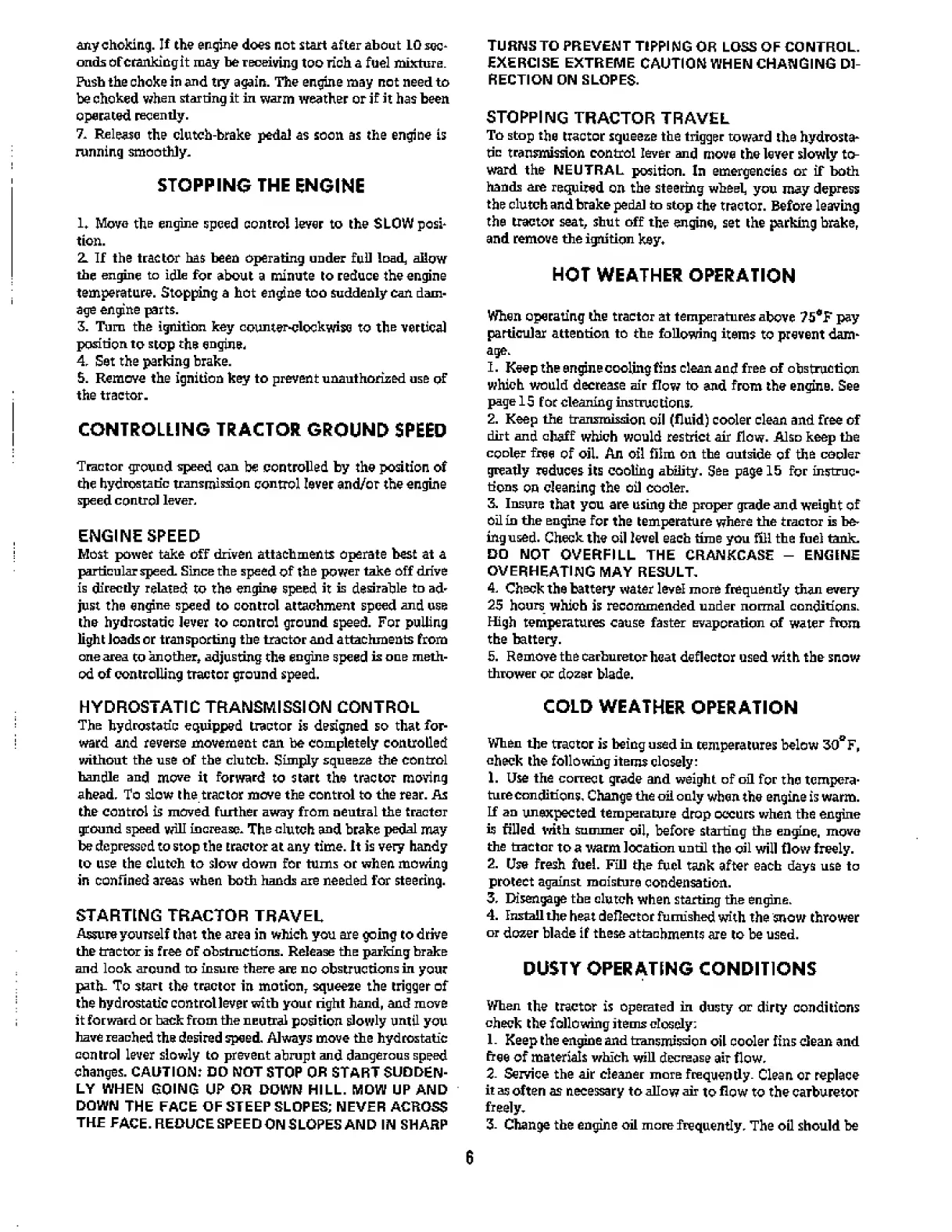
Simplicity 759 3415H - Stopping the Engine; Controlling Tractor Ground Speed; Hot Weather Operation; Cold Weather Operation

Simplicity 759 3415H
44 pages
Print Icon
To Next Page IconTo Next Page
To Previous Page IconTo Previous Page
Loading...
any
choking.
If
the
engine
does
not
start
after
about
10
sec¬
onds
of
cranking
it
may
be
receiving
too
rich
a
fuel
mixture.
Push
the
choke
in
and
try
again.
The
engine
may
not
need
to
be
choked
when
starting
it
in
warm
weather
or
if
it
has
been
operated
recently.
7.
Release
the
clutch-brake
pedal
as
soon
as
the
engine
is
running
smoothly.
STOPPING
THE
ENGINE
1.
Move
the
engine
speed
control
lever
to
the
SLOW
posi¬
tion.
2.
If
the
tractor
has
been
operating
under
full
load,
allow
the
engine
to
idle
for
about
a
minute
to
reduce
the
engine
temperature.
Stopping
a
hot
engine
too
suddenly
can
dam¬
age
engine
parts.
3.
Turn
the
ignition
key
counterclockwise
to
the
vertical
position
to
stop
the
engine.
4
Set
the
parking
brake.
5.
Remove
the
ignition
key
to
prevent
unauthorized
use
of
the
tractor.
CONTROLLING
TRACTOR
GROUND
SPEED
Tractor
ground
speed
can
be
controlled
by
the
position
of
the
hydrostatic
transmission
control
lever
and/or
the
engine
speed
control
lever.
ENGINE
SPEED
Most
power
take
off
driven
attachments
operate
best
at
a
particular
speed.
Since
the
speed
of
the
power
take
off
drive
is
direedy
related
to
the
engine
speed
it
is
desirable
to
ad'
just
the
engine
speed
to
control
attachment
speed
and
use
the
hydrostatic
lever
to
control
ground
speed.
For
pulling
light
loads
or
transporting
the
tractor
and
attachments
from
one
area
to
another,
adjusting
the
engine
speed
is
one
meth¬
od
of
controlling
tractor
ground
speed.
HYDROSTATIC
TRANSMISSION
CONTROL
The
hydrostatic
equipped
tractor
is
designed
so
that
for¬
ward
and
reverse
movement
can
be
completely
controlled
without
the
use
of
the
clutch.
Simply
squeeze
the
control
handle
and
move
it
forward
to
start
the
tractor
moving
ahead.
To
slow
the
tractor
move
the
control
to
the
rear.
As
the
control
is
moved
further
away
from
neutral
the
tractor
ground
speed
will
increase.
The
clutch
and
brake
pedal
may
be
depressed
to
stop
the
tractor
at
any
time.
It
is
very
handy
to
use
the
clutch
to
slow
down
for
turns
or
when
mowing
in
confined
areas
when
both
hands
are
needed
for
steering.
STARTING
TRACTOR
TRAVEL
Assure
yourself
that
the
area
in
which
you
are
going
to
drive
the
tractor
is
free
of
obstructions.
Release
the
parking
brake
and
look
around
to
insure
there
are
no
obstructions
in
your
path-
To
start
the
tractor
in
motion
T
squeeze
the
trigger
of
the
hydrostatic
control
lever
with
your
right
hand,
and
move
it
forward
or
back
from
the
neutral
position
slowly
until
you
have
reached
the
desired
speed.
Always
move
the
hydrostatic
control
lever
slowly
to
prevent
abrupt
and
dangerous
speed
changes.
CAUTION:
DO
NOT
STOP
OR
START
SUDDEN¬
LY
WHEN
GOING
UP
OR
DOWN
HILL.
MOW
UP
AND
DOWN
THE
FACE
OF
STEEP
SLOPES;
NEVER
ACROSS
THE
FACE.
REDUCE
SPEEDONSLOPES
AND
IN
SHARP
TURNS
TO
PREVENT
TIPPING
OR
LOSS
OF
CONTROL.
EXERCISE
EXTREME
CAUTION
WHEN
CHANGING
DI¬
RECTION
ON
SLOPES.
STOPPING
TRACTOR
TRAVEL
To
stop
the
tractor
squeeze
the
trigger
toward
the
hydrosta¬
tic
transmission
control
lever
and
move
the
lever
slowly
to¬
ward
the
NEUTRAL
position.
In
emergencies
or
if
both
hands
are
required
on
the
steering
wheel,
you
may
depress
the
clutch
and
brake
pedal
to
stop
the
tractor.
Before
leaving
the
tractor
seat,
shut
off
the
engine,
set
the
parking
brake,
and
remove
the
ignition
key.
HOT
WEATHER
OPERATION
When
operating
the
tractor
at
temperatures
above
75*F
pay
particular
attention
to
the
following
items
to
prevent
dam¬
age.
1.
Keep
the
engine
cooling
fins
dean
and
free
of
obstruction
which
would
decrease
air
flow
to
and
from
the
engine.
See
page
15
for
cleaning
instructions.
2.
Keep
the
transmission
oil
(fluid)
cooler
clean
and
free
of
dirt
and
chaff
which
would
restrict
air
flow.
Also
keep
the
cooler
free
of
oil.
An
oil
film
on
the
outside
of
the
cooler
greatly
reduces
its
cooling
ability.
See
page
15
for
instruc¬
tions
on
cleaning
the
oil
cooler.
3.
Insure
that
you
are
using
the
proper
grade
and
weight
of
oil
in
the
engine
for
the
temperature
where
the
tractor
is
be*
mg
used.
Check
the
oil
level
each
time
you
fill
the
fuel
tank.
DO
NOT
OVERFILL
THE
CRANKCASE
-
ENGINE
OVERHEATING
MAY
RESULT.
4.
Check
the
battery
water
level
more
frequently
than
every
25
hours
which
is
recommended
under
normal
conditions.
High
temperatures
cause
faster
evaporation
of
water
from
the
battery.
5.
Remove
the
carburetor
heat
deflector
used
with
the
snow
thrower
or
dozer
blade.
COLD
WEATHER
OPERATION
When
the
tractor
is
being
used
in
temperatures
below
30°
F,
check
the
following
items
closely:
1.
Use
the
correct
grade
and
weight
of
oil
for
the
tempera¬
ture
conditions.
Change
the
oil
only
when
the
engine
is
warm.
If
an
unexpected
temperature
drop
occurs
when
the
engine
is
filled
with
summer
oil,
before
starting
the
engine,
move
the
tractor
to
a
warm
location
until
the
oil
will
flow
freely.
2.
Use
fresh
ftiel.
Fill
the
fuel
tank
after
each
days
use
to
protect
against
moisture
condensation.
3.
Disengage
the
clutch
when
starting
the
engine.
4.
Install
the
heat
deflector
furnished
with
the
snow
thrower
or
dozer
blade
if
these
attachments
are
to
be
used.
DUSTY
OPERATING
CONDITIONS
When
the
tractor
is
operated
in
dusty
or
dirty
conditions
check
the
following
items
closely:
1.
Keep
the
engine
and
transmission
oil
cooler
fins
dean
and
free
of
materials
which
will
decrease
air
flow.
2-
Service
the
air
cleaner
more
frequently-
Clean
or
replace
it
as
often
as
necessary
to
allow
air
to
flow
to
the
carburetor
freely.
3-
Change
the
engine
oil
more
frequently.
The
oil
should
be
6

Related product manuals