EasyManua.ls Logo

Simplicity 759 3415H - Page 5

Simplicity 759 3415H
44 pages
Print Icon
To Next Page IconTo Next Page
To Previous Page IconTo Previous Page
Loading...
GENERATOR
WARNING
LIGHT:
(Figure
L
ItemF)
The
generator
light
will
warn
you
if
the
generator
or
voltage
regulator
on
your
tractor
is
not
functioning
properly.
It
is
norrual
for
the
generator
light
to
come
on
when
the
ignition
switch
is
in
the
OK
position
and
the
engine
is
stopped
or
running
at
low
speed.
The
light
should
go
out
when
the
en¬
gine
is
tunning
at
high
speeds.
If
it
does
not
the
generator
or
voltage
regulator
is
not
functioning
properly.
Check
the
gen¬
erator
belt
adjustment
as
derdcribedon
page
14-See
your
Sim¬
plicity
dealer
if
the
light
will
not
go
out
arter
the
belt
is
ad¬
justed.
HOURMETER:
(OPTI
TjNAL)
-
(Figure
1,
item
G)
The
hourmeter
is
designed
to
record
the
number
of
hours
the
en¬
gine
runs.
However,
since
it
is
electrically
operated,
it
will
run
any
time
the
ignition
switch
is
in
the
ON
position
even
though
the
engine
may
not
be
running.
The
hourmeter
is
use¬
ful
in
keeping
accurate
maintenance
records,
and
also
a
con¬
venient
way
of
telling
how
much
time
the
tractor
has
been
used
on
a
particular
job.
FUEL
GAUGE
AND
FILLER
CAP:
(Figure
1,
item
A)
The
fuel
gauge
indicates
thE
amount
of
fuel
in
the
tank.
Before
adding
fuel,
shut
off
the
engine
and
allow
it
to
cool.
To
remove
the
fuel
<^uge
and
filler
cap
for
adding
gasoline,
tum
the
fuel
filler
gauge-cap
counter-clockwise.
The
fuel
tank
holds
approximately
3
gallons
-
enough
for
about
3
hours
of
mowing.
Use
leaded
or
non-leaded
"regular"
grade
automotive
gasoline.
CAUTION:
DO
NOT
ALLOW
LIGHT¬
ED
CIGARETTES,
MATCHES,
ETC.,
AROUND
ANY
OPEN
GASOLINE
CONTAINER.
DO
NOT
OVER
FILL;
WIPE
UP
ANY
SPILLED
GASOLINE,
LIGHTSWITCH:
(Standard
equipment
on
Sovereign;
Optional
on
Landlord)
(Figure
1,
item
C)
The
switch
should
be
moved
up
to
the
ON
position
to
turn
on
the
tractor
lights.
To
prevent
the
lights
from
being
turned
on
by
un¬
authorized
persons,
the
ignition
switch
must
also
be
in
the
ON
position
for
the
lights
to
operate.
To
tum
the
lights
off,
push
the
Light
switch
down
to
the
OFF
position.
DO
NOT
OPERATE
THE
LIGHTS
FOR
LONG
PERIODS
OF
TIME
(MORE
THAN
20
MINUTES)
WHEN
THE
GENERATOR
LIGHT
IS
ON
OR
THE
BATTERY
MAY
DISCHARGE
ENOUGH
SO
IT
WILL
NOT
START
THE
ENGINE.
POWER
LIFTSWITCH:
(OPTIONAL)
(Figure
1,
item
B)
The
power
lift
switch
controls
the
electrically
oper¬
ated
power
lift
unit.
Push
the
toggle
switch
forward
when
you
wish
to
raise
a
front
center
or
rear
mounted
attachment.
Pull
it
back
toward
you
to
lower
the
attachments.
The
power
lift
will
stop
and
hold
in
any
position
when
you
release
the
toggleswitch.
The
height
indicator
(Figure
7
T
item
A)
on
the
left
side
of
the
tractor
can
be
used
to
determine
what
posi¬
tion
the
lift
is
in.
The
lift
motor
will
ratchet
when
it
has
reached
the
end
of
its
travel.
Ratcheting
is
not
harmful
to
the
unit,
but
you
should
release
the
toggle
switch
as
soon
as
ratcheting
begins
to
prevent
unnecessary
wear.
If
the
motor
is
allowed
to
ratchet
for
an
extended
period
of
time,
a
circuit
breaker
will
open,
disconnecting
power
to
the
lift
motor.
It
will
automatically
reset
after
about
a
minute.
CLUTCH
AND
BRAKE
PEDAL:
(Figure
2,
itemA)
Depressing
the
pedal
will
first
disengage
the
tractor
drive
clutch.
As
you
continue
to
depress
the
pedal,
the
brakes
will
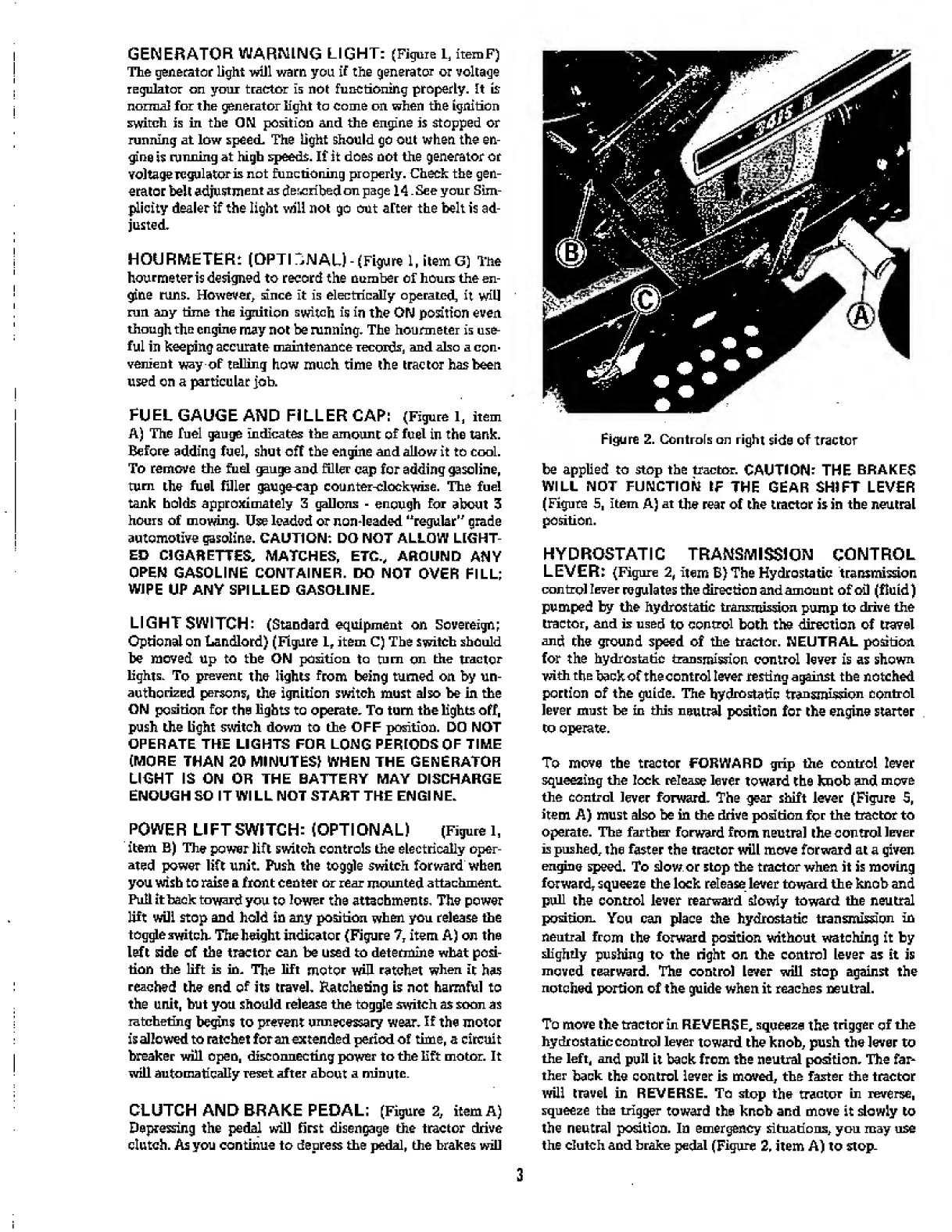
Figure
2.
Controls
on
right
side
of
tractor
be
applied
to
stop
the
tractor.
CAUTION:
THE
BRAKES
WILL
NOT
FUNCTION
IF
THE
GEAR
SHIFT
LEVER
(Figure
5,
Item
A)
at
the
rear
of
the
tractor
is
in
the
neutral
position.
HYDROSTATIC
TRANSMISSION
CONTROL
LEVER:
(Figure
2,
Item
BJThe
Hydrostatic
transmission
control
lever
regulates
the
direction
and
amount
of
oil
(fluid)
pumped
by
the
hydrostatic
transmission
pump
to
drive
the
tractor,
and
is
used
to
control
both
the
direction
of
travel
and
the
ground
speed
of
the
tractor.
NEUTRAL
position
for
the
hydrostatic
transmission
control
lever
is
as
shown
with
the
back
of
the
control
lever
resting
against
the
notched
portion
of
the
guide.
The
hydrostatic
transmission
control
lever
must
be
in
this
neutral
position
for
the
engine
starter
to
operate.
To
move
the
tractor
FORWARD
grip
the
control
lever
squeezing
the
lock
release
lever
toward
the
knob
and
move
the
control
lever
forward.
The
gear
shift
lever
(Figure
5,
item
A)
must
also
be
in
the
drive
position
for
the
tractor
to
operate.
The
farther
forward
from
neutral
the
control
lever
is
pushed,
the
faster
the
tractor
will
move
forward
at
a
given
engine
speed.
To
slow,
or
stop
the
tractor
when
it
is
moving
forwardj
squeeze
the
lock
release
lever
toward
the
knob
and
pull
the
control
lever
rearward
slowly
toward
the
neutral
position.
You
can
place
the
hydrostatic
transmission
in
neutral
from
the
forward
position
without
watching
it
by
slightly
pushing
to
the
right
on
the
control
Lever
as
it
is
moved
rearward.
The
control
Lever
will
stop
against
the
notched
portion
of
the
guide
when
it
reaches
neutral.
To
move
the
tractor
in
REVERSE,
squeeze
the
trigger
of
the
hydrostatic
control
lever
toward
the
knob,
push
the
lever
to
the
left,
and
pull
it
back
from
the
neutral
position.
The
far¬
ther
back
the
control
lever
is
moved,
the
faster
the
tractor
will
travel
in
REVERSE.
To
stop
the
tractor
in
reverse,
squeeze
the
trigger
toward
the
knob
and
move
it
slowly
to
the
neutral
position.
In
emergency
situations,
you
may
use
the
clutch
and
brake
pedal
(Figure
2,
item
A)
to
stop.
3

Related product manuals