14
3.5 Effect Of Operator’s Presence
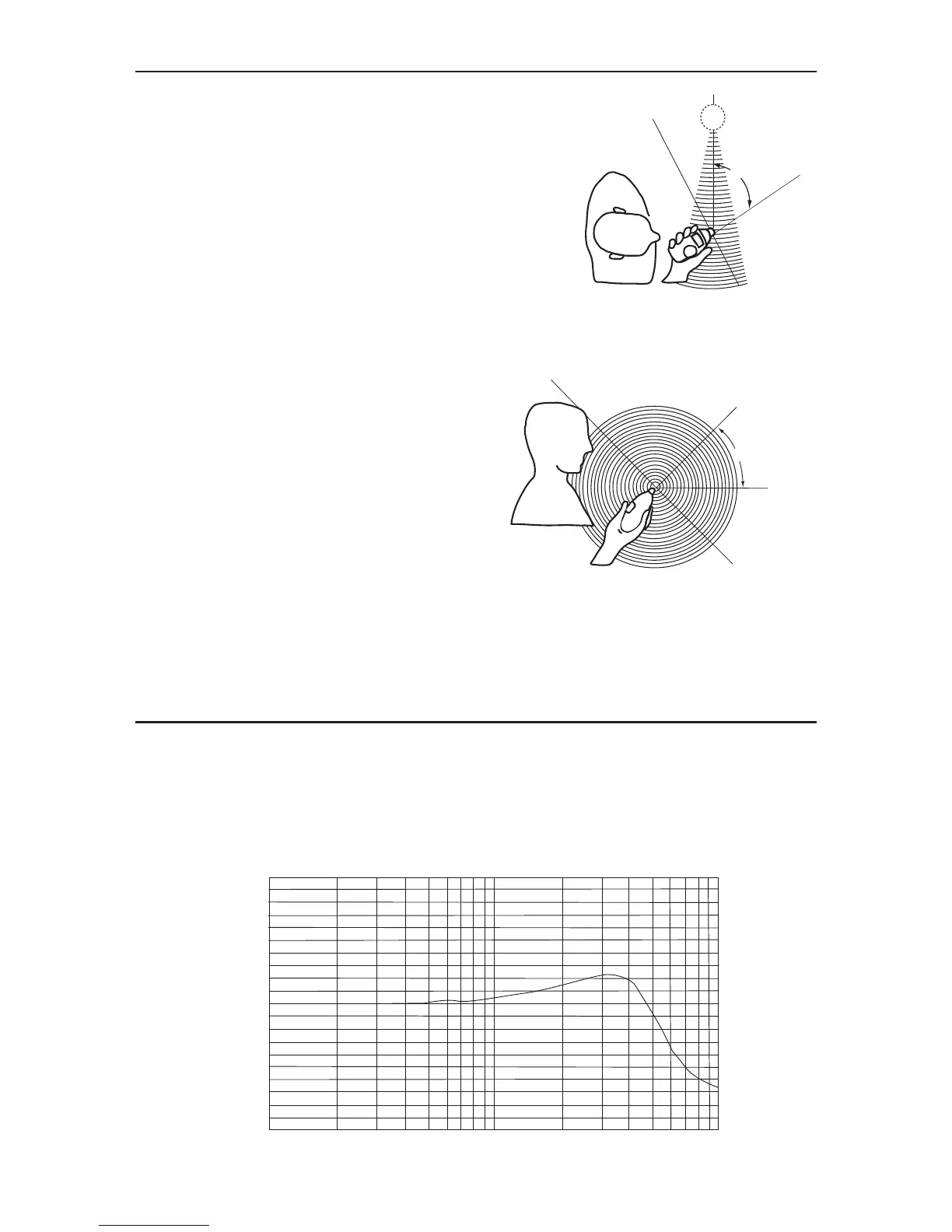
When sound is coming mainly from one
direction, the reading might be affected
by the relative positions of the microphone
and operator. For example, if the opera-
tor and microphone are in line and facing
the sound source, there can be a marked
increase in response at high frequencies
because the operator will act as a reflec-
tor and produce errors of several dB at
frequencies above 100 Hz. A more uni-
form frequency response is obtained with
the Instrument extended as far as conve-
niently possible in front of the operator,
and the axis of the microphone oriented
to form an angle of incidence of 70° with
the incoming sound wave. Do not point
the Instrument toward a source of noise
other than the one being measured.
The 886-2 (or its microphone) can be
mounted on a tripod for further reduction
in the effects of the operator’s presence.
A practical arrangement is to tilt the mi-
crophone axis at an angle of approxi-
mately 45° to 70° with respect to the hori-
zon. This allows the operator to step sev-
eral feet back or completely away and
still be able to make measurements.
3.6 Windscreen
When making measurements where wind is present, a low frequency interfer-
ence can be introduced by air passing across the microphone. Try to make
measurements where wind is not present; if this is not practical a windscreen
should be employed. When using this screen, indicated wind noise will be at-
tenuated approximately 20 dB. The loss of system sensitivity occurring with use
of the windscreen is shown in Figure 3-3.
PLANE OF
MICROPHONE
SOUND SOURCE
AXIS OF
MICROPHONE
INCOMING
SOUND WA VE
ANGLE OF
INCIDENCE (70˚)
PLANE OF
MICROPHONE
AXIS OF
MICROPHONE
VERTICAL ANGLE
(45˚ – 70˚)
Top View
Side View
+5
+4
+3
+2
+1
0
–1
–2
–3
–4
–5
200
1000
500
2000
5000
10,000
FREQUENCY RESPONSE ERROR DUE TO WINDSCREEN (dB)
FREQUENCY (Hz)
Figure 3-3. Loss Of System Sensitivity Due To Windscreen
Figure 3-2. Orientation of
Microphone and Operator with
respect to incoming Sound Waves.






 To Next Page