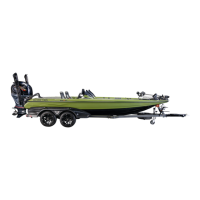
This document is the owner's manual for Skeeter Deep-V performance fishing boats. It provides comprehensive information on the boat's operation, maintenance, and safety.
Function Description
Skeeter Deep-V boats are performance fishing boats designed for various water activities, primarily fishing. They are equipped with features that enhance the fishing experience and provide a safe and enjoyable time on the water. The boats are designed to operate in different water conditions and are suitable for both experienced and novice boaters.
Important Technical Specifications
The manual covers several Deep-V models, including WX2190, WX2060, WX1910, WX1850, MX2025, MX1825, and WX2000T. While specific technical specifications vary by model, common features and systems are detailed:
- Hull: The hull identification number (HIN) is a unique identifier for each boat. The hull design is optimized for performance and stability in deep-V conditions.
- Outboard Motor: The boats are powered by outboard motors, with maximum horsepower limits specified by U.S. Coast Guard regulations to prevent overpowering and overloading. The manual emphasizes the importance of proper engine installation height and the use of an engine stop switch and cord lanyard for safety.
- Fuel System: Equipped with a fuel tank and associated components, the fuel system is designed for safe operation. Regular inspection for leaks or corrosion is crucial. Dual fuel tanks may be present in some models.
- Electrical System: The electrical system includes batteries (12-volt, 24-volt, and 36-volt configurations depending on the trolling motor), circuit breakers, and fuses to protect various electrical components. Wiring is designed to support the trolling motor batteries and other accessories.
- Bilge System: Features a bilge pump and float switch to remove excess water from the bilge area, preventing accumulation and potential damage.
- Livewell/Baitwell System: Designed to keep fish alive and healthy, this system includes fill and recirculation functions. The "FILL" function uses a remote valve to pump water into the livewell, while "RECIRCULATE" aerates the water to maintain oxygen levels. The "EMPTY" function allows for draining and cleaning.
- Steering System: The steering system provides smooth and responsive control of the boat. Hydraulic steering is checked periodically for correct fluid levels.
- Instruments and Controls: The helm features a range of instruments and switches, including a speedometer, tachometer, trim gauge, water pressure gauge, voltmeter, fuel gauge, power switch, bilge switch, courtesy light switch, navigation lights switch, horn switch, and circuit breakers. Specific layouts vary by model (e.g., WX2190/WX2060, WX1910, WX1850, MX2025/MX1825, WX2000T).
- Storage: Various storage compartments are integrated into the deck layout for gear and accessories.
- Seating: Adjustable pedestal seats are provided for both the driver and passenger, with safety warnings regarding ejection from rotating seats.
- Ladders: Instructions are provided for lowering the ladder, typically by pulling a pin.
Usage Features
- Boating Safety: The manual emphasizes critical safety information, including warnings about serious injury or death, and cautions about potential damage. It outlines limitations on who may operate the boat (e.g., age restrictions, boating safety course requirements) and maximum weight/person capacities.
- Pre-Operation Checks: A comprehensive checklist is provided for pre-operation checks, covering the engine, hull, bilge, fuel, electrical equipment, and safety gear.
- Rules of the Road: Detailed explanations of navigation rules are included, such as steering and sailing rules, stand-on and give-way vessels, meeting and crossing situations, overtaking, narrow channels, fishing vessel right-of-way, and reading buoys.
- Regulated / Limited Access Areas: Information on regulations for operating in areas with nuclear power plants, petroleum facilities, bridges, dams, and shipping channels.
- Starting the Engine: Step-by-step instructions for starting the engine, including checking the stern, ensuring the throttle shift lever is in NEUTRAL, and turning the ignition key.
- Driving the Skeeter Boat: Guidance on getting to know the boat, boating with passengers, boarding from a dock or landing jetty, and stopping the boat.
- Docking: Instructions for proper docking procedures, including approaching the dock and using wind and water currents.
- Leaving a Dock: Steps for safely leaving a dock, considering wind and water conditions.
- Boat Trim: Explanations and diagrams illustrating proper and improper boat trim for optimal performance and fuel efficiency.
- Getting Under Way: Safety checklist for getting underway, including weather, required safety equipment, fire extinguisher, and fuel system checks.
- Maneuvering Techniques: Descriptions of steering response, propeller thrust, and various maneuvering techniques.
- Anchoring: Instructions for proper anchoring procedures, including selecting an appropriate anchor and securing it.
- Water-Skiing: Guidelines for safe water-skiing, including proper towrope length and awareness of hazards.
- Night Operation: Information on using bow and stern lights during dawn, dusk, and night.
Maintenance Features
- Repairs and Modifications: Emphasizes that repairs and modifications should be performed by qualified Skeeter Dealer personnel to maintain safety and warranty.
- Electrical Maintenance: Regular checks for electrical problems, including battery connections, charging systems, and circuit breakers/fuses. Batteries should be kept clean, tight, and insulated.
- Corrosion Protection: Guidance on preventing galvanic corrosion, which is the breakdown of metals due to electrolytic action. Regular inspection of zinc anodes and painting with anti-fouling paint are recommended.
- General Maintenance:
- Boat Finish: Regular cleaning and waxing to protect the boat's surface from sun, water, dust, and chemicals.
- Maintenance Procedures: Scheduled maintenance procedures described in the manual.
- When Not in Use: Proper storage practices, including covering the boat and draining the livewell/baitwell system.
- Each Month: Washing the boat's surface with a mild soap and water solution.
- Twice Yearly (Minimum): Waxing the boat's gelcoat surface.
- Carpet: Regular cleaning and vacuuming of the carpet.
- Upholstery: Cleaning and protecting upholstery from UV inhibitors.
- Paints: Checking for marine growth and anti-fouling paint.
- Cleaning Agents: Using appropriate cleaning agents for marine environments.
- Fuel System Maintenance: Regular inspection for fuel leaks and fumes. USCGA-approved fuel hoses should be used.
- Motor Mounts: Checking mounting system bolts for proper torque every 6 months.
- Steering System Maintenance: Regular lubrication and checking for unusual backlash.
- Service / Maintenance Log: A log is provided to record dates, hour readings, and descriptions of services/repairs performed.
- Troubleshooting: A trouble check chart helps diagnose common performance issues (e.g., poor boat performance, poor gas mileage, excessive vibration, engine problems, electrical problems, dim lights).
- Preparing Boat for Storage: Detailed instructions for winterizing the boat, including draining systems, removing batteries, and protecting the outboard motor.
- Lifting: Guidelines for safely lifting the boat using slings and spreader bars, with warnings against using lift rings or improper lifting methods.
- Trailering: Information on proper trailering, including trailer ownership, maintenance, and safety procedures. It covers hitching, securing the boat, and launching/loading.
- Warranty: Details on the limited warranty, including conditions, exclusions, and registration information.

 Need help?

 To Next Page
 General