8-1Table Of Contents www.SkeeterBoats.com
RUNNING
MANEUVERING TECHNIQUES
Skeeter urges you and all others operating your boat to seek certied instruction from the local
boating authorities.
This section is designed to present the most basic operational principles. It is NOT intended to cover
all conditions encountered during operation. Therefore, the principles in this manual are limited to the
facts related directly to the operation of your boat, while the responsibility for the proper application of
these principles belongs to you.
Steering response depends on three factors:
outboard position, motion, and throttle.
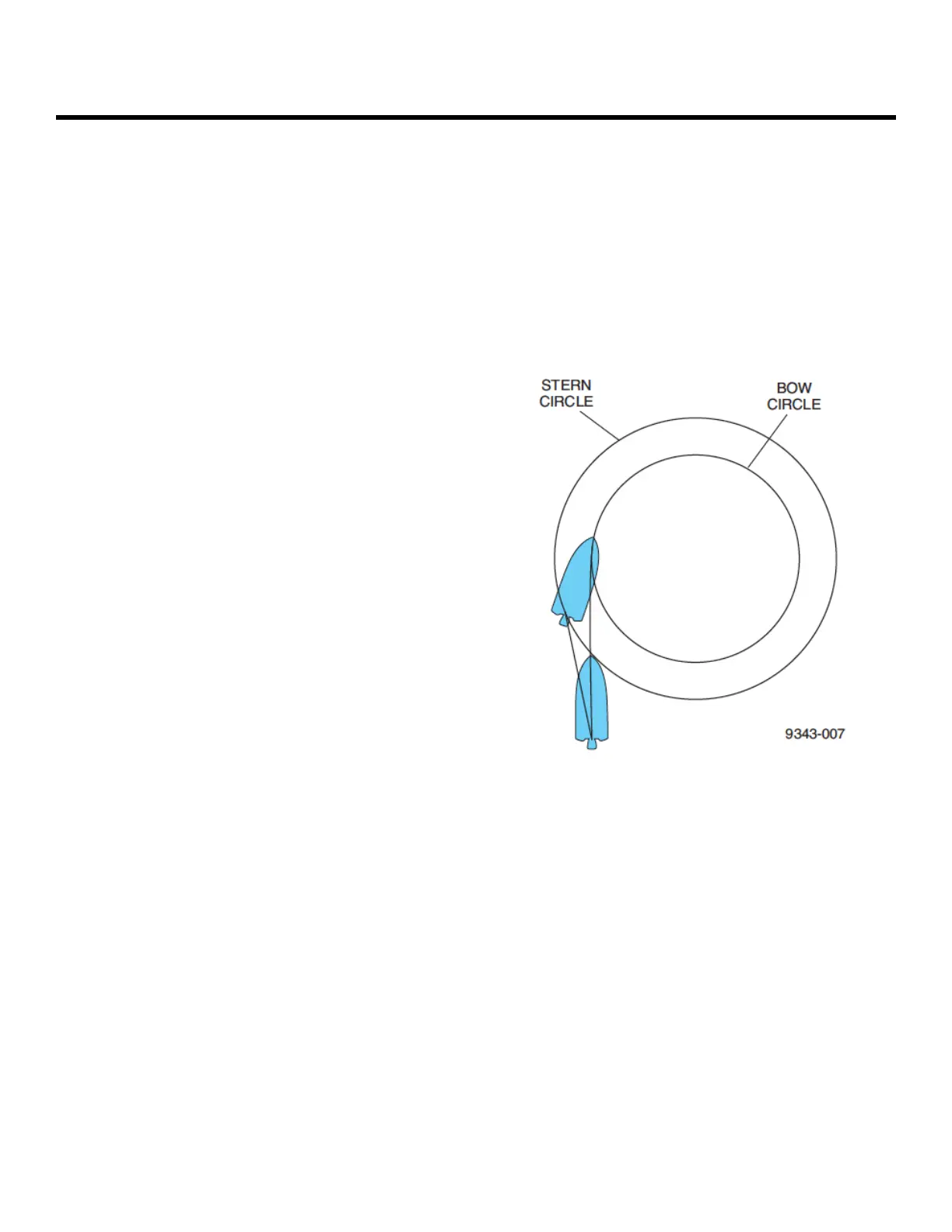
When making tight maneuvers, it is important to
understand the effects of turning. Since both thrust
and steering are at the stern of the boat, the stern
will push away from the direction of the turn. The
bow follows a smaller turning circle than the stern.
The effects of unequal propeller thrust, wind,
and current must also be kept in mind. While
wind and current may not always be present, an
experienced boater will use them to his or her
advantage. Unequal thrust is an aspect shared
by all single-engine propeller-driven watercraft.
A clockwise rotation propeller tends to cause the
boat, steering in the straight ahead position, to drift
to starboard when going forward, and to port when
going backward. At high speed, this effect is usually
unnoticed, but at slow
speed, especially during backing, it can be powerful.
For this reason, many veteran boaters approach the dock with the port side of the boat toward the
dock, if possible.
Stopping (checking headway) is a technique that must be developed. Reverse thrust is used to slow
and stop the boat. The momentum of the boat will vary according to the load as well as the speed.
Make it a practice to slow to idle (no-wake) speed before shifting into reverse.
It is best to learn maneuvering skills in open water away from trafc. Adequate practice is the only
way to develop your boating skills.
Maneuvering
Figure 8-1


 To Next Page