EasyManua.ls Logo

Skil 9105 - Sanding Tips

Skil 9105
24 pages
Print Icon
To Next Page IconTo Next Page
To Previous Page IconTo Previous Page
Loading...
Sanding
Operations
SANDING
TIPS
For
best
results,
tilt
the
Disc
Sander
at
a
10°
to
15°
angle
while
sanding
so
that
only
about
i"
of
the
surface
around
the
edge
of
the
disc
contacts
the
work.
mi
lf
the
disc
(accessory)
is
held
flat
or
the
back
&
edge
of
the
disc
comes
in
contact
with
the
work,
the
side
may
result.
If
sander
is
tilted
too
much,
sanding
action
will
be
too
great
and
a
rough
cut
surface
or
gouging
and
snagging
will
result.
Guide
the
Disc
Sander
with
crosswise
strokes.
Be
careful
not
to
hold
the
sander
in
one
spot
teo
long.
Do
not
use
a
circular
motion,
as
this
makes
swirl
marks.
Test
before
use on
scrap
stock,
De
not
force
or
apply
pressure
when
sanding.
Use
only
the
weight
of
the
tool
for
pressure.
Excess
pressure
actually
slows
the
tool
down,
and
will
cause
the
circuit
breaker
to
trip.
If
faster
stock
removal
is
desired,
change
to
a
coarser
grit
disc.
Remove
gummy
paint
from
metal
with
an
“open
coat”
disc.
Sand
until
sparks
start
to
appear,
then
stop
and
change
to
a
“closed
coat”
disc
to
remove
any
remaining
paint.
SANDING
WOOD
When
sanding
wood
the
direction
of
the
disc
motion
at
the
contact
point
should
paraliel
the
grain
as
much
as
possible,
The
rapid
cut
of
discs
and
the
swirl
type
scratch
pattern
they
occasionally
create
generally
prohibit
their
use
for
producing
the
final
finish.
Scratches
and
circular
marks
are
usually
the
result
of
using
too
coarse
a
grit.
When
changing
to
a
finer
grit,
move
across
the
sand-
ing
lines
that
were
made
by
a
previous
coarser
disc.
SANDING
METAL
When
sanding
automobiles
or
appliances,
wipe
the
metal
clean
with
a
non-flammable
solvent
or
commercial
cleaner
to
rernove
ail
wax
and
grease.
By
doing
this
first,
the
sanding
discs
will
sand
better
and
last
longer.
For
heavy
duty
work,
use
a
coarse
grit
disc
first.
Follow-up
with
a
medium
grit
to
remove
scratches.
To
produce
smooth
finish,
use
fine
grit
disc.
Masonry
Cutting
Operations
For
cutting
masonry
materials
like
brick,
tile,
stone,
etc.,
itis
best
to
use
a
dry
diamond
cutting
wheel.
Use
only
lock
nut
and
flange
with
equal
diameters.
The
wheel
guard
must
be
used
with
a
dry
diamond
cutting
wheel.
Do
not
use
water
or other
cooling
fluid
with
this
ioal
for
cutting.
Disconnect
tool
from
power
source
before
attaching
cutting
wheel.
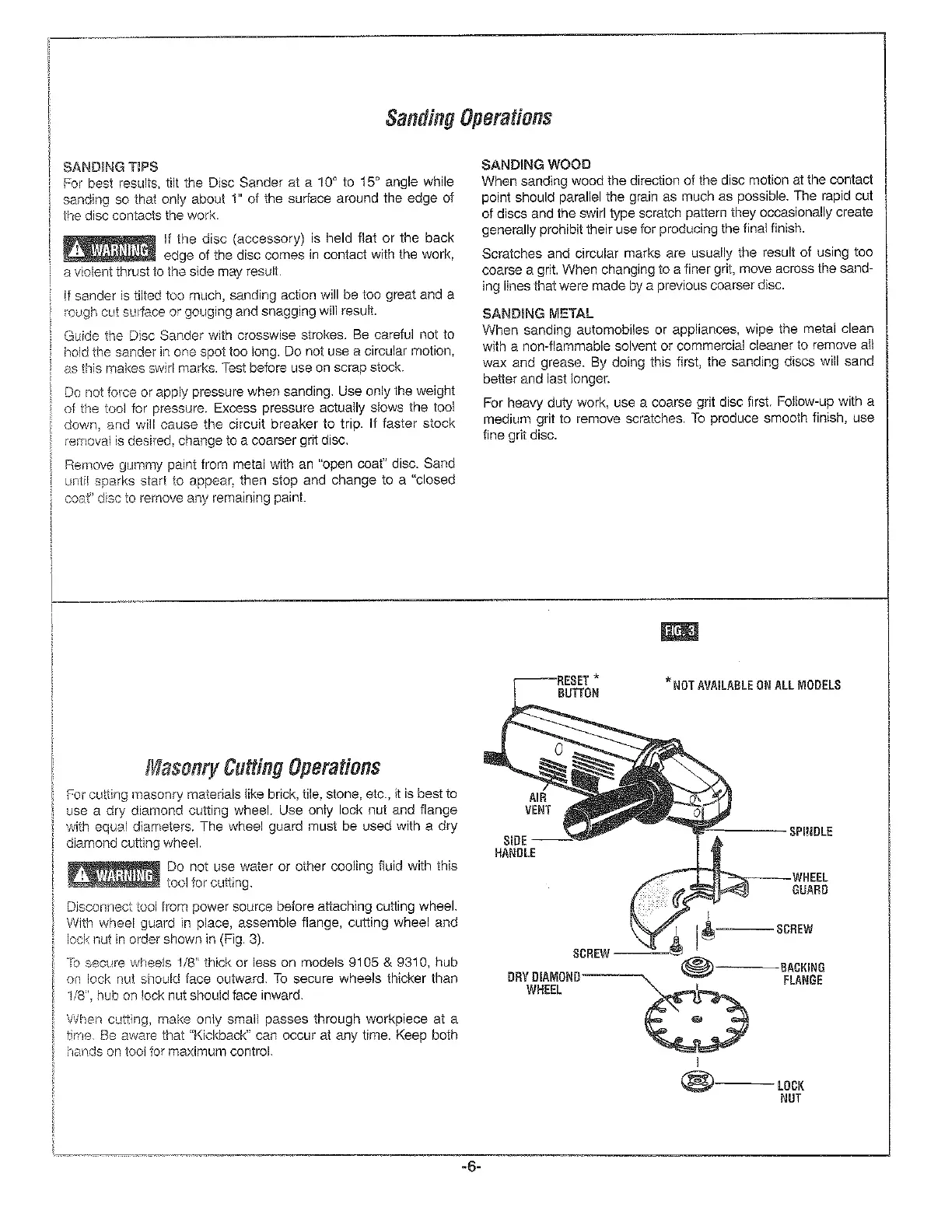
With
wheel
guard
in
place,
assemble
flange,
cutting
wheel
and
lock
nut
in
order
shown
in
(Fig.
3).
To
secure
wheels
1/8"
thick
or
less
on
models
9105
&
93710,
hub
on
jock
nut
should
face
outward.
To
secure
wheels
thicker
than
1/8",
hub
on
lock
nut
should
face
inward.
When
cutting,
make
only
small
passes
through
workpiece
at
a
time.
Be
aware
that
“Kickback”
can
occur
at
any
time.
Keep
both
hands
on
tool
jor
maximum
control.
VENT
SIDE
SPINDLE
HANDLE
———
WHEEL
GUARD
SCREW
SCREW
BACKING
DRY
DIAMOND
WHEEL
FLANGE
LOCK
NUT

Related product manuals