Need help?
Do you have a question about the skilsaw SPT77WML and is the answer not in the manual?
Keep work area clean, well-lit, and free from explosive atmospheres. Keep children and bystanders away.
Ensure proper plug matching, avoid earthed surfaces, and keep cords dry to reduce electric shock risk.
Stay alert, use PPE, prevent unintentional starting, dress properly, and maintain balance for safe operation.
Handle blade carefully, adjust depth, secure workpiece, and use insulated grips to prevent injury.
Understand kickback causes and take precautions like firm grip and proper positioning to avoid it.
Ensure lower guard operates freely and covers the blade before setting down the saw.
Use GFCI, avoid AC-only tools with DC, keep handles dry, and use proper workpiece support.
Details maximum cutting depths and blade arbor hole specifications for the saw.
Step-by-step guide for safely attaching the saw blade, including Vari-Torque Clutch.
Explains the clutch function to reduce kickback tendency by allowing blade slip.
Guides for setting cutting depth, 90° angle, and bevel angles for accurate cuts.
Using the foot notches for approximate cut lines and ensuring good side finish.
Adjusting set screw for maximum depth of cut stability and contact with motor housing.
Functions of the provided wrench, including blade bolt and other adjustments.
How to operate the trigger switch for turning the tool on/off and its spring-loaded return.
Proper grip and operation for general cutting, avoiding forcing the saw.
Step-by-step guide for performing plunge cuts safely, including blade stop and avoiding kickback.
Warning against using abrasive wheels for cutting masonry or metal.
Proper support and technique for cutting large sheets to prevent binding and kickback.
How to perform rip cuts using a rip fence or board guide for accurate lengthwise cuts.
Recommendation for authorized service centers for internal repairs and component replacement.
How to check and add oil, including notes on oil condition and replacement.
Information on brush maintenance, wear limits, and replacement procedures.
Guidance on bearings and cleaning the tool with compressed air, avoiding solvents.
Advice on blade dullness, cleaning, and specific connector/extension cord requirements.
List of standard and optional accessories for the saw.
Common causes and remedies for the saw failing to start, including power and switch issues.
Reasons for the blade not reaching full speed, such as extension cord issues or low voltage.
Causes of excessive vibration, including blade imbalance and improper workpiece support.
Troubleshooting steps for achieving square cuts, referencing specific operating instructions.
Solutions for binding, burning, or motor stalling during ripping operations.
Remedies for blade slipping, primarily related to clutch assembly and tightening.
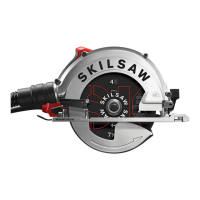
This document provides operating and safety instructions for SKILSAW circular saws, specifically models SPT77WM and SPT77WML. It emphasizes the importance of reading the manual before use to ensure safe and effective operation.
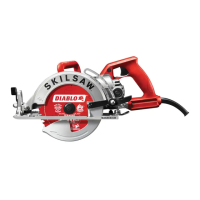
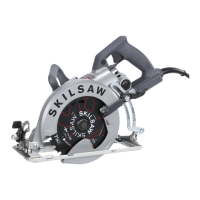
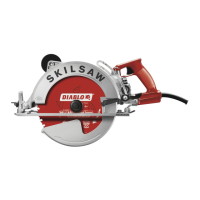
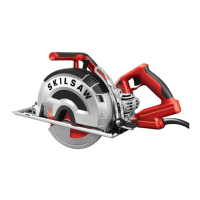
The SKILSAW circular saw is a power tool designed for cutting various materials, primarily wood. It operates by means of a rotating blade that makes precise cuts. The saw features a trigger switch for activation, and its design includes an upper guard and a lower guard to protect the user from the spinning blade. A depth adjustment lever allows the user to set the desired cutting depth, while a bevel adjustment lever enables angled cuts up to 45° (and up to 53° with a 45° stop spring override). The tool is equipped with a blade stud and outer washer system that acts as a VARI-TORQUE CLUTCH, designed to reduce the intensity of kickback by allowing the blade to slip when encountering excessive resistance. The saw also includes a saw hook for convenient storage and a lock button to secure the blade during changes. For rip cutting, a rip fence or straight edge guide can be used to improve accuracy and reduce blade binding.
Before operating the saw, users are instructed to ensure the work area is clean, well-lit, and free from children and bystanders. Personal protective equipment, including eye protection, dust mask, non-skid safety shoes, hard hat, and hearing protection, should always be worn. The saw's power tool plug must match the outlet, and adapter plugs should not be used with earthed tools. Users should avoid body contact with earthed surfaces and keep the power tool away from rain or wet conditions. The cord should be protected from heat, oil, sharp edges, and moving parts. For outdoor use, an extension cord suitable for outdoor use is required, and for damp locations, a Ground Fault Circuit Interrupter (GFCI) protected supply is recommended.
When starting the tool, a firm, two-handed grip is essential to counteract the motor's torque. The saw should be allowed to reach full speed before starting a cut and only turned off after completing the cut. For general cuts, both hands should hold the main and auxiliary handles, ensuring the lower guard's free movement. Light and continuous pressure should be applied without forcing the saw. After a cut, the trigger should be released, and the blade allowed to come to a complete stop before lifting the saw.
Plunge cuts require setting the depth adjustment, tilting the saw forward, and resting the front of the foot plate on the material. The lower guard is raised using the lift lever, and the saw is started. Once at full speed, the back end of the saw is gradually lowered using the front end as a hinge point. Once the foot plate is flat, the lower guard is released, and the cut proceeds. It is crucial not to pull the saw backward during plunge cuts to avoid kickback.
For cutting large sheets, proper support is vital to prevent sagging, bending, blade binding, and kickback. Supports should be placed under the panel on both sides, near the line of cut and the edge of the panel, with the broadest sides supporting the work. The depth of cut should be set to cut only through the sheet or board, not the table or workbench.
Rip cuts can be performed using a rip fence, which is inserted through slots in the foot and secured. When rip cutting large sheets where the rip fence may not allow the desired width, a straight piece of lumber can be clamped or nailed to the sheet as a guide, using the right side of the foot against it.
Regular maintenance is crucial for the safe and efficient operation of the SKILSAW circular saw. Before any adjustments, accessory changes, or storage, the tool must be disconnected from the power source.
Tool Lubrication: The gears are factory-lubricated, but relubrication with Skil lubricants (No. 80111) is recommended. The oil level should be checked before each use by removing the oil plug/lock button assembly with the provided wrench, ensuring the saw's foot is on a horizontal surface and the tool is set to maximum depth of cut. Oil should reach the bottom threads of the housing, and overfilling should be avoided. If the oil is dirty or thick, it should be replaced with fresh Skil lubricant after warming up the saw for one minute. For new saws, the oil should be changed after the first ten hours of use.
Carbon Brushes: The carbon brushes and commutator are designed for long service life. To maintain peak motor efficiency, brushes should be examined every two to six months, kept free from dust and dirt, and replaced when worn down to 3/16" in length. They should slide freely in and out of their holders. To check brushes, the plug must be disconnected, brush caps unscrewed, and brushes lifted out, noting their orientation for correct reinstallation. The blade side brush requires the tool to be set to minimum depth of cut. Brush holder openings should be cleaned with compressed air or a clean cloth. Only genuine Skil replacement brushes should be used.
Bearings: Noisy bearings, often caused by heavy loads or abrasive material cutting, should be replaced immediately to prevent overheating or motor failure.
Cleaning: The tool can be effectively cleaned with compressed dry air. Safety goggles must be worn during this process. Ventilation openings and switch levers must be kept clean and free of foreign matter, avoiding the insertion of pointed objects. Certain cleaning agents like gasoline, carbon tetrachloride, chlorinated cleaning solvents, ammonia, and household detergents containing ammonia can damage plastic parts and should not be used.
Care of Blades: Dull blades, indicated by the need to force the saw, should be cleaned or replaced. To clean gum and wood pitch, the saw should be unplugged, and the blade removed. Kerosene or a similar solvent can be used, but caution is advised due to the blade's sharpness. Sharpening blades is not recommended unless experienced.
Lower Guard Maintenance: The lower guard's operation should be checked before each use to ensure it moves freely and closes instantly. It should never be clamped or tied in an open position. If the saw is dropped, the lower guard should be checked for bending. The lower guard lift lever should be used to raise the guard, ensuring it moves freely and does not touch the blade or any other part at all angles and depths of cut. The lower guard spring's operation should also be checked, and if not functioning properly, it should be serviced. Sluggish operation may indicate damaged parts, gummy deposits, or debris buildup. For special cuts like "Plunge Cuts" and "Compound Cuts," the lower guard can be manually retracted, but it should be released as soon as the blade enters the material. Before placing the saw down, ensure the lower guard covers the blade to prevent accidental cutting. Periodically, the blade, upper, and lower guards, and the hub area should be cleaned with kerosene and wiped dry, or blown clean with compressed air, to reduce the probability of accidents.
 General
| Motor | 15 Amp |
|---|---|
| Weight | 11.5 lbs |
| Blade Diameter | 7-1/4 inches |
| Cord Length | 8 feet |
| No Load Speed | 5, 300 RPM |
| Dust Port | Yes |
| Worm Drive | Yes |
| Electric Brake | Yes |
| Bevel Capacity | 53° |
| Type | Worm Drive Circular Saw |


 To Next Page